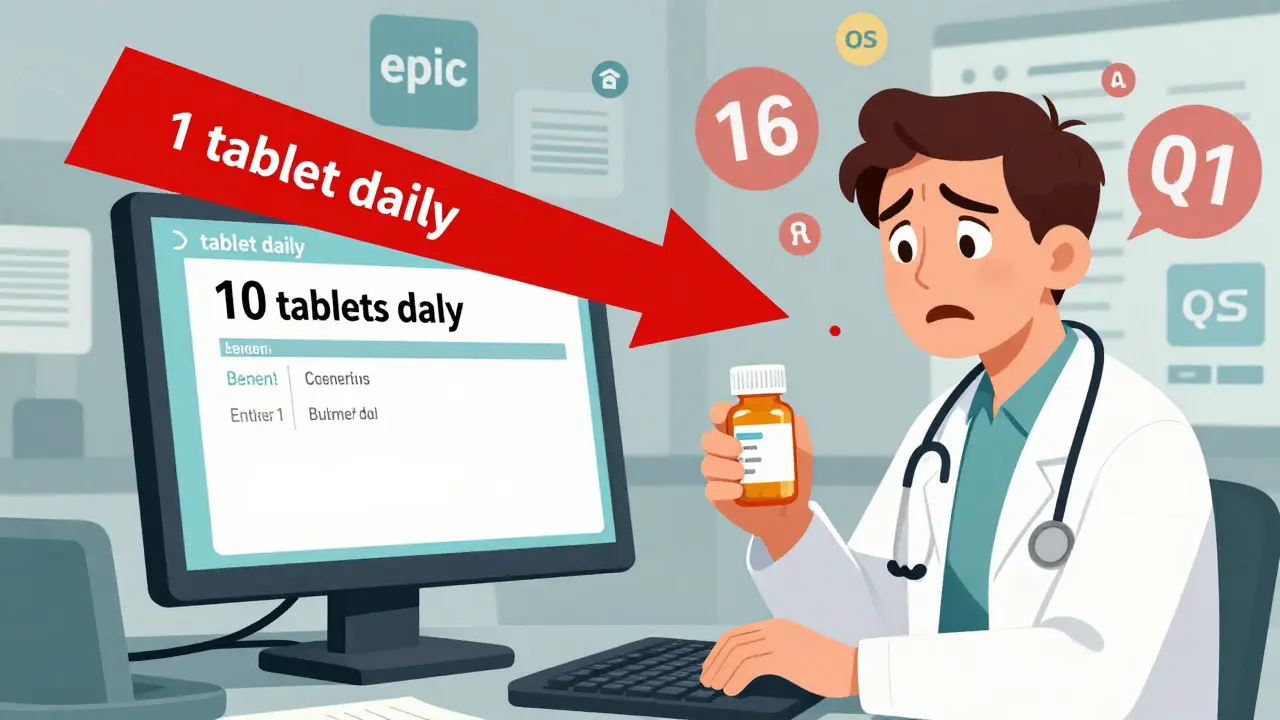
Imagine this: a doctor sends an e-prescription for methotrexate to treat rheumatoid arthritis. The system automatically fills in "1 tablet by mouth daily." But when it hits the pharmacy’s system, it reads as "10 tablets by mouth daily." The patient takes the wrong dose. This isn’t a hypothetical. It’s happened. And it’s not because someone made a mistake at the pharmacy-it’s because of a transcription error in the e-prescribing system.
E-prescribing was supposed to fix handwriting errors that caused one in four medication mistakes. But instead of eliminating errors, it just moved them. Now, 37% to 41.5% of all prescribing errors come from digital systems-not from messy handwriting, but from bad data transfer between platforms. That’s the new reality. And if you’re a prescriber, pharmacist, or patient, you need to know how to stop it.
Why E-Prescribing Creates New Errors
It sounds simple: you type a prescription, click send, and the pharmacy gets it. But behind that click is a messy chain of systems talking to each other. Epic, Cerner, QS/1, Pioneer-each uses different formats, different codes, different ways of saying the same thing.
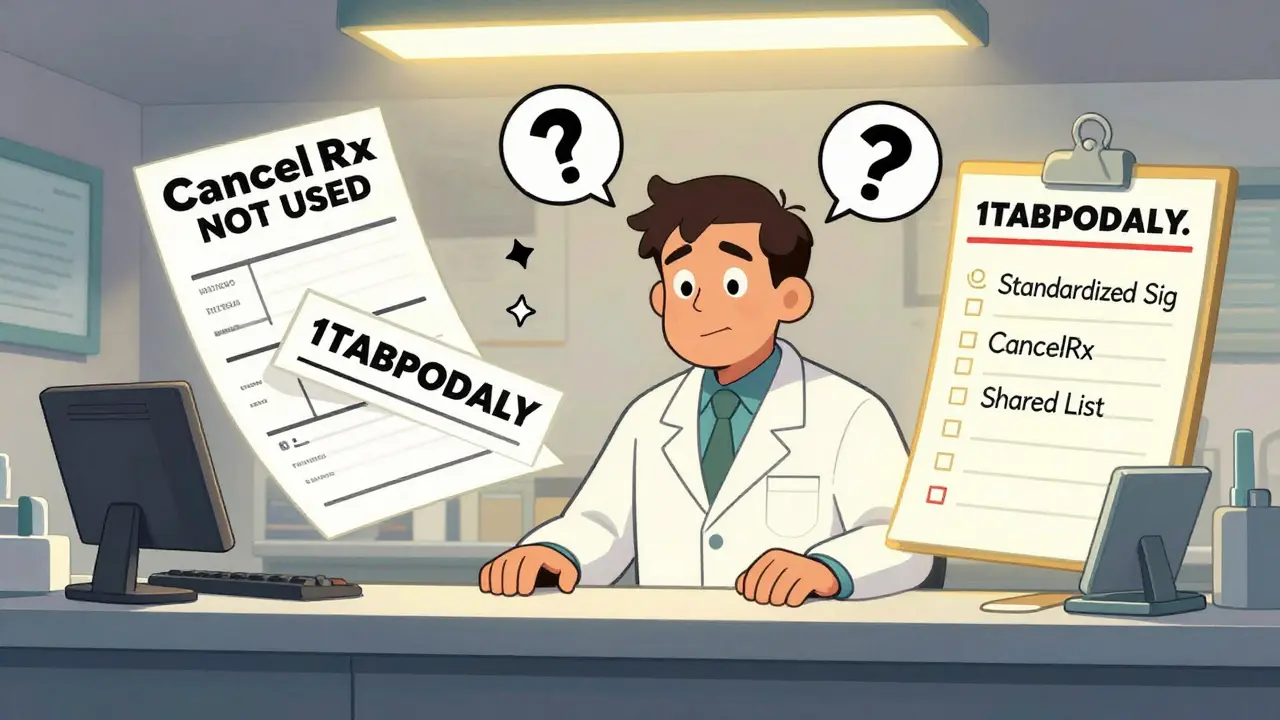
Take the sig (instructions). One system might write "1 tab po qd." Another reads that as "10 tabs po qd" because it misinterprets "tab" as a code for 10. A third system strips out spaces and turns "take 1 tablet daily" into "1TABPODAILY," which gets parsed wrong. These aren’t typos. They’re structural flaws in how systems exchange data.
A 2023 survey by Surescripts found that 41% of pharmacists spend 15 to 30 minutes a day just fixing e-prescription errors. That’s half an hour per pharmacist, per day, on something that should’ve been automated. And it’s not just time-it’s risk. A 2015 study showed that while e-prescribing errors are less likely to cause serious harm than handwritten ones, they still happen often enough to put patients in danger.
The Six Proven Ways to Cut Transcription Errors
Research from the Agency for Healthcare Research and Quality (AHRQ) and leading medical informatics groups has identified six evidence-backed strategies that actually work. These aren’t suggestions. They’re fixes that have been tested in real clinics and pharmacies.
- Standardized sig formatting-Instead of letting doctors type free-form instructions like "take one every 8 hours," systems should offer dropdowns: "1 tablet by mouth every 8 hours," "2 tablets by mouth twice daily," etc. This cuts transcription errors by 41%.
- CancelRx protocol-When a doctor changes a prescription, the old one should be electronically canceled. Without this, pharmacies get two prescriptions for the same drug-one old, one new-and can’t tell which to fill. CancelRx reduces these errors by 63%.
- Single shared medication list-If the patient’s active meds are pulled from one central list across all systems, pharmacists won’t have to guess what’s current. One practice using this eliminated 100% of their refill transcription errors.
- Structured indication entry-When a doctor selects "rheumatoid arthritis" as the reason for prescribing methotrexate, the system should flag if the dose is wrong for that condition. This cuts indication-drug mismatches by 79%.
- Pharmacy-prescriber connectivity-Systems need to talk directly using HL7 FHIR Release 4.0.1 standards. When they do, manual re-entry drops by 92%. That’s not a guess-it’s what happened in a 2017 ISMP Canada case study.
- Redesigned workflow for changes-If a prescription needs to be changed after it’s sent, the system should force the provider to cancel the original and send a new one. No "edit" button. No ambiguous updates. Just clean replacement.
Integrated Systems Beat Standalone Ones
Not all e-prescribing tools are created equal. There are two main types: standalone systems like DrFirst Rcopia, and integrated systems like Epic’s Hyperspace or Cerner’s PowerChart.
Standalone systems are popular in small practices because they’re cheaper and easier to install. But they’re also more error-prone. A 2019 KLAS report found they have 42% more transcription errors than integrated systems. Why? Because they don’t talk to the EHR. The doctor has to manually copy patient data from one screen to another. That’s where mistakes creep in.
Integrated systems pull data from the patient’s record automatically-medications, allergies, lab results. That’s why Epic’s system reduced overall prescribing errors by 84% in a 2021 JAMIA study. But here’s the catch: integration only works if the pharmacy system speaks the same language. If your clinic uses Epic but your pharmacy uses QS/1, and they’re not connected via FHIR, you’re back to manual entry.
What’s Broken in Today’s Systems
Even the best systems have blind spots. Dr. David Bates from Harvard says adding medication indications could fix 78% of dosing errors. Yet most systems still don’t require it. Dr. Joan Ash points out that alert fatigue is a silent killer-when doctors see too many pop-up warnings, they start clicking past them. That’s how a warning about a dangerous drug interaction gets ignored, and the wrong dose gets sent.
And then there’s the fragmentation. Dr. Blackford Middleton from the American Medical Informatics Association says current systems only address 38% of possible transcription error pathways. That means over 60% of the ways errors can happen are still wide open.
One pharmacy tech on Reddit described it perfectly: "Epic sends prescriptions to our QS/1 system, and 27% of the time, the sig gets scrambled. We have to manually fix it. It’s not the pharmacist’s fault. It’s the system’s."
What You Can Do Right Now
You don’t need to wait for a system overhaul. Here’s what you can do today, whether you’re a doctor, nurse, or pharmacist:
- Always check the sig-Before sending, read the instructions exactly as they’ll appear to the pharmacy. If it’s not clear, use a dropdown menu if available.
- Use CancelRx every time you change a script-Don’t just send a new one. Cancel the old one first. It’s a two-click fix that prevents confusion.
- Verify the patient’s medication list-Before prescribing, pull up the active meds from your EHR. Don’t rely on memory or what the patient says.
- Ask your pharmacy about connectivity-If they’re still calling you to clarify scripts, ask if they’re using FHIR. If not, push for it.
- Report errors-If a prescription comes back wrong, document it. Systems only improve when people report what’s broken.
The Future: FHIR, AI, and What’s Coming
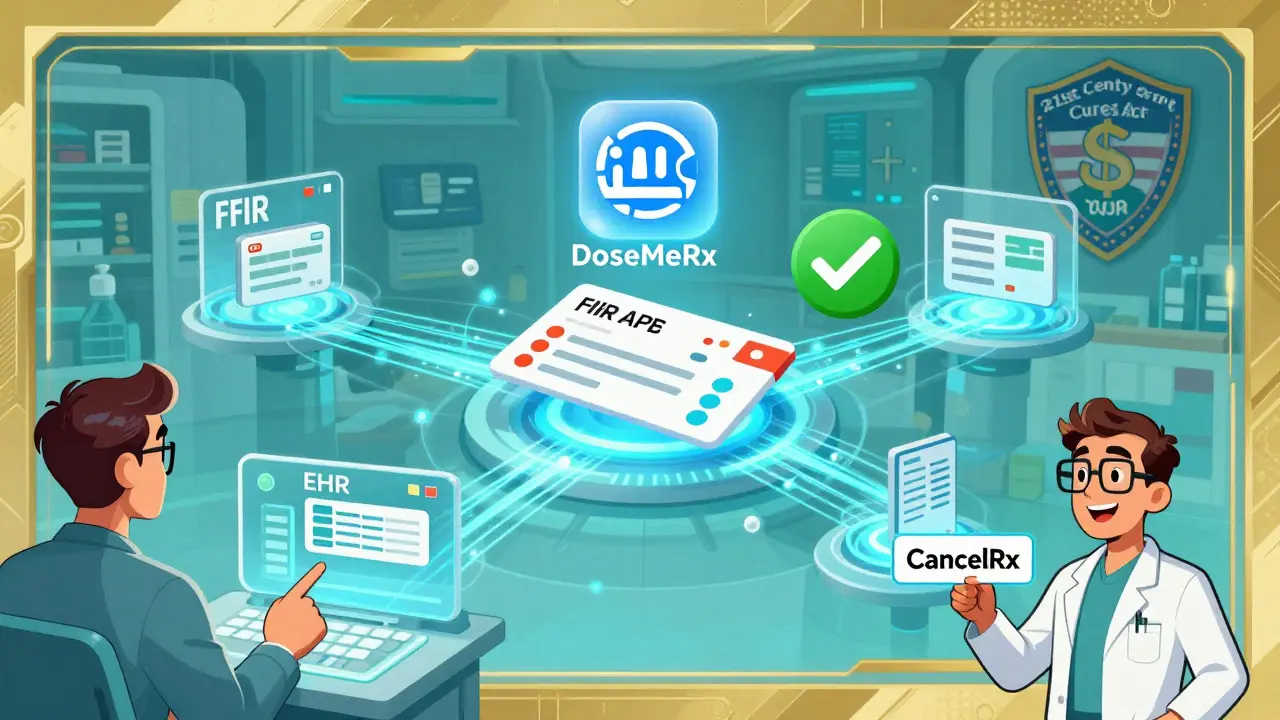
The big shift is coming with FHIR (Fast Healthcare Interoperability Resources). By 2025, the Office of the National Coordinator for Health Information Technology requires all e-prescribing systems to use FHIR APIs. That means systems will finally talk like humans do-clear, structured, and consistent.
Already, pilot programs using FHIR have cut transcription errors by 98%. The Da Vinci Project, led by HL7 International, proved this in 2023. And soon, AI tools like Epic’s DoseMeRx will scan prescriptions in real time, flagging mismatches before they’re sent. Early tests show these tools can reduce errors by another 65% by 2026.
But none of this matters if we don’t fix the basics. No AI can fix a system that doesn’t know what "q.d." means. No algorithm can fix a pharmacy that gets two prescriptions for the same drug because CancelRx wasn’t used.
The tools are here. The standards exist. The data proves what works. What’s missing is consistent use.
Regulations Are Pushing Change
The 21st Century Cures Act, effective since 2021, makes it illegal for systems to block data exchange. That’s called "information blocking." If your EHR vendor won’t connect to a pharmacy system, they could face fines.
And the DEA’s 2021 rule requiring electronic prescriptions for controlled substances (EPCS) has already cut transcription errors for Schedule II drugs by 57%. That’s proof that when you mandate digital, you reduce errors.
Small practices are still lagging. Only 68% of practices with fewer than 10 providers have full interoperability. But the government is stepping in-with $15 million in funding to help small clinics upgrade to FHIR-compliant systems by 2025.
Final Thought: It’s Not About Technology. It’s About Discipline.
E-prescribing didn’t fail. We did. We let vendors build systems that were fast and cheap, not safe and smart. We accepted "close enough" instead of "exactly right."
The fix isn’t a new app. It’s a habit. Check the sig. Cancel the old. Use the shared list. Demand FHIR. Report errors. These aren’t extra steps-they’re safety checks. And if you skip them, you’re not just being inefficient. You’re risking a patient’s life.
The technology is ready. The standards are set. The data is clear. Now it’s up to you to use it right.



Nancy Kou on 21 December 2025, AT 07:30 AM
Every time I see a script come through with '1 tab po qd' I cringe. I've seen this exact scenario play out three times this month alone. The system turns 'tab' into '10' because some dumb algorithm thinks it's a code. No one's fixing this because it's 'just how it is.' But it's not just how it is-it's how we let it be.