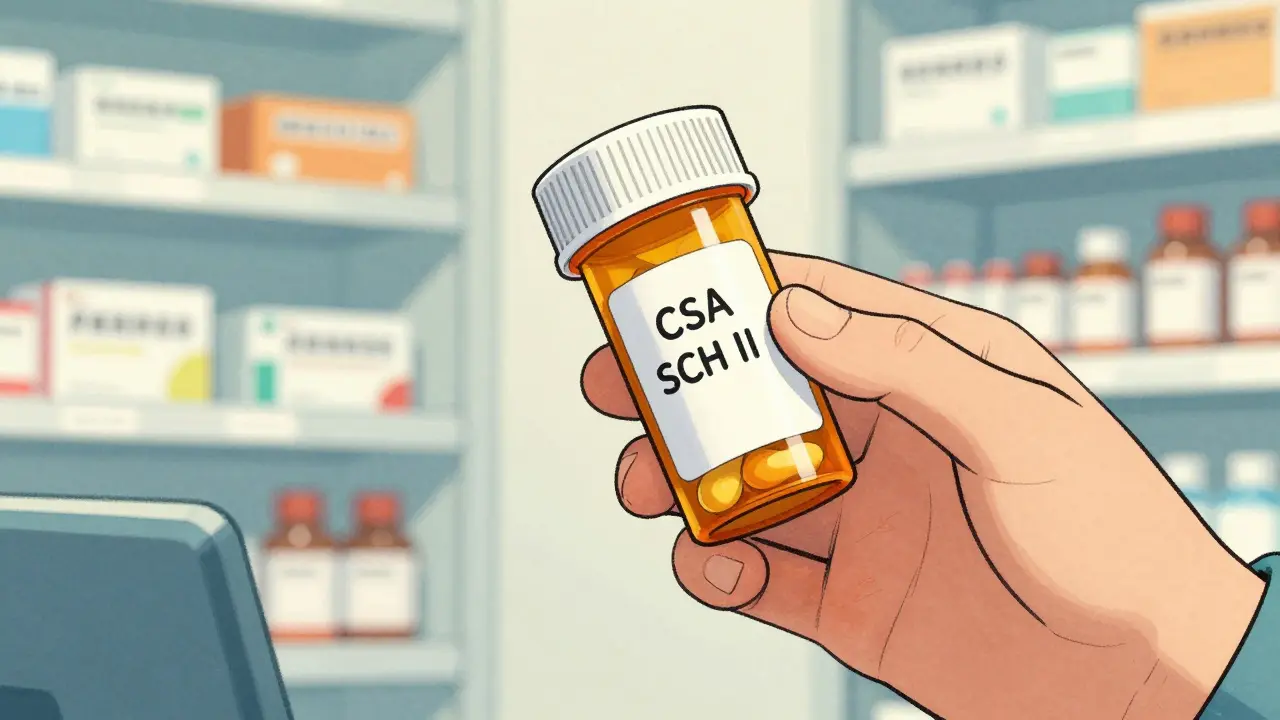
You might have noticed a small, often overlooked code on your prescription bottle, or perhaps your pharmacist mentioned that your medication is a "Schedule II" drug. While it sounds like something out of a legal textbook, these labels are actually critical safety markers. They tell healthcare providers and patients exactly how dangerous a drug can be if misused and how strictly the government needs to track it. If you've ever wondered why some meds can't be refilled or why certain pills require a special type of prescription paper, it all comes down to the regulatory framework known as the Controlled Substances Act is a federal U.S. drug policy that classifies substances based on their medical use, safety, and potential for abuse.
The Logic Behind the Labels
The goal of the scheduling system is to create a "closed system." Think of it as a high-security chain of custody. From the moment a chemical is manufactured to the second you swallow a pill, the Drug Enforcement Administration (DEA) monitors who is handling the substance and in what quantity. This prevents "diversion," which is just a fancy way of saying it stops legal meds from ending up on the street.
When the government decides where a drug fits, they don't just guess. They look at the scientific evidence of the drug's pharmacological effect, its history of abuse, and whether it's an immediate precursor to another dangerous drug. For example, a drug that creates a severe physical dependence will be placed in a stricter category than one that only has a mild sedative effect.
Breaking Down the Five Schedules
Not all controlled substances are created equal. They are split into five distinct "schedules." The lower the number, the higher the potential for abuse and the stricter the rules.
- Schedule I: These are the most restricted. They have a high potential for abuse and, according to the law, no currently accepted medical use. This includes substances like heroin and LSD. While some states have legalized Cannabis for medical use, it technically remains in this category federally, which often creates a legal headache for doctors and patients.
- Schedule II: These drugs have a high potential for abuse but are accepted for medical use. You'll find powerful painkillers like Fentanyl, morphine, and oxycodone here. Because they are so potent, they have the strictest prescription rules of any legal medication.
- Schedule III: These have a moderate to low potential for dependence. An example would be ketamine or tablets containing less than 90 milligrams of codeine. They are easier to prescribe than Schedule II drugs but still require a prescription.
- Schedule IV: These have a low potential for abuse. Common medications like Xanax or Ambien fall into this group. You can usually get these refilled more easily than a Schedule II drug.
- Schedule V: This is the lowest tier. These drugs have the lowest potential for abuse, such as some cough medicines with small amounts of codeine. In some cases, these can even be bought over-the-counter with a pharmacist's supervision.
| Schedule | Abuse Potential | Medical Use | Refill Rules | Example Substance |
|---|---|---|---|---|
| I | High | None (Federal) | Not Prescribable | Heroin |
| II | High | Accepted | No Refills | Oxycodone |
| III | Moderate | Accepted | Up to 5 refills / 6 mos | Ketamine |
| IV | Low | Accepted | Up to 5 refills / 6 mos | Xanax |
| V | Lowest | Accepted | Varies / Some OTC | Pregabalin |
How This Affects Your Pharmacy Visit
Depending on the schedule code, your experience at the pharmacy can change drastically. If you are prescribed a Schedule II medication, you might notice that your doctor can't just "call in" a refill. In most states, these must be written on tamper-resistant paper to prevent people from forging prescriptions. Even for doctors, the paperwork is a burden; some oncology nurses report that processing a single Schedule II script takes about 15 minutes longer than a standard medication because of the required documentation.
For Schedules III through V, the process is smoother. Electronic prescriptions are the norm, and partial fills are often allowed. If you're using a Schedule IV drug for anxiety, for instance, your doctor can authorize a few refills on a single prescription, saving you a trip to the clinic every month.
Identifying the Codes on the Label
When you look at a professional drug listing or a pharmacy database, you'll see specific abbreviations. You might see CSCN, which stands for the Controlled Substance Code Number. This is a unique ID assigned by the DEA to every single controlled substance. Other common markers include "NARC" for narcotics or "CSA SCH" followed by the number (e.g., CSA SCH II).
It is also worth noting that some drugs can jump between schedules depending on how they are made. Codeine is the perfect example. Pure codeine is a Schedule II drug. If it's mixed with acetaminophen in a tablet, it might become Schedule III. If it's in a cough syrup with a very low concentration, it drops to Schedule V. The label changes because the risk of abuse changes based on the dose and the ingredients.
The Controversy and Future of Scheduling
The system isn't perfect, and many experts argue it's outdated. The biggest point of contention is cannabis. While the majority of U.S. states have recognized its medical value, the federal government still keeps it in Schedule I. This creates a weird legal gray area where a patient is legal under state law but technically using a "Schedule I" substance under federal law.
There is a push toward a more nuanced framework. Some analysts believe we will move toward a six- or seven-schedule system to better differentiate between substances that have a risk of addiction but are vastly different in their actual danger to the public. In the meantime, the DEA is trying to speed up how quickly they can add new synthetic cannabinoids and other "designer drugs" to the lists to keep up with illegal labs.
Why can't my Schedule II medication be refilled?
Schedule II drugs have the highest potential for physical and psychological dependence among legal medications. To prevent over-prescription and abuse, federal law requires a new, valid prescription for every single fill. This ensures a doctor re-evaluates the patient's need for the drug before more is dispensed.
What happens if a doctor doesn't have a DEA number?
A physician cannot legally prescribe any controlled substance without a DEA registration number. If a doctor lacks this number, the pharmacy will be unable to process the prescription. Obtaining this number involves a registration process that typically takes 4-6 weeks.
Can a drug be in two different schedules?
Yes, but usually only if the formulation changes. A drug like codeine can be Schedule II (pure), Schedule III (combination tablets), or Schedule V (low-dose syrup). The schedule is based on the specific concentration and the other ingredients in the medication.
Is the Controlled Substances Act only for illegal drugs?
No, it covers both. While it classifies illegal drugs like heroin (Schedule I), its primary day-to-day function is managing legal medications that have a risk of abuse, such as opioids, benzodiazepines, and stimulants.
What is a CSCN?
A CSCN is a Controlled Substance Code Number. It is a unique identifier assigned by the DEA to each substance to allow for precise tracking throughout the pharmaceutical supply chain, ensuring that the exact amount produced matches the amount dispensed.
Next Steps for Patients and Caregivers
If you're managing a medication with a schedule code, the best thing you can do is stay ahead of your refills. Because Schedule II drugs require a new prescription every time, don't wait until the last pill to contact your doctor. Give them at least a week's notice to avoid a gap in your treatment.
If you're a caregiver, keep a log of the dates and quantities of controlled substances dispensed. Because these drugs are so tightly regulated, pharmacies and insurance companies are more likely to flag "early refills," which can lead to delays at the counter. Being able to show a clear history of use can help resolve these issues quickly.




Daniel Runion on 26 April 2026, AT 14:23 PM
Typical government overreach!!! The whole system is basically a joke anyway... who actually believes these 'schedules' are based on real science and not just political whims?!?! Ridiculous!!!