
When your lower back aches after standing too long, or your hamstrings feel tight no matter how much you stretch, it might not just be a bad day. For about 6 in every 100 people, that pain is caused by spondylolisthesis-a condition where one of the lower spine bones slips forward over the one below it. It’s not rare. It’s not always dramatic. But when it starts affecting how you walk, sit, or even breathe, it changes everything.
What Exactly Is Spondylolisthesis?
Spondylolisthesis comes from Greek: spondylo means vertebra, and olisthesis means slip. So, it’s literally a slipped vertebra. Most often, it happens between the fifth lumbar vertebra (L5) and the first sacral bone (S1). That’s the bottom of your lower back, right above your tailbone. The slip isn’t usually dramatic-sometimes it’s just a few millimeters. But even a small shift can pinch nerves, strain muscles, and throw your whole posture off. There are five main types, each with a different cause:- Degenerative-the most common in adults over 50. Arthritis wears down the joints and discs, letting the bone slide forward.
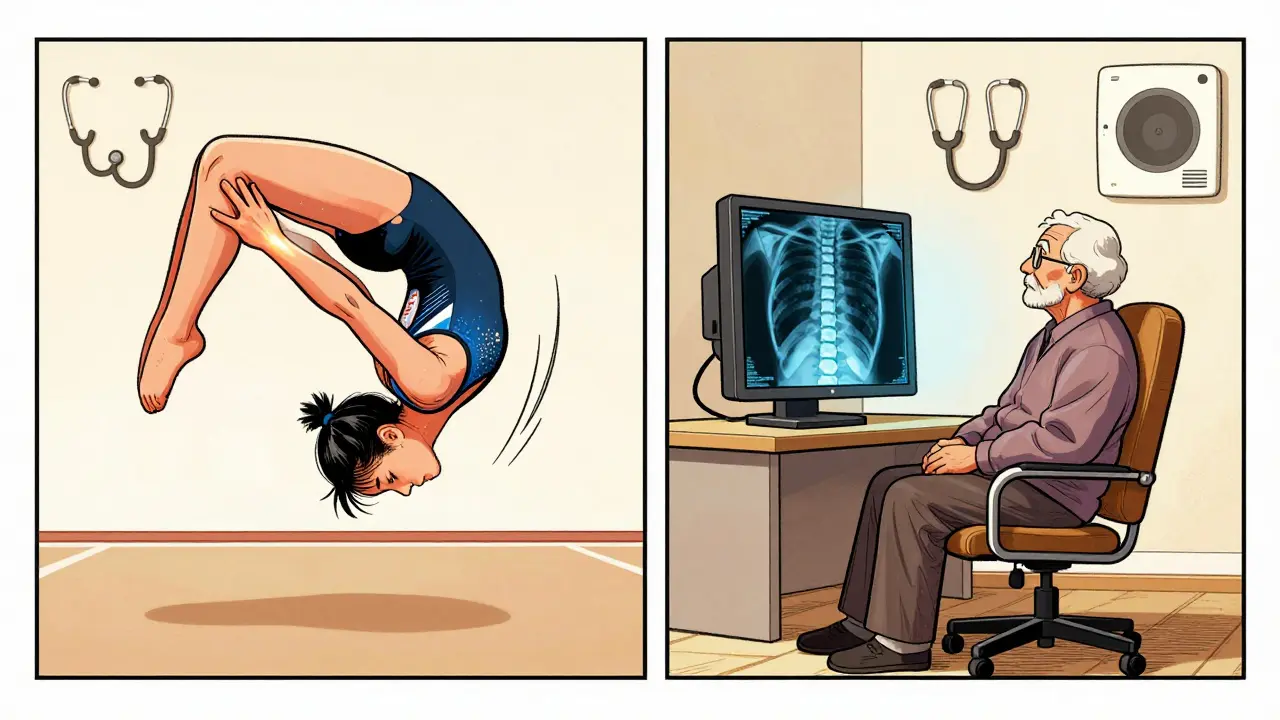
- Isthmic-caused by a tiny fracture in the pars interarticularis, a thin bone bridge connecting vertebrae. This often starts in teens or young adults who play sports like gymnastics or football.
- Dysplastic-a birth defect where the spine didn’t form right. Seen in kids under 6, especially with family history.
- Pathologic-due to diseases like cancer or osteoporosis that weaken the bone.
- Traumatic-from a sudden injury, like a fall or car crash.
Degenerative spondylolisthesis makes up about 65% of adult cases. Isthmic is the main cause in younger people. And here’s the thing: about half of people with this condition never feel a thing. It shows up on an X-ray, but they’re fine. Others? Their pain is constant.
Why Does It Hurt? The Real Symptoms
If you’re feeling pain, it’s usually not just a dull ache. It’s deeper. Worse when you’re upright. Better when you sit or bend forward. That’s because bending forward opens up the space between the bones, taking pressure off the nerves. Common signs include:- Lower back pain that feels like a deep muscle strain
- Pain radiating into your buttocks or back of the thighs
- Tight hamstrings-70% of people with symptoms have this
- Stiffness in the lower back, especially in the morning
- Difficulty walking for long distances
- Numbness, tingling, or weakness in one or both legs (if nerves are compressed)
Some people develop an exaggerated swayback at first. In advanced cases, the upper spine starts to collapse forward, creating a rounded back-kyphosis. That’s not common, but it happens in about 28% of severe cases.
Grade matters. Doctors use the Meyerding scale to measure how far the bone has slipped:
- Grade I: 1-25% slip
- Grade II: 26-50%
- Grade III: 51-75%
- Grade IV: 76-100%
People with Grade III or IV slips are far more likely to have leg symptoms-35% report numbness or weakness. And 68% of them develop neurogenic claudication-a cramping pain in the legs when walking, relieved by sitting. That’s a big red flag.
How Is It Diagnosed?
It starts with a simple standing X-ray. That’s all you need to see the slip. But if you’re having leg pain, tingling, or weakness, you’ll likely get an MRI. That shows if nerves are being squeezed, or if discs are worn out. A CT scan gives a clearer picture of the bone structure, especially if there’s a fracture in the pars interarticularis.Doctors don’t just look at the slip. They look at your whole picture: age, activity level, how long the pain’s been there, and whether you’ve tried conservative treatments. A 2023 study found that disc degeneration correlates more with age than with how far the bone has slipped. That means treatment should focus on symptoms, not just the X-ray.
Non-Surgical Treatments: What Actually Works
Most people never need surgery. In fact, 80-90% of cases improve with conservative care. But it takes time and consistency.- Physical therapy-the cornerstone. Focuses on core strengthening, hamstring stretching, and posture retraining. Most people see results after 12-16 weeks. But only about 65% stick with it long enough.
- Activity modification-avoid sports or movements that arch the back hard: gymnastics, weightlifting, football. Even heavy gardening can trigger pain.
- NSAIDs-like ibuprofen or naproxen-help with inflammation and pain. But they don’t fix the slip. Just manage symptoms.
- Epidural steroid injections-can reduce nerve swelling and give relief for weeks or months. Useful if pain is blocking your ability to do PT.
The NHS recommends seeing a doctor if back pain lasts more than 3-4 weeks, or if you have leg pain, numbness, or trouble walking. Don’t wait until it’s unbearable.
Fusion Surgery: The Big Decision
Surgery is considered only if:- Conservative care has failed after 6-12 months
- Pain is disabling
- Nerve symptoms are getting worse
- You can’t walk more than a few blocks without stopping
The goal of surgery isn’t just to stop the slip-it’s to relieve pressure on nerves and restore stability. Spinal fusion is the standard. It means permanently joining two vertebrae together so they can’t move anymore.
There are three main types:
- Posterolateral fusion-bone graft placed along the back of the spine. Used in about 55% of cases. Success rate: 75-85% for Grade I-II slips, but drops to 60-70% for Grade III-IV.
- Interbody fusion-PLIF or TLIF. The disc is removed, and a spacer is inserted between the vertebrae. This restores height and opens up the nerve pathways. Used in 35% of cases. Success rate: 85-92% across all grades.
- Minimally invasive fusion-smaller incisions, less muscle damage. Only 10% of procedures now, but growing fast. Recovery is quicker, but not always suitable for high-grade slips.
Why does interbody fusion do better? Because it doesn’t just fuse bones-it fixes the disc space. That means better alignment, less nerve pressure, and fewer complications.
What You Need to Know Before Surgery
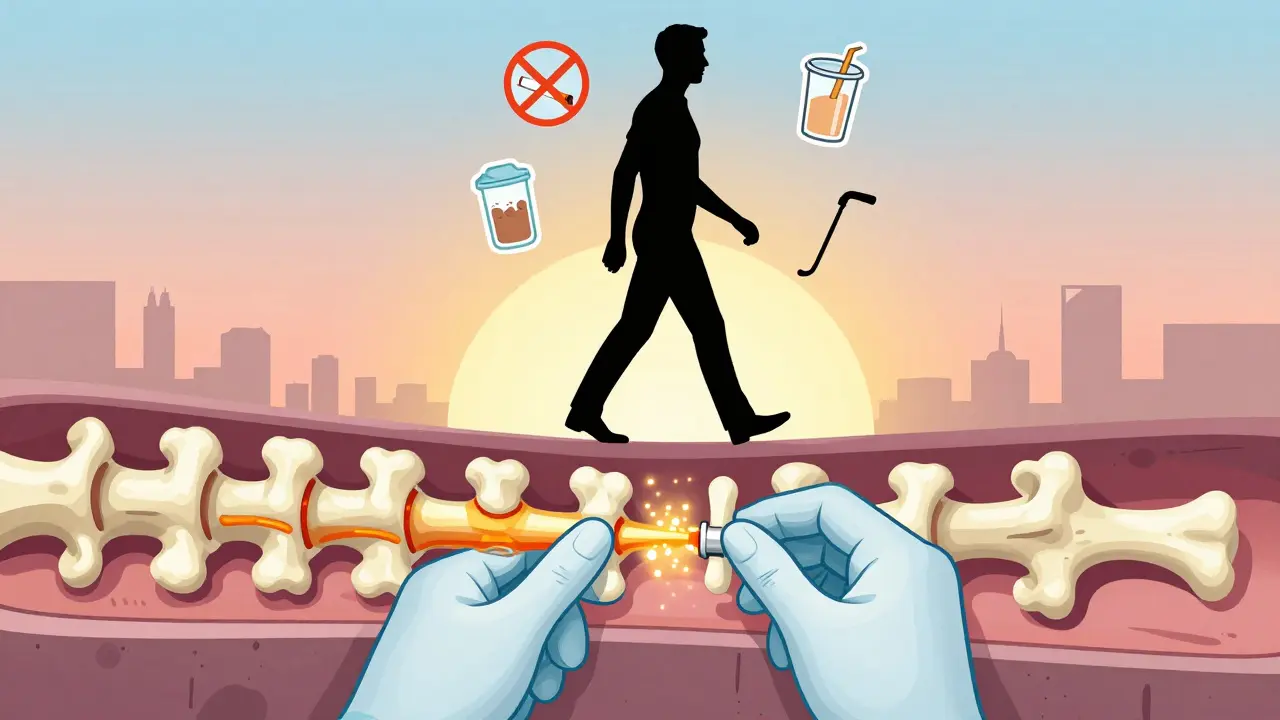
If you’re considering fusion, here’s what you must do first:- Quit smoking-smokers have 3.2 times higher risk of failed fusion (pseudoarthrosis).
- Manage your weight-BMI over 30 increases surgical complications by 47%.
- Get your nutrition right-protein, vitamin D, and calcium matter for bone healing.
Recovery isn’t quick. You’ll need:
- 6-8 weeks of limited activity
- 3-6 months of physical therapy
- Up to 18 months for full bone healing
Satisfaction rates are good-78-85% at 2 years. But 12-15% of people with high-grade slips need revision surgery. Why? Adjacent segment disease. That’s when the discs above or below the fusion start wearing out faster because they’re taking extra stress. It happens in 18-22% of patients within 5 years.
New Options: What’s Changing in 2026
The field is evolving. In 2022, the FDA approved two new interbody devices designed specifically for spondylolisthesis. Early results show 89% fusion rates at 6 months-better than older models.Bone morphogenetic protein (BMP) and stem cell therapies are being tested. A 2023 trial showed BMP-2 boosted fusion rates to 94% in high-risk patients. That’s huge for smokers or diabetics.
There’s also growing interest in motion-preserving devices-dynamic stabilization systems that limit movement without fusing the spine. They’re promising for Grade I-II slips. But long-term data? Only 5 years so far. Success rate: 76% vs. 88% for fusion.
The global spinal fusion market is expected to hit $7.8 billion by 2027. More older adults, more diagnoses, more tech. But better patient selection is the real breakthrough. A 2023 study identified 11 clinical and imaging markers that predict surgical success with 83% accuracy. That means fewer people get unnecessary surgery.
When to Choose Fusion-and When Not To
Fusion isn’t a cure-all. It’s a tool. Ask yourself:- Is my pain truly disabling, or just annoying?
- Have I given PT, rest, and lifestyle changes a real shot?
- Am I healthy enough to heal? (No smoking, good weight, no diabetes)
- Do I understand the long-term risks? (Adjacent segment disease, revision surgery)
For young athletes with isthmic spondylolisthesis, fusion is often avoided unless the slip is high-grade or neurological symptoms are present. For older adults with degenerative spondylolisthesis, fusion can be life-changing-if done right.
Remember: the slip on the X-ray doesn’t tell the whole story. Your pain, your mobility, your life-those do.
Can spondylolisthesis get worse over time?
Yes, especially if it’s degenerative. As arthritis progresses, the disc and joints keep wearing down, which can cause the vertebra to slip further. High-grade slips (Grade III-IV) are more likely to progress. But many people’s slips stay stable for years, especially if they avoid activities that strain the lower back.
Is walking good for spondylolisthesis?
Yes, but with limits. Walking is low-impact and helps maintain mobility. But if you develop neurogenic claudication-leg pain or cramping that forces you to stop-you’re putting too much pressure on your nerves. In that case, walking in a slightly bent-forward position (like pushing a shopping cart) can help. Avoid long distances or steep hills until your symptoms improve.
Will I need a brace after fusion surgery?
Sometimes. Surgeons may recommend a soft or rigid brace for the first 6-12 weeks to limit movement while the bone starts to fuse. It’s not always required, especially with modern interbody techniques that provide strong immediate stability. Your surgeon will decide based on your slip grade, surgical approach, and overall health.
Can I still play sports after spinal fusion?
You can return to many activities, but not high-impact or twisting sports. Running, swimming, cycling, and light hiking are usually fine after full healing. Avoid football, gymnastics, weightlifting, or anything that involves repeated back hyperextension. Most people adapt well and stay active-just differently.
How do I know if my back pain is spondylolisthesis and not just a pulled muscle?
Pulled muscles usually improve within days to a week with rest. Spondylolisthesis pain lasts weeks or months and gets worse with standing or walking. It often radiates to the buttocks or thighs. Tight hamstrings and relief when bending forward are strong clues. If pain lasts more than 3-4 weeks, get imaging. Don’t assume it’s just strain.
Next Steps: What to Do Today
If you suspect spondylolisthesis:- Stop activities that arch your back hard-like heavy lifting or backbends.
- Start gentle hamstring stretches and core exercises. Even 10 minutes a day helps.
- See a physiotherapist who understands spinal conditions. Don’t just do generic back exercises.
- If pain persists beyond 4 weeks, get an X-ray. Don’t wait for it to get worse.
- If you’re considering surgery, get a second opinion. Ask about fusion type, success rates, and alternatives.
You don’t have to live with constant pain. But you also don’t need surgery right away. The right path is the one that matches your body, your life, and your goals-not just the number on an X-ray.



Brian Anaz on 4 January 2026, AT 18:04 PM
This is why America's healthcare is broken. You pay $20k for a fusion when you could've just done PT for $300. They sell surgery like it's a Tesla. Wake up.