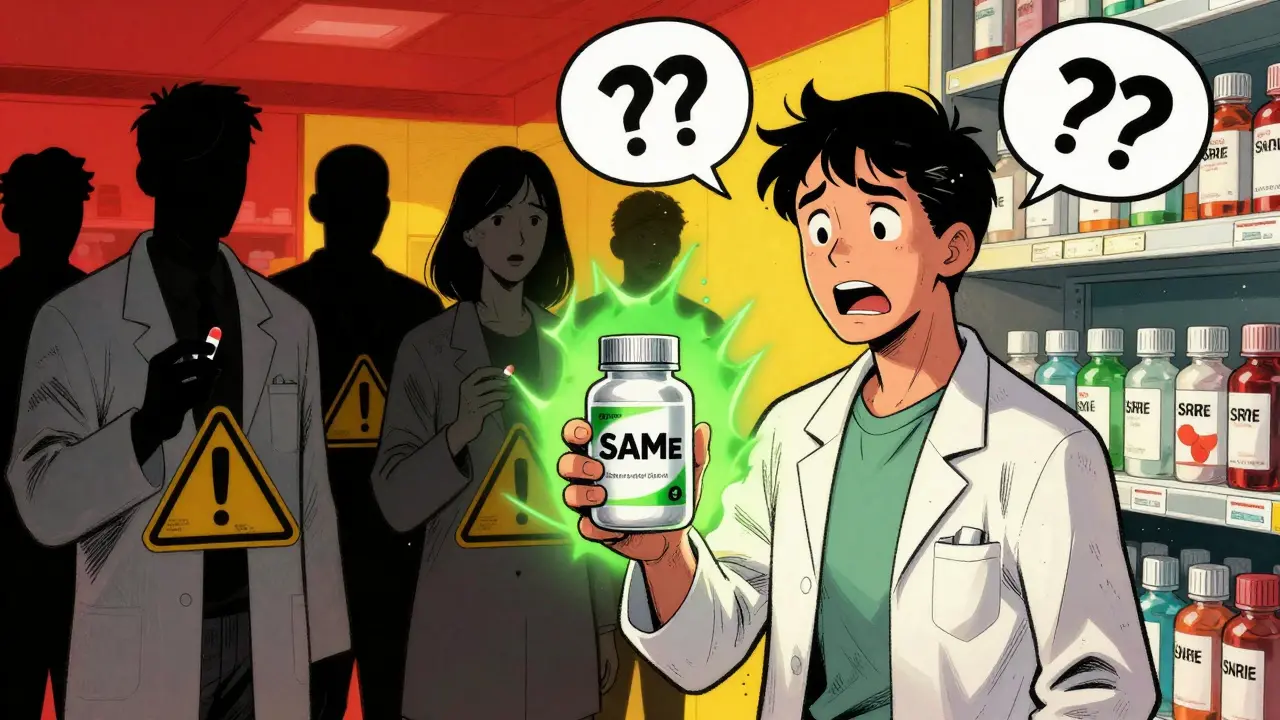
When you’re struggling with depression and standard treatments aren’t cutting it, it’s easy to look for something else-something natural. That’s where SAMe comes in. Sold in health stores and online as a supplement, SAMe (S-adenosylmethionine) is often marketed as a mood booster that works faster than antidepressants. But here’s the catch: mixing it with your prescription antidepressant can be dangerous. Not just risky-potentially life-threatening.
What SAMe Actually Does in Your Brain
SAMe isn’t just another vitamin. It’s a molecule your body naturally makes, and it plays a key role in producing neurotransmitters like serotonin, dopamine, and norepinephrine-the same chemicals targeted by antidepressants. Think of it as a methyl donor: it helps your brain build and activate these mood-regulating chemicals. In clinical trials, SAMe has shown it can lift mood in mild to moderate depression, with some people feeling better in as little as 7-10 days. That’s faster than SSRIs, which usually take 4-6 weeks.
But here’s the reality: SAMe doesn’t work for everyone. In severe depression, remission rates are around 18%, compared to 42% with venlafaxine. It’s also expensive-$80 to $120 a month-and not all supplements contain what’s on the label. ConsumerLab found 32% of tested SAMe products were underdosed. And unlike real drugs, SAMe isn’t FDA-approved for depression. It’s sold as a supplement, meaning manufacturers don’t have to prove it works before putting it on shelves.
Why Combining SAMe With Antidepressants Is a Problem
The biggest danger isn’t SAMe alone-it’s what happens when you stack it with SSRIs, SNRIs, or other antidepressants. Both SAMe and these medications increase serotonin levels. When you combine them, serotonin can build up too fast. That’s when serotonin syndrome kicks in.
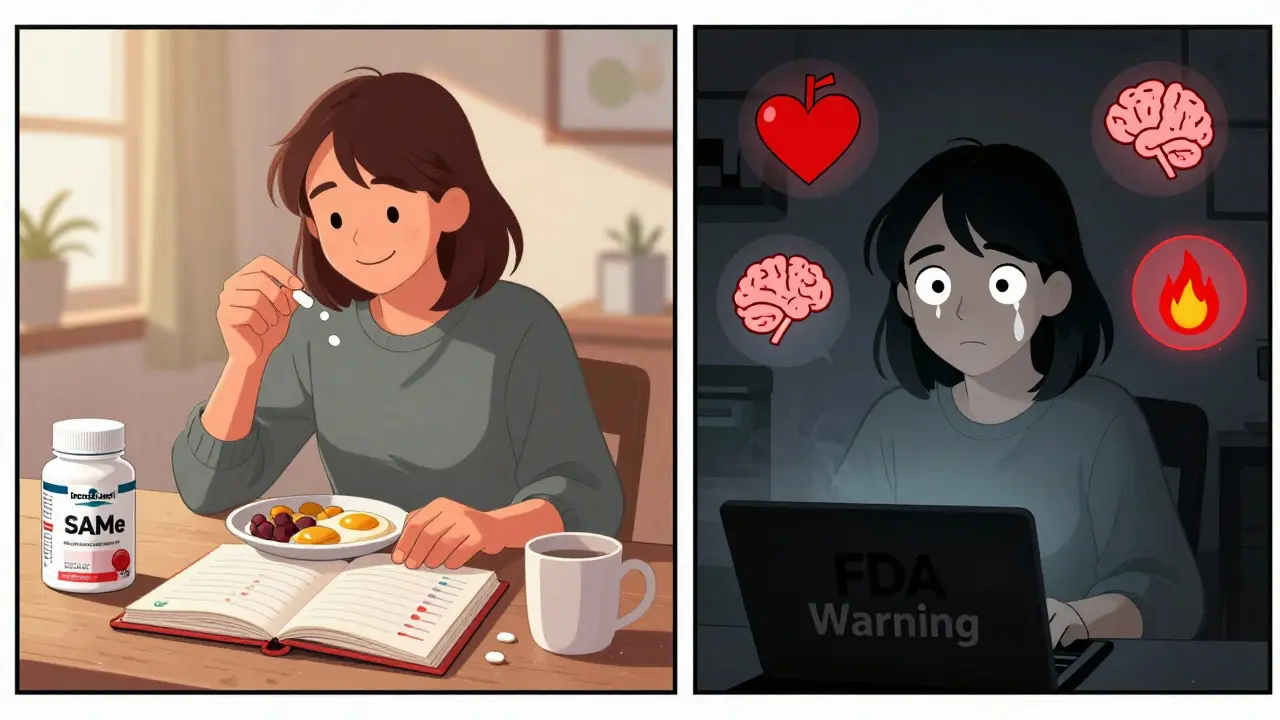
Serotonin syndrome isn’t a mild side effect. It’s a medical emergency. Symptoms include: racing heart, high blood pressure, muscle rigidity, tremors, confusion, sweating, fever, and in severe cases, seizures or loss of consciousness. The Mayo Clinic, Natural Medicines Database, and the FDA all warn against combining SAMe with antidepressants. The interaction is rated a ‘Major’ risk-7.3 out of 10 on the severity scale.
Real cases exist. One Reddit user reported racing heart, muscle stiffness, and confusion after adding 400mg of SAMe to their 20mg Prozac. They ended up in the ER. On the flip side, some people report success-like a user who added 800mg SAMe to Zoloft and saw their depression score drop from 16 to 7 over eight months. But those are anecdotes. Science says the risk isn’t worth it unless you’re under strict supervision.
Who Should Avoid SAMe Altogether
If you’re on any antidepressant-whether it’s fluoxetine, sertraline, venlafaxine, or even an MAOI-don’t take SAMe without talking to your doctor. The risk isn’t theoretical. Between 2000 and 2022, there were 12 published case reports of serotonin syndrome linked to SAMe-antidepressant combos. The FDA’s adverse event database recorded 32 incidents involving these combinations from 2018-2022, including 9 serious cases.
Even if you’re not on antidepressants, SAMe isn’t safe for everyone. People with bipolar disorder should avoid it-SAMe can trigger mania. Those with Parkinson’s disease should skip it too, as it may worsen symptoms. And if you’re pregnant or breastfeeding, there’s not enough safety data to recommend it.

What the Experts Say
Dr. David Mischoulon from Massachusetts General Hospital says SAMe can be useful as an add-on-but only if you’re closely monitored. His team found serotonin syndrome risk increases by about 35% when SAMe is added to SSRIs. Dr. Maurizio Fava from McLean Hospital notes that while documented cases are rare, the biological mechanism is clear: SAMe boosts serotonin synthesis AND blocks reuptake, essentially doubling down on what antidepressants do.
The American Psychiatric Association’s 2023 guidelines don’t recommend SAMe for routine use. They say the evidence is too inconsistent. The European College of Neuropsychopharmacology goes further: they advise against SAMe-antidepressant combinations outside of clinical trials. Even the NIH is still studying it-there’s an ongoing trial (NCT04821234) testing SAMe with escitalopram, with results expected in mid-2024.
What If You’re Already Taking Both?
If you’re already combining SAMe and an antidepressant, don’t stop abruptly. Sudden withdrawal from either can cause rebound anxiety or depression. Instead, talk to your doctor. They may recommend:
- Stopping SAMe first, while keeping the antidepressant
- Monitoring for withdrawal or worsening symptoms for 2-3 weeks
- Reintroducing SAMe only under controlled conditions, starting at 200mg twice daily
Most serotonin syndrome cases happen in the first 2-4 weeks of starting the combo. That’s when your body is adjusting. Symptoms often start mild-restlessness, sweating, a faster heartbeat-and get worse fast. Know the Hunter Criteria: spontaneous clonus, inducible clonus with agitation, ocular clonus with agitation, or tremor with hyperreflexia and fever above 38°C. If you have any of these, seek help immediately.
How to Use SAMe Safely (If You Choose To)
If your doctor agrees you’re a candidate for SAMe as an add-on, here’s what you need to do:
- Start low: 200mg twice daily, never more than 800mg total in the first week
- Take with food to reduce nausea or stomach upset (helps in 65% of cases)
- Split doses: take one in the morning, one at lunch-avoid evening doses to prevent insomnia
- Use refrigerated, enteric-coated brands (like Doctor’s Best or NOW Foods) to ensure absorption
- Check the label: make sure it says ‘400mg per capsule’ and the batch has been third-party tested
- Track your mood and symptoms daily using a simple journal or app
Some people feel worse before they feel better. About 22% report increased anxiety or agitation in the first week. That’s often temporary. But if it lasts more than 5 days, tell your doctor.
The Bigger Picture: Supplements Aren’t Regulated Like Drugs
Here’s the uncomfortable truth: the supplement industry isn’t held to the same standards as pharmaceuticals. In the U.S., SAMe is legal to sell without proving it works. In Europe, it was banned in 2015 due to safety concerns. The FDA has issued warning letters to three SAMe makers for claiming it treats depression-something they’re not allowed to do.
Amazon reviews show 42% of negative feedback says ‘ineffective for depression.’ And with 68% of users combining SAMe with antidepressants, the risk of hidden interactions is high. Only 37% of products even mention drug interactions on their labels.
So if you’re considering SAMe, ask yourself: are you looking for a quick fix, or are you willing to do the work to do it safely? Because if you’re not under medical supervision, you’re gambling with your brain chemistry.
What’s Next for SAMe?
Researchers are trying to fix SAMe’s problems. New versions-like SAMe-PEG and SAMe-phospholipid complexes-are being tested in Phase II trials. Early results show they reduce serotonin interaction risk by 40% in animal models. That could mean safer use in the future. But right now? The science isn’t there.
For now, SAMe remains a niche option. It might help someone who hasn’t responded to other treatments-but only if used carefully, slowly, and under the watch of a knowledgeable provider. For most people, sticking with proven, regulated antidepressants-plus therapy-is the smarter, safer path.


amanda s on 16 December 2025, AT 23:48 PM
So let me get this straight-you’re telling me some guy on Reddit took 400mg of SAMe with Prozac and ended up in the ER, but somehow Amazon reviews are more trustworthy than peer-reviewed journals? I’ve seen people take Adderall with energy drinks and call it ‘biohacking.’ This is the same level of dumb. Don’t mix supplements with SSRIs unless you want your brain to throw a rave it can’t shut down.