
Clozapine ANC Monitoring Calculator
ANC Monitoring Calculator
Monitoring Results
Treatment Duration
Next Test Due
Current Monitoring Stage
Recommended ANC threshold: cells/μL
Important: Even though the REMS program has been removed, ANC monitoring remains critical for safe clozapine treatment. The FDA, VA, and psychiatric associations still recommend this monitoring schedule.
On February 24, 2025, the U.S. Food and Drug Administration (FDA) made a major shift in how clozapine is prescribed. After more than a decade of strict rules, the REMS for clozapine was officially removed. That means doctors no longer have to register with a federal system. Pharmacies don’t need special certification. And patients no longer have to submit monthly blood test reports just to get their medication. But here’s the thing: the risk of severe neutropenia hasn’t gone away. It’s still real. The change wasn’t about safety being less important-it was about trust in doctors to do the right thing.
What Was the Clozapine REMS Program?
The Risk Evaluation and Mitigation Strategy (REMS) for clozapine started in 2015. It was created because clozapine, while incredibly effective for treatment-resistant schizophrenia, carries a risk of agranulocytosis-a dangerous drop in white blood cells called neutrophils. If left unchecked, this can lead to life-threatening infections. The REMS program forced everyone involved-prescribers, pharmacies, and patients-to jump through hoops to make sure blood tests were done on time. Under the old system, every patient had to be enrolled. Every prescriber had to be certified. Every pharmacy had to be approved. Before each refill, the pharmacy had to confirm the patient’s latest Absolute Neutrophil Count (ANC) was above the safety threshold: 1,500/μL for most people, or 1,000/μL for those with benign ethnic neutropenia. Missing a test? No clozapine. Even a one-day delay could mean a week without medication. The process was slow. Pharmacies spent 10 to 15 minutes per prescription just verifying results. Clinics used up 3.2 hours a week filling out forms. Patients in rural areas often waited days or weeks just to get their next supply. Many gave up entirely.Why Did the FDA Remove the REMS?
The FDA didn’t make this decision lightly. In 2024, they launched a full review. They looked at real-world data from the Sentinel System, the Department of Veterans Affairs, and Brigham and Women’s Hospital. They studied over 100,000 clozapine users. They asked: Is the REMS actually keeping people safe-or just making access harder? The answer? Doctors were already doing the right thing. Even without the mandatory system, 94% of prescribers continued to monitor ANC levels according to the recommended schedule: weekly for the first 6 months, biweekly from 6 to 12 months, then monthly after that. The risk of severe neutropenia is highest in the first 18 weeks, but it never fully disappears. Yet, the data showed that healthcare providers were consistently following guidelines-not because they were forced to, but because they understood the risk. The FDA also found that the REMS program was a major barrier to treatment. A 2022 study in JAMA Psychiatry found that only 31.7% of eligible patients received clozapine. Nearly half of the doctors who didn’t prescribe it said the REMS requirements were too burdensome. In clinics without dedicated REMS coordinators, initiation rates were 3.7 times lower. The bottom line: the system was working, but it was slowing down life-saving care. Removing it was about removing unnecessary red tape-not about lowering safety standards.What Changed on February 24, 2025?
Here’s what’s different now:- No more prescriber certification. You don’t need to sign up with the Clozapine REMS website.
- No more pharmacy certification. Any pharmacy can dispense clozapine.
- No more monthly Patient Status Forms. No more calling a REMS hotline.
- No more blocked prescriptions due to missing ANC reports.

How Should ANC Be Monitored Today?
Even though the REMS is gone, the monitoring schedule hasn’t changed. It’s still based on decades of clinical evidence. Here’s the standard protocol recommended by the FDA, VA, and major psychiatric associations:- Before starting: Get a baseline ANC. If it’s below 1,500/μL (or 1,000/μL for patients with benign ethnic neutropenia), clozapine should not be started.
- Weeks 1-18: Weekly ANC tests. This is the highest-risk period. Severe neutropenia most often happens here.
- Months 2-6: Continue weekly testing. Some providers may switch to biweekly if ANC stays stable and above 1,500/μL.
- Months 7-12: Biweekly testing if ANC remains normal.
- After 12 months: Monthly testing. This is the long-term standard. Some patients may extend to every 2 months if ANC is consistently normal and they’ve been stable for years-but only with shared decision-making between patient and provider.
What About Access and Use?
The removal of REMS has already started to change things. Before 2025, only about 128,450 people in the U.S. were taking clozapine-even though an estimated 1.1 million have treatment-resistant schizophrenia. That’s less than 12%. Many patients had tried three, four, or five other antipsychotics with no success. Clozapine works when nothing else does. Meta-analyses show it helps 30-50% of these patients. Other drugs? Maybe 10-15%. Now, providers are already seeing a shift. Anthem’s Provider News predicted a 25-30% increase in new clozapine starts over the next two years. Evaluate Pharma raised its market forecast from $487 million in 2024 to $612 million by 2026. Rural clinics, community hospitals, and small pharmacies-places that used to avoid clozapine because of the REMS paperwork-are now able to prescribe it. Patients who dropped out of care because of delays are returning.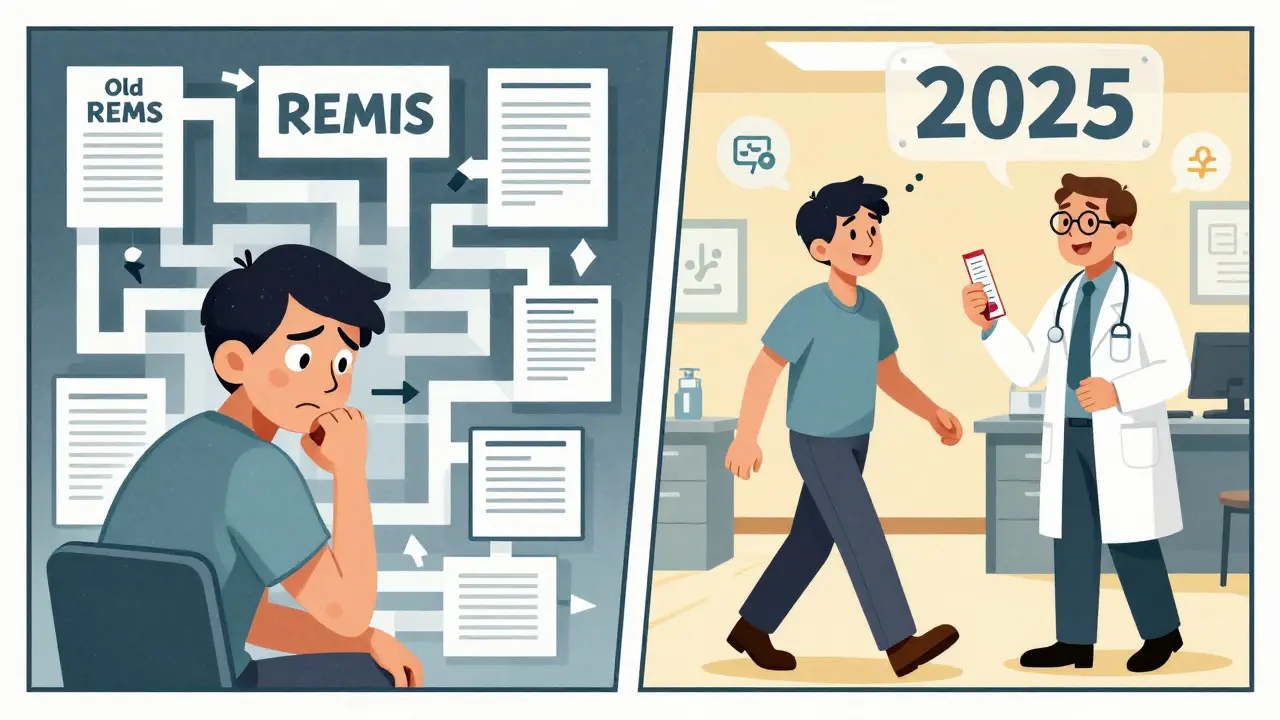
What’s Still the Same?
Don’t think this means clozapine is risk-free. The boxed warning is still there. The risk of neutropenia hasn’t disappeared. It’s still a drug that needs careful management. Patients still need to know the signs of infection: fever, sore throat, mouth ulcers, fatigue. They still need to call their doctor immediately if they feel unwell. And while the FDA removed the mandatory reporting, they’re still watching. The Sentinel System continues to track adverse events. If neutropenia rates suddenly spike, the FDA can bring back some form of oversight. The American Society of Health-System Pharmacists is already rolling out updated guidelines for 2025. The American Psychiatric Nurses Association praised the change-not because safety was lowered, but because it was finally trusted.What Should Patients and Providers Do Now?
For prescribers:- Continue monitoring ANC according to the standard schedule.
- Document every test result in the medical record.
- Educate patients on symptoms of infection.
- Use shared decision-making to determine monitoring frequency after 12 months.
- Keep all scheduled blood tests-even if no one is checking.
- Don’t skip doses because you think the “system” is gone.
- Report any fever, sore throat, or unusual fatigue immediately.
- Ask your doctor: “What’s my ANC? When’s the next test?”
- You no longer need to verify ANC through a REMS portal.
- But you should still confirm the patient has had a recent ANC test before dispensing.
- Don’t assume the doctor ordered the test-ask.
What’s Next?
The FDA expects this change to improve access without compromising safety. Early data from VA hospitals and large health systems show ANC monitoring rates remain above 90% since the REMS removal. Experts believe this could become a model for other medications. If a drug has a known risk, but providers are already following best practices, maybe the government doesn’t need to micromanage it. For now, clozapine is still the gold standard for treatment-resistant schizophrenia. And now, more people who need it can actually get it.Is clozapine still dangerous?
Yes, clozapine still carries a risk of severe neutropenia, especially in the first 6 months of treatment. The FDA removed the mandatory REMS program, but the boxed warning on the label remains. The risk hasn’t disappeared-just the federal enforcement. Doctors are still expected to monitor ANC levels regularly to prevent serious complications.
Do I still need to get blood tests for clozapine?
Yes. Even though the FDA no longer requires you to report your ANC results, medical guidelines strongly recommend ongoing blood monitoring. Weekly tests for the first 6 months, then biweekly or monthly after that. Skipping tests increases your risk of life-threatening infection. Your doctor will still expect you to follow the schedule.
Can any pharmacy fill my clozapine prescription now?
Yes. As of February 24, 2025, pharmacies no longer need special certification to dispense clozapine. Any licensed pharmacy can fill your prescription. However, they should still confirm you’ve had a recent ANC test before giving you your medication. If they refuse, ask why-this is now a clinical decision, not a legal requirement.
What if I miss a blood test?
If you miss a test, your doctor may delay your next refill until results are available. While there’s no federal system blocking you anymore, your prescriber still has a duty to protect your safety. Missing tests could lead to your doctor pausing treatment until monitoring is up to date. Don’t wait-schedule your bloodwork in advance.
Why did the FDA change its mind?
The FDA reviewed real-world data from hundreds of thousands of patients and found that doctors were already following safety guidelines-even without the REMS program. The administrative burden was preventing many patients from getting a life-changing medication. The agency concluded that trust in clinical judgment, combined with clear guidelines, was enough to keep patients safe.



Samuel Mendoza on 20 January 2026, AT 18:04 PM
This is pure nonsense. Removing REMS won’t stop neutropenia-it’ll just let lazy docs ignore it until someone dies. I’ve seen it happen. No system? Great. Now the ER will be full of septic patients because their ‘trusted’ psychiatrist forgot to check a CBC.