When a woman says her pelvis hurts - constantly, deeply, and without clear reason - doctors often send her in circles. She’s told it’s a UTI, then stress, then IBS, then maybe even "all in her head." But for millions, the real culprits are two hidden conditions that look almost identical: endometriosis and interstitial cystitis. They’re not just similar. In many cases, they show up together. And if you’re getting treated for one but still in pain, you might actually have both.
What’s Really Going On?
Endometriosis isn’t just heavy periods. It’s tissue that looks like the lining of your uterus growing where it shouldn’t - on your ovaries, bowel, bladder, even your diaphragm. This tissue bleeds and swells with your cycle, creating inflammation, scarring, and nerve damage. It doesn’t just hurt during your period. It hurts when you pee, have sex, sit for too long, or even go to the bathroom. Interstitial cystitis (IC), sometimes called painful bladder syndrome, is different. It’s not caused by infection, cancer, or stones. Instead, the bladder wall becomes inflamed and overly sensitive. The lining breaks down, letting urine irritate the muscle underneath. This makes the bladder feel like it’s on fire, even when it’s not full. You’ll feel the urge to go every 30 minutes. You might wake up five times at night. And when you do pee? It burns. Both conditions cause chronic pelvic pain. Both lead to urinary frequency and pain during sex. Both are often dismissed. And both are vastly underdiagnosed.The Overlap Is Real - And Dangerous
In 2011, researchers studied 178 women with long-term pelvic pain. The results were startling: 75% had endometriosis. 89% had IC. And 65% had both. That’s not coincidence. That’s a pattern. Here’s what that means for you: if you’ve been told you have IC, you might actually have endometriosis affecting your bladder. And if you’ve had surgery for endometriosis but still have bladder pain? You might still have IC. Doctors used to treat them as separate problems. Now, experts say you can’t diagnose one without ruling out the other. Dr. Tamer Seckin, a leading endometriosis surgeon, says flatly: "It is not possible to confirm interstitial cystitis without first excluding endometriosis." Why? Because endometriosis on the bladder wall looks exactly like IC on a cystoscopy. The same bladder spasms. The same pain when filling. The same urgency. Without a biopsy, you can’t tell the difference.How to Tell Them Apart - The Real Differences
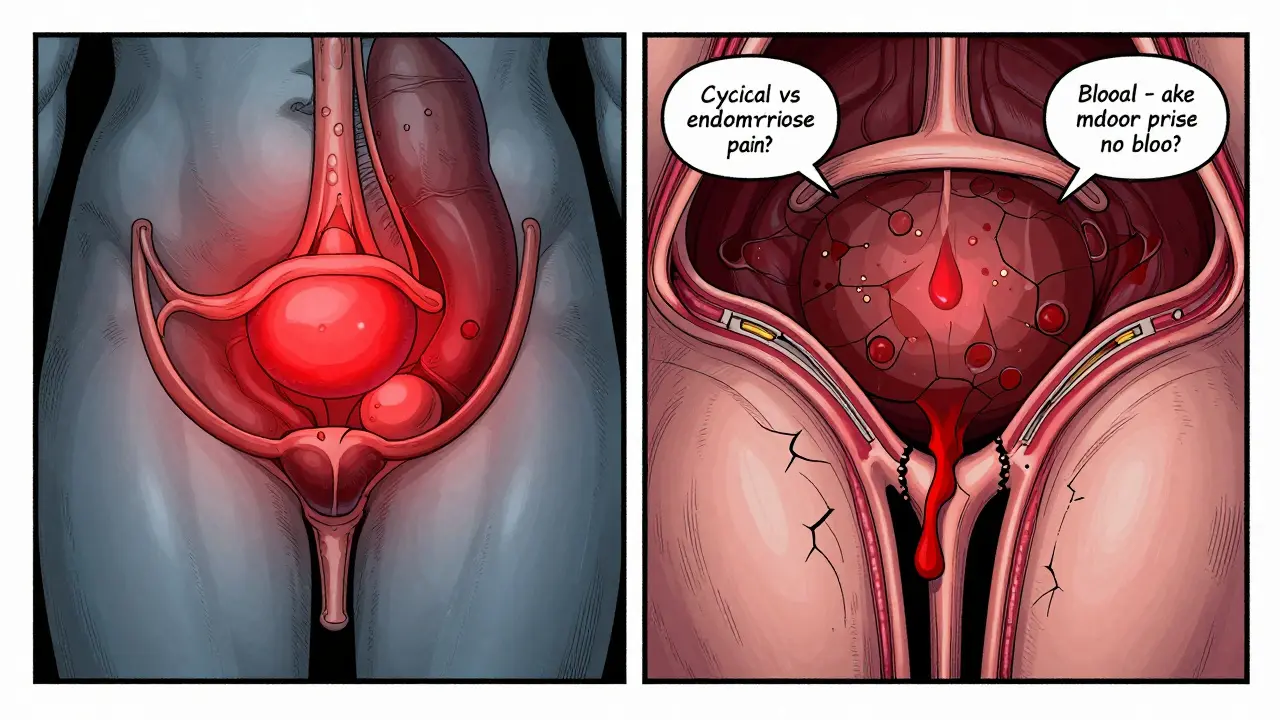
At first glance, they’re twins. But look closer, and the cracks appear.- Cyclical pain? Endometriosis flares hard around your period. Pain gets worse right before or during menstruation. For 92% of women, it’s tied to hormones. IC? Pain stays steady all month - though 45% do get worse around their period.
- Blood in urine? If you see red in your urine, especially around your period, it’s a red flag for endometriosis. Bladder endometriosis causes hematuria in 20-30% of cases. Pure IC? Blood is rare - under 5%.
- Bladder capacity? During a urodynamic test, a healthy bladder holds 400-600 mL. IC patients average 300-400 mL. Endometriosis patients? Their bladder can be full - but it hurts like crazy because of nerve involvement, not because the bladder is small.
- Response to treatment? If you take IC meds like Elmiron or do bladder instillations and still hurt? That’s a clue. Endometriosis doesn’t respond to those. It needs surgery - deep excision - to remove the lesions.
How They’re Diagnosed - And Why It Takes Years
Diagnosing endometriosis is invasive. The only way to confirm it? Laparoscopic surgery. A surgeon cuts into your abdomen, looks for lesions, and removes them. Then, a pathologist checks the tissue under a microscope. This isn’t optional. It’s the gold standard. And it costs between $5,000 and $15,000 in the U.S. Recovery takes 2-4 weeks. IC? No test confirms it. You get diagnosed by elimination. First, they rule out UTIs, yeast infections, bladder cancer, and STIs. Then they do a cystoscopy - a camera up the urethra. If they see Hunner’s lesions (ulcers on the bladder wall), it’s likely IC. But only 10-15% of IC patients have those. The rest? They do a Potassium Sensitivity Test (PST). It’s uncomfortable. It involves filling the bladder with potassium solution. If it burns worse than normal? You likely have IC. But the test has a 20% false negative rate. And here’s the kicker: the average woman waits 7-10 years for an endometriosis diagnosis. For IC? 3-5 years. Many are misdiagnosed with recurrent UTIs. One survey found 63% of IC patients were treated with antibiotics an average of 5 times before getting the right diagnosis.Why So Many Get It Wrong
Partly because doctors aren’t trained to look for both. A 2022 survey found only 25% of primary care doctors routinely check for pelvic floor dysfunction - a key part of both conditions. And only 15% of OB/GYNs in the U.S. are trained in deep excision surgery for endometriosis. There’s also bias. Women’s pain is still taken less seriously. A 2023 survey of 850 IC patients found 76% were told their pain was "all in their head." One Reddit user shared her 9-year journey: misdiagnosed with IC, treated for years with bladder meds, then finally had surgery - and they found stage IV endometriosis on her bladder wall. Her urinary symptoms dropped 80% after removal. Pelvic floor dysfunction is present in 92% of women with either condition. Tight, overactive pelvic muscles make both pain and urgency worse. But few doctors check for it.
What Works - And What Doesn’t
Treating just one condition often fails. If you have both, you need a two-pronged approach.- For endometriosis: Excision surgery is the only proven fix. Medications like birth control or GnRH agonists only mask symptoms. They don’t remove the disease.
- For IC: Diet changes (avoiding caffeine, alcohol, citrus, spicy foods), pelvic floor physical therapy, and bladder instillations can help. Elmiron (pentosan polysulfate) is approved but carries risks - 23% of long-term users develop retinal damage.
- For both: Pelvic floor physical therapy is essential. A skilled therapist can release tight muscles, reduce nerve sensitivity, and improve bladder control. Many women report dramatic improvement after 6-8 sessions.
What’s Changing - And Hope on the Horizon
In 2023, the International Pelvic Pain Society launched a new protocol: every woman with chronic pelvic pain gets evaluated by both a gynecologist and a urologist at the same time. No more passing the buck. The NIH just gave $4.2 million to the University of Michigan to find biomarkers - blood or urine tests - that can tell endometriosis apart from IC. That could cut diagnosis time from years to weeks. And the mindset is shifting. Experts like Dr. Hugh Taylor at Yale now say we’re moving away from seeing these as separate diseases. They’re part of one bigger picture: chronic pelvic pain syndromes. The future? Multidisciplinary clinics where gynecologists, urologists, physical therapists, and pain specialists work together.What to Do If You’re Still in Pain
If you’ve been told you have one condition but still hurt - here’s what to ask for:- Request a pelvic floor physical therapy evaluation. Don’t wait.
- Ask your OB/GYN if they do deep excision surgery. If not, ask for a referral to a specialist.
- Request a cystoscopy - even if you’ve been diagnosed with endometriosis. Bladder involvement is common.
- Keep a symptom diary. Track pain, urination, menstrual cycle, and triggers (food, stress, activity). This helps doctors spot patterns.
- Find a support group. The Endometriosis Foundation and Interstitial Cystitis Network have active communities. You’re not alone.
Can you have endometriosis and interstitial cystitis at the same time?
Yes - and it’s more common than most doctors realize. Studies show that 65% of women with chronic pelvic pain have both conditions. They share symptoms like pelvic pain, urinary urgency, and pain during sex. Treating one without checking for the other often leads to ongoing pain. A 2023 guideline now recommends evaluating for both simultaneously.
Is there a blood test for endometriosis or IC?
Not yet. Endometriosis still requires laparoscopic surgery and tissue biopsy to confirm. IC is diagnosed by ruling out other conditions and using tests like cystoscopy and the Potassium Sensitivity Test. However, researchers are actively working on biomarkers. In February 2024, the NIH awarded $4.2 million to the University of Michigan to develop a blood or urine test that can distinguish between the two.
Why does IC pain get worse during my period?
While IC pain is usually constant, about 45% of women report flare-ups around their period. This isn’t because IC is hormonal - it’s because endometriosis often coexists. Hormonal shifts can trigger inflammation in endometrial lesions on or near the bladder, making bladder symptoms feel worse. Many women who think their IC is flaring are actually experiencing endometriosis-related bladder involvement.
Can pelvic floor therapy help with both conditions?
Yes - and it’s critical. Pelvic floor dysfunction is present in 92% of women with either endometriosis or IC. Tight, overactive pelvic muscles can cause or worsen pain, urinary urgency, and sexual discomfort. Physical therapy that targets these muscles can reduce pain by 50-70% in many cases, even before surgery or other treatments. It’s one of the most underused but effective tools available.
How long does it take to get diagnosed?
On average, women wait 7-10 years for an endometriosis diagnosis and 3-5 years for IC. Many are misdiagnosed with UTIs, IBS, or stress. The delay happens because symptoms overlap, doctors aren’t trained to look for both, and invasive tests are required. But new guidelines and increased awareness are starting to shorten this timeline.


phyllis bourassa on 7 March 2026, AT 02:47 AM
Oh honey, I’ve been here. Seven years. Seven. Years. Told I had IBS, then UTIs, then "anxiety." Then they called me a hypochondriac. I laughed until I cried - literally, because my bladder felt like it was on fire. Turns out? Endo on my bladder AND IC. They don’t even teach this in med school. I had to Google my way out of hell. Now I’m on pelvic floor PT, no caffeine, and I cry happy tears when I can sit through a movie without running to the bathroom. You’re not broken. You’re just undiagnosed. And you’re not alone. 💔➡️💖