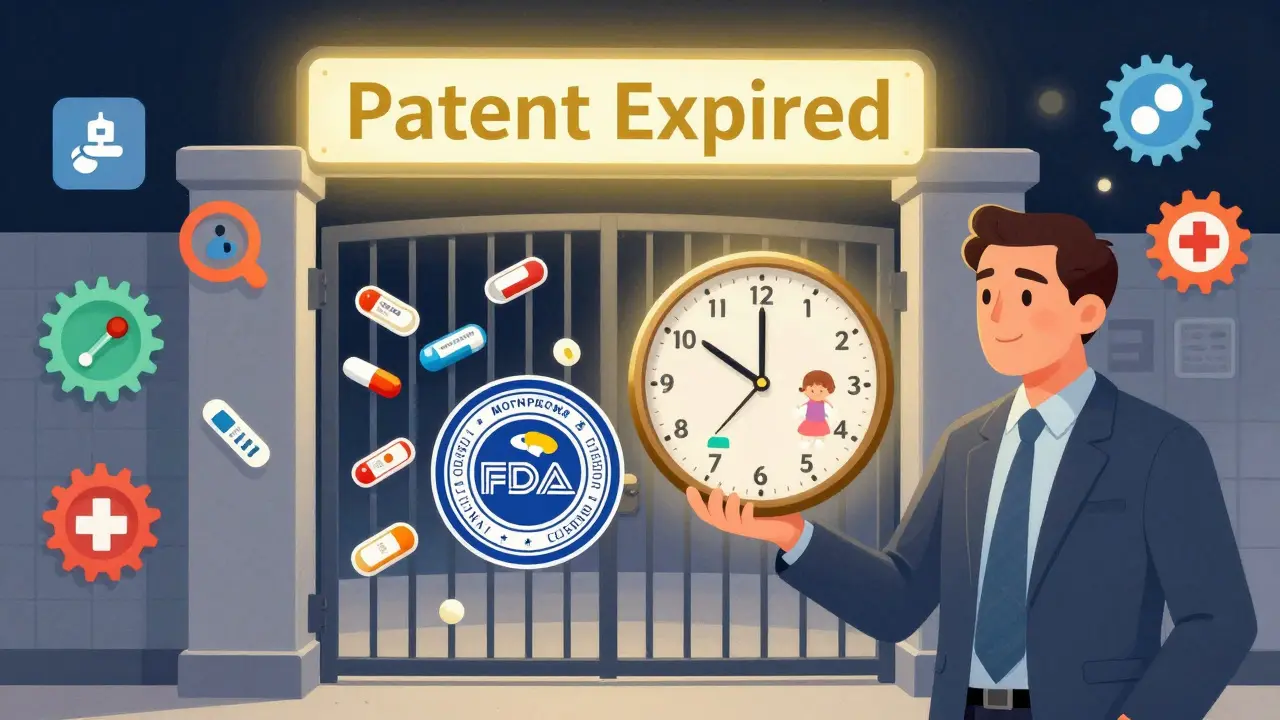
When a drug company gets approval for a new medicine, it doesn’t just get a patent-it gets a clock. But that clock doesn’t tick alone. The FDA has a hidden lever that can stretch that timeline by six months, even after the patent expires. This isn’t a loophole. It’s a rule written into law, and it’s called pediatric exclusivity.
Most people think patent protection means the drug company owns the rights to sell the medicine for a set number of years-usually 20. But that’s only half the story. The real power comes from something the FDA controls: the ability to block generic versions from entering the market. Pediatric exclusivity doesn’t change the patent. It changes how the FDA enforces it.
How Pediatric Exclusivity Works
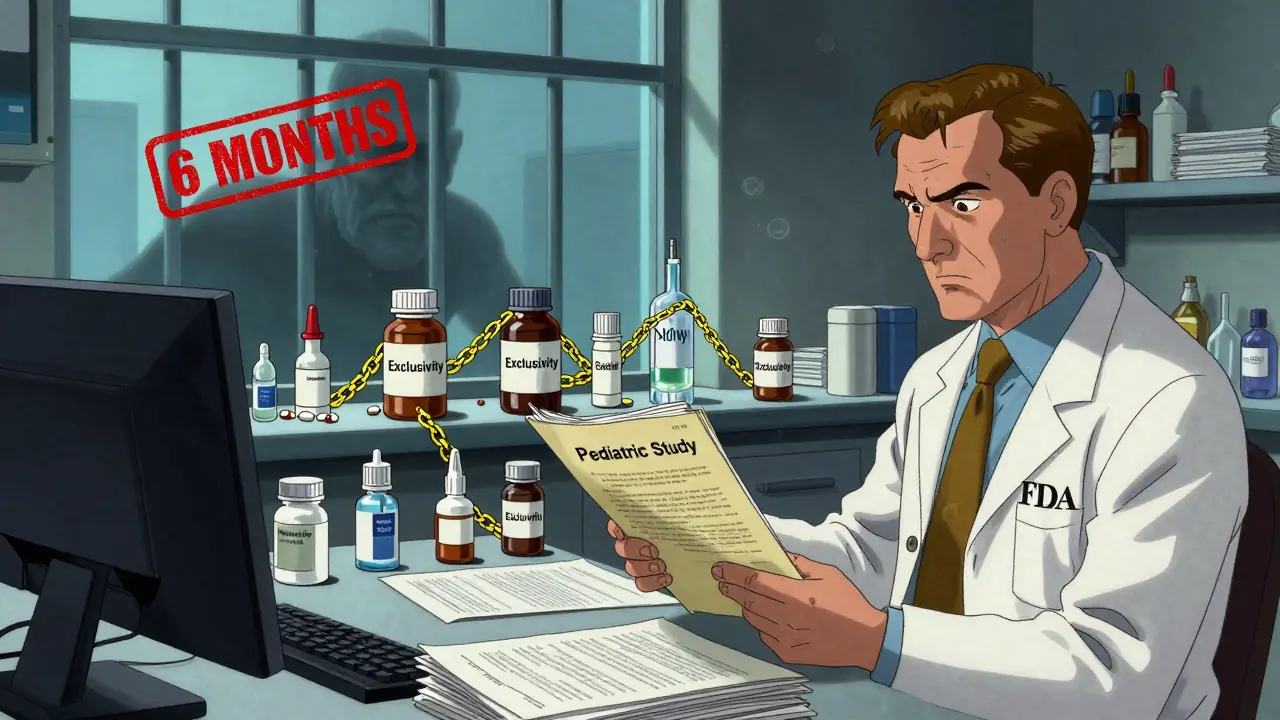
Under Section 505A of the Federal Food, Drug, and Cosmetic Act, the FDA can offer a six-month extension to any existing exclusivity period-if a drug company studies the medicine in children. It sounds simple. But the mechanics are complex.
The process starts with a Written Request from the FDA. This isn’t a suggestion. It’s a formal ask: "Here’s what we need you to study in kids-dosing, safety, how it behaves in their bodies." The company then has to actually do the studies. Not just collect data. Not just submit paperwork. The studies must meet FDA standards. Then, the agency has 180 days to review whether the work was done right.
Here’s the kicker: you don’t need to change the drug’s label. You don’t even need to get final approval for a new use. Just submit the studies, and if they pass muster, the six-month clock starts ticking. That’s it.
It’s Not a Patent Extension-It’s a Regulatory Block
Many assume pediatric exclusivity extends the patent. It doesn’t. Patents are legal rights granted by the U.S. Patent and Trademark Office. Pediatric exclusivity is a regulatory tool controlled by the FDA.
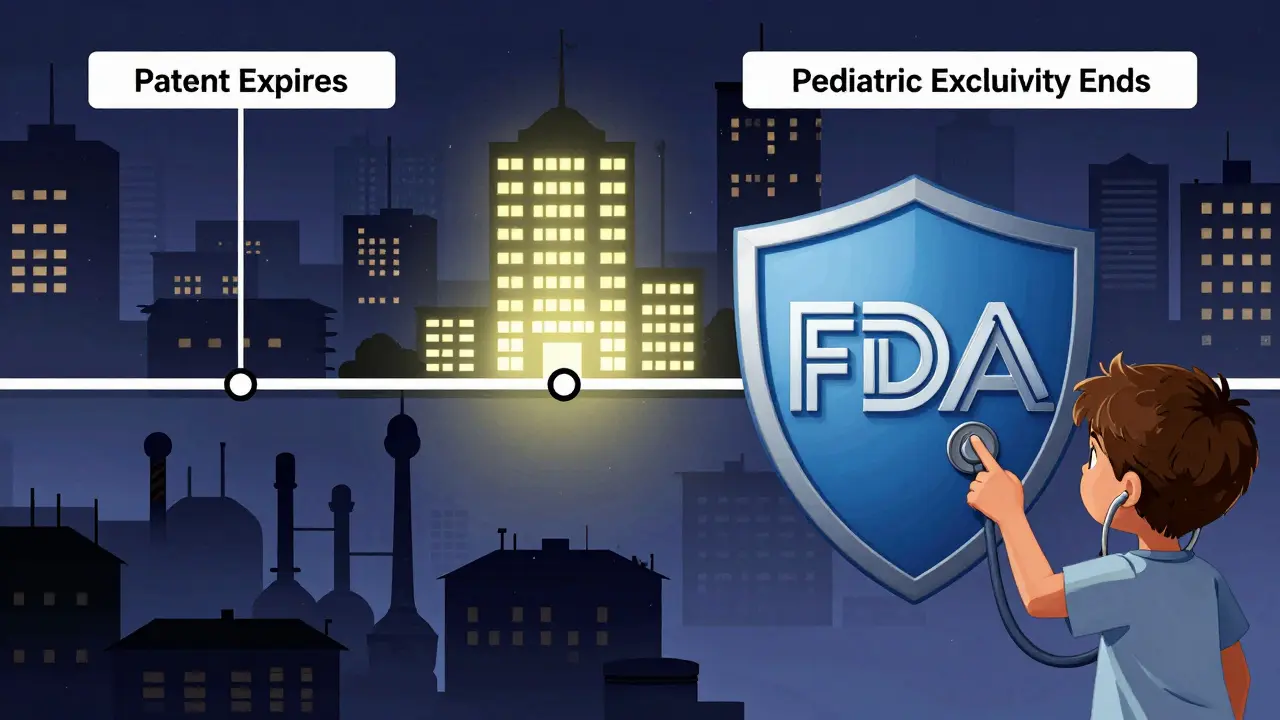
Think of it this way: if a drug has a patent that expires in 2027, and the company earns pediatric exclusivity, the FDA won’t approve any generic version until 2027 plus six months-even if the patent is gone. That’s because pediatric exclusivity overrides the usual rules for generic drug approval.
Generic manufacturers file applications called ANDAs (Abbreviated New Drug Applications). These usually rely on proving the drug is the same as the brand-name version. But if pediatric exclusivity is active, the FDA can’t approve those applications until the six months are up. Even if the generic says, "The patent expired," the FDA still says no-unless one of four exceptions applies:
- The brand company gives a waiver
- A court rules the patent is invalid
- The generic wins a patent lawsuit
- The brand company didn’t sue within 45 days of the generic’s filing
This makes pediatric exclusivity one of the most powerful tools in pharma. It’s not about owning the patent. It’s about controlling when the FDA lets competitors in.
Who Gets It-and Who Doesn’t
Not every drug qualifies. Pediatric exclusivity only attaches if the drug already has some form of market protection. That means:
- Five-year exclusivity for a new chemical entity (NCE)
- Three-year exclusivity for new clinical studies
- Orphan drug exclusivity
- An active patent listed in the Orange Book
And here’s the catch: the underlying protection must have at least nine months left when pediatric exclusivity is granted. If your patent expires in eight months, you’re out of luck. The FDA won’t extend it.
But there’s one exception. If a company applies to expand a drug’s use to children-and that application requires new clinical data-the FDA can grant pediatric exclusivity even if no patent or exclusivity remains. That’s rare, but it happens. For example, a 30-year-old drug with expired patents could still get six extra months if a new pediatric indication requires fresh studies.
And it applies to everything. If a company studies a drug in children, the six-month extension covers all formulations-oral pills, injections, creams, eye drops-of that same active ingredient. It doesn’t matter if the child study was done on one form. All versions get the extension.
Why It Matters So Much
For blockbuster drugs, six months can mean hundreds of millions in revenue. Take a drug that brings in $2 billion a year. Six months of exclusivity? That’s $1 billion in extra sales. No generics. No price drops. No competition.
That’s why companies chase pediatric exclusivity like it’s gold. Some even design their clinical programs around it. They’ll delay adult studies or delay patent filings just to time it right with a pediatric request.
But it’s not just about money. The original goal was to fix a real problem: kids were getting medicines without proper dosing info. Doctors guessed. Parents worried. Kids got sick. Pediatric exclusivity forced companies to study kids-not because it was nice, but because it was profitable. And it worked. Today, over 80% of new drugs have pediatric labeling. That’s a direct result of this rule.
What It Doesn’t Cover
Pediatric exclusivity is powerful-but it’s not universal.
It doesn’t apply to biologics. That’s because biologics (like insulin, vaccines, monoclonal antibodies) are regulated under a different law-the Biologics Price Competition and Innovation Act (BPCIA). Unlike small-molecule drugs, biologics don’t have patent linkage. So even if a biologic company does pediatric studies, they don’t get the six-month exclusivity boost.
It also doesn’t protect against court decisions. If a generic wins a patent lawsuit, the FDA must approve their product-even if pediatric exclusivity is still active. That’s been upheld in court cases like Apotex v. FDA. Congress made it clear: if the patent is legally invalid, exclusivity can’t block approval.
And it doesn’t work retroactively. If a company forgets to respond to a Written Request, or submits incomplete data, they lose the chance. No second chances. No do-overs.
The Real Impact
Pediatric exclusivity isn’t just a legal trick. It’s a system that changed how medicine is made for children.
Before 1997, fewer than 20% of drugs approved for adults had any pediatric data. Today, it’s over 80%. That shift didn’t happen because doctors asked nicely. It happened because the FDA gave companies a financial reason to study kids.
And it’s still active. In 2023 alone, the FDA issued over 40 Written Requests for pediatric studies. Companies responded with hundreds of studies. Every one of them could mean six more months of exclusivity.
For generic makers, it’s a minefield. They have to track not just patent expirations, but exclusivity dates too. One missed date, one wrong certification, and their entire launch plan falls apart.
For brand companies, it’s a lifeline. A six-month extension can mean the difference between a profitable product and a fading one. It’s why some companies file for pediatric exclusivity even on drugs that are already near the end of their patent life.
What’s Next?
The system isn’t perfect. Critics say it’s too easy to game. Some companies do minimal studies just to lock in exclusivity. Others argue the FDA should require more meaningful data.
But for now, it works. It’s predictable. It’s enforceable. And it’s still the most powerful tool in the FDA’s toolkit for extending market protection without changing a single patent.
If you’re in pharma, you don’t just track patents. You track Written Requests. You track study submissions. You track FDA review timelines. Because in this game, six months isn’t just time. It’s value.
Does pediatric exclusivity extend the actual patent term?
No. Pediatric exclusivity does not extend the patent term itself. Patents are granted by the U.S. Patent and Trademark Office and have fixed expiration dates. Pediatric exclusivity is a separate regulatory mechanism controlled by the FDA. It prevents the FDA from approving generic versions for six months after the original exclusivity or patent expires, creating a de facto market barrier even after the patent is gone.
Can a drug get pediatric exclusivity if it has no patents left?
Yes-but only under specific conditions. If a company submits a supplemental application to extend a drug’s use to children and the FDA requires new clinical studies to approve that expansion, pediatric exclusivity can be granted even if the original patent and other exclusivities have expired. This is rare and only applies if the new pediatric indication itself qualifies for a new exclusivity period under the Hatch-Waxman Act.
Does pediatric exclusivity apply to biologics?
No. Pediatric exclusivity only applies to small-molecule drugs regulated under the Hatch-Waxman Act. Biologics, such as vaccines, insulin, and monoclonal antibodies, are governed by the Biologics Price Competition and Innovation Act (BPCIA), which does not include a pediatric exclusivity provision. Even if a biologic company conducts pediatric studies, they do not receive the six-month market protection.
How does pediatric exclusivity affect generic drug approvals?
The FDA cannot approve generic drug applications (ANDAs) during the six-month pediatric exclusivity period unless one of four conditions is met: (1) the brand company grants a waiver, (2) a court rules the patent invalid or not infringed, (3) the generic won a patent lawsuit, or (4) the brand company failed to sue within 45 days of the generic’s filing. Without one of these, the generic must wait until exclusivity expires.
Does pediatric exclusivity apply to all dosage forms of a drug?
Yes. If a company conducts pediatric studies on one formulation-say, an oral tablet-the six-month exclusivity extends to all dosage forms containing the same active ingredient, including injections, creams, eye drops, and suspensions. The FDA treats the active moiety as the key unit, not the specific product form.
Can pediatric exclusivity be granted more than once for the same drug?
No. A drug can only receive one six-month pediatric exclusivity period, regardless of how many studies are done. Even if a company conducts multiple pediatric studies across different indications, the FDA grants only one six-month extension. The clock starts once the first qualifying study is accepted.
What happens if the patent expires before pediatric exclusivity ends?
The FDA converts any Paragraph III or IV patent certifications (where the generic challenges or waits for the patent) to Paragraph II, meaning the patent is treated as expired. But pediatric exclusivity still blocks generic approval until the six months are over. The FDA can legally prevent approval even if the patent is gone, as long as the exclusivity period is active. This has been upheld in court.
How long does the FDA take to review pediatric study submissions?
The FDA has 180 days from the date a complete pediatric study report is submitted to determine whether the studies meet the requirements of the Written Request. If they do, pediatric exclusivity is granted. If not, the company may be given a chance to fix the submission-but only once. After that, the opportunity is lost.
Is pediatric exclusivity automatic after submitting studies?
No. It’s not automatic. The company must submit the studies in the exact format required by the FDA. The FDA then reviews them for compliance with the Written Request. Only after the agency confirms the studies were conducted properly and reported correctly does pediatric exclusivity get granted. There’s no guarantee-only a process.
Can pediatric exclusivity be combined with other types of exclusivity?
Yes. Pediatric exclusivity can stack on top of other exclusivities like five-year NCE exclusivity, three-year clinical exclusivity, or orphan drug exclusivity. The six-month extension applies to the longest remaining exclusivity period. For example, if a drug has three years of exclusivity left and earns pediatric exclusivity, the total protection becomes three years and six months. The FDA treats it as an add-on, not a replacement.


Manish Singh on 17 March 2026, AT 10:36 AM
Man, I never realized how much of a game this is. I work in pharma logistics in India, and we’ve seen generics get held up for months over this. It’s not just about money - it’s about access. In rural areas, parents wait months for affordable meds, and this rule delays it. But I also get why it exists. Kids need proper dosing. Just wish the system wasn’t so exploitable.