If you're constantly tired, losing muscle, struggling to stay hard, or just feel like your old self is slipping away-you're not imagining it. For millions of men, especially as they hit their 40s and beyond, this isn't just aging. It's male hypogonadism: a real, measurable drop in testosterone that affects how your body functions, feels, and performs. And while it’s often dismissed as "just getting older," it’s not. It’s a medical condition with clear signs, clear causes, and real treatment options.
What Exactly Is Male Hypogonadism?
Male hypogonadism means your testes aren’t making enough testosterone. Simple as that. But here’s the catch: it’s not one problem. There are two types, and they need different approaches.
Primary hypogonadism means the testes themselves are broken. This can happen because of genetic issues like Klinefelter syndrome, past mumps infection that damaged the testicles, or too much iron in the blood from hemochromatosis. In these cases, your brain is screaming at your testes to make more testosterone-but they’re not listening. So your LH and FSH hormone levels go up.
Secondary hypogonadism is more common-making up 85-90% of cases. Here, the problem isn’t the testes. It’s the brain. The hypothalamus or pituitary gland isn’t sending the right signals. This is often tied to obesity, chronic stress, opioid use, or even a small pituitary tumor. Your LH and FSH levels stay low because the message never gets sent.
How Do You Know If You Have Low Testosterone?
Symptoms aren’t always obvious, but if you’re experiencing three or more of these, it’s time to get tested:
- Reduced sex drive-your interest in sex drops noticeably
- Fewer or no morning erections
- Difficulty getting or keeping an erection
- Loss of muscle mass-even if you’re lifting the same weights
- Increased body fat, especially around the belly
- Feeling drained all the time, even after a full night’s sleep
- Mood changes: irritability, depression, lack of motivation
- Reduced bone density-you’re at higher risk for fractures
- Anemia: low red blood cell count causing fatigue and shortness of breath
Here’s the thing: not every tired guy has low T. But if you’re under 50 and experiencing these symptoms, especially with a BMI over 30, you should get checked. A 2023 study found that 78% of men with confirmed low testosterone reported fewer spontaneous erections. That’s not normal aging. That’s a biological signal.
How Doctors Diagnose It
You can’t just walk in and say, "I think I have low T." Doctors need proof. And it’s not as simple as one blood test.
First, your testosterone level must be measured in the morning-between 8 a.m. and 11 a.m. That’s when levels peak. Testing later in the day can give false lows.
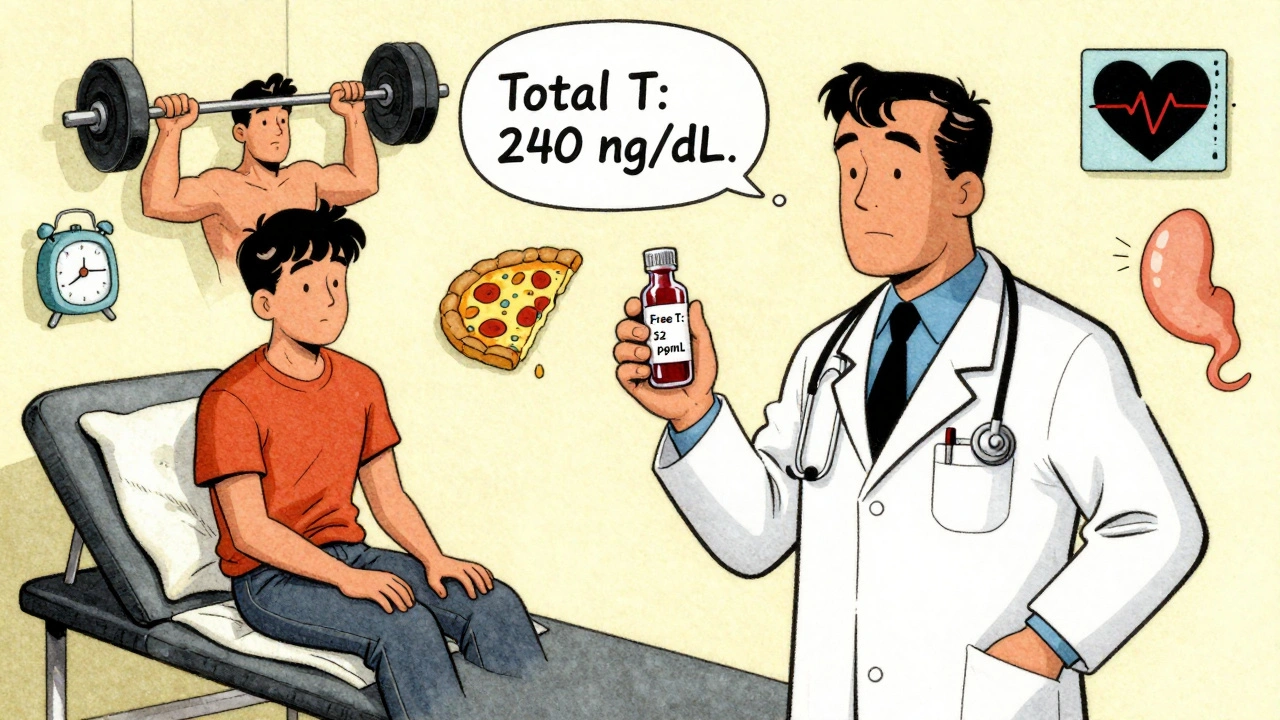
Second, you need two separate tests showing levels below 300 ng/dL. The American Urological Association says this is the threshold for diagnosis. But here’s what most people don’t know: many men with levels between 250-350 ng/dL still feel fine. That’s why doctors also check free testosterone-the active part your body actually uses. If your free testosterone is below 65 pg/mL, treatment is often recommended even if total testosterone is borderline.
Third, you’ll get tested for LH, FSH, prolactin, and hematocrit. These help figure out if it’s primary or secondary hypogonadism. And if your hematocrit is above 50%, that’s a red flag-your blood is getting too thick, which raises heart risks.
And don’t trust a standard blood test. Many labs use immunoassays, which can be 15-20% inaccurate. The gold standard is mass spectrometry. Ask your doctor which method they use.
What Happens If You Don’t Treat It?
Left alone, low testosterone doesn’t just make you feel crummy-it changes your body long-term.
Over time, you lose 20-30% of your lean muscle mass. Your body fat percentage climbs by 10-15%. Your bones weaken. Studies show that 33% of men with untreated hypogonadism develop osteoporosis. That means a simple fall could break a hip or spine.
Your heart health is also at risk. Low testosterone is linked to higher triglycerides, insulin resistance, and inflammation-all of which drive heart disease. And here’s the irony: many men with low T are overweight, sedentary, and diabetic. Treating the low T doesn’t fix those problems-but it can help you get back to the energy you need to fix them.
Testosterone Therapy: What Works and What Doesn’t
If you’re diagnosed and symptomatic, testosterone replacement therapy (TRT) is the standard treatment. But not all TRT is the same.
Testosterone gels (like Androgel or Testim) are applied daily to clean, dry skin-shoulders, arms, or abdomen. They’re convenient, but you have to avoid skin-to-skin contact for hours after application. There have been cases where women or kids got exposed to the gel and developed symptoms. About 1.5% of household contacts report this.
Injections (testosterone cypionate or enanthate) are given every 2-4 weeks. They’re cheap-$30 to $50 a month-and effective. But your levels spike right after the shot, then drop before the next one. That rollercoaster can cause mood swings, acne, or irritability.
Subcutaneous pellets are tiny rods inserted under the skin every 3-6 months. They release steady hormone levels and require no daily effort. But they cost $500-$1,000 per insertion and need a minor procedure.
Oral testosterone (Jatenzo) is new. Approved in 2023, it’s the first pill that actually works. You take it with a high-fat meal, and it’s absorbed efficiently. No skin transfer risk. No needles. But it’s expensive and can stress the liver.
And then there’s the elephant in the room: safety.
The FDA added a black box warning in 2015 after studies showed a 30% spike in heart attacks in men over 65 during the first 90 days of TRT. But newer research, like the 2022 Testosterone Trials, shows no increased risk in healthy men. In fact, men who respond well to TRT have a 30% lower death rate over time. The key? Proper screening. If you have untreated heart disease, prostate cancer, or polycythemia (too many red blood cells), TRT is dangerous.
Who Shouldn’t Get TRT?
Not everyone should take testosterone. Here are the red flags:
- Prostate cancer (current or past)
- Untreated severe heart failure
- Hematocrit above 50%
- Severe sleep apnea
- Uncontrolled high blood pressure
Also, if your symptoms are vague-just "feeling down"-and your testosterone is barely below 300 ng/dL, TRT probably won’t help. A 2023 Endocrine Society study found that 30% of men who got TRT with borderline levels saw no improvement. Their real issue was sleep apnea, depression, or thyroid problems.
Can You Fix Low T Without Pills or Shots?
Yes. Especially if your low T is caused by weight gain.
Obesity is the #1 reversible cause of secondary hypogonadism. A 2023 Mayo Clinic study showed that men who lost 10% of their body weight saw testosterone levels rise by 30-50%. That’s like getting a free TRT without the cost or side effects.
How? Combine strength training (3x a week) with a diet low in sugar and processed carbs. Even 30 minutes of walking daily helps. One man in Bristol, 56, lost 42 pounds over 8 months. His testosterone jumped from 240 to 580 ng/dL. He stopped TRT. He didn’t need it anymore.
But if your low T is genetic-like Klinefelter syndrome-you’ll need lifelong therapy. Weight loss won’t fix it. That’s not your fault. It’s biology.
What to Expect After Starting Treatment
Most men notice changes in stages:
- Weeks 1-2: Energy improves. You stop napping after lunch.
- Weeks 3-6: Morning erections return. Libido picks up.
- Months 2-4: Muscle starts coming back. Fat starts melting. Mood stabilizes.
- Months 6-12: Bone density improves. Blood counts normalize. You feel like yourself again.
But it’s not magic. You still have to lift weights. You still have to sleep well. You still have to eat clean. TRT gives you the energy and drive to do it-but it doesn’t do the work for you.
And side effects? They’re real. About 35% of men get acne. 15% develop polycythemia and need blood drawn. 25% see testicular shrinkage. That’s normal with TRT-your body stops making its own testosterone. It’s not dangerous, but it’s permanent unless you stop.
The Bottom Line
Low testosterone isn’t a lifestyle problem. It’s a medical one. And it’s treatable.
If you’re tired, losing muscle, and losing interest in sex-don’t just accept it. Get tested. Two morning blood tests. Mass spectrometry. LH and FSH. Hematocrit.
If your levels are truly low and you have symptoms, TRT can change your life. But it’s not for everyone. It’s not a quick fix. And it’s not a fountain of youth.
For men with obesity-related low T, weight loss can reverse it. For men with genetic or permanent causes, TRT is a lifeline. The goal isn’t to hit a number on a lab report. It’s to feel strong, awake, and alive again.
And if you’re reading this and thinking, "I’ve been ignoring this for years"-you’re not alone. But you’re also not too late.
Can low testosterone cause depression?
Yes. Low testosterone is strongly linked to low mood, lack of motivation, and even clinical depression in men. Studies show that men with testosterone levels below 300 ng/dL are twice as likely to report depressive symptoms compared to men with normal levels. TRT often improves mood, but it’s not a substitute for therapy or antidepressants if depression is severe.
Does TRT make you grow more body hair?
It can. Testosterone stimulates hair follicles, so you may notice thicker facial or body hair after starting treatment. This is normal and expected. But if you’re genetically predisposed to male pattern baldness, TRT may speed up hair loss on the scalp. That’s why doctors check your family history before starting therapy.
How long do you need to stay on testosterone therapy?
For most men with permanent causes-like Klinefelter syndrome, surgical removal of testes, or pituitary damage-TRT is lifelong. For men whose low T is caused by obesity, poor sleep, or stress, treatment may be temporary. Many men who lose 10% of their body weight can stop TRT and maintain normal levels. But stopping without addressing the root cause often leads to a return of symptoms.
Is TRT safe for men over 65?
It can be, but only with strict monitoring. The FDA warns of increased heart attack risk in men over 65 during the first 90 days. That’s why doctors check heart health, blood pressure, and hematocrit before starting. The TRAVERSE trial (2025) is studying 5,000 older men to determine long-term safety. For now, TRT in older men should be cautious, slow, and closely monitored.
Can I get TRT without a prescription?
No. Testosterone is a controlled substance. Any clinic offering "bio-identical" or "over-the-counter" testosterone without blood tests and a doctor’s evaluation is breaking the law. Online sellers often sell fake or contaminated products. Don’t risk your health. Get tested properly through a licensed provider.
Will TRT affect my fertility?
Yes. TRT shuts down your body’s natural sperm production. If you want to have children in the future, TRT is not the right choice. Instead, doctors may prescribe clomiphene or hCG to stimulate your own testosterone and sperm production. If fertility is a goal, talk to a reproductive endocrinologist before starting any treatment.


Rudy Van den Boogaert on 4 December 2025, AT 19:34 PM
Been dealing with this for years. Started noticing the fatigue around 42, thought it was just stress. Got tested after my wife said I hadn't touched her in months. Turned out my T was at 210. Started injections and within 6 weeks I was lifting again and actually wanted to go out. Not magic, but it's like someone turned the volume back up on my life.