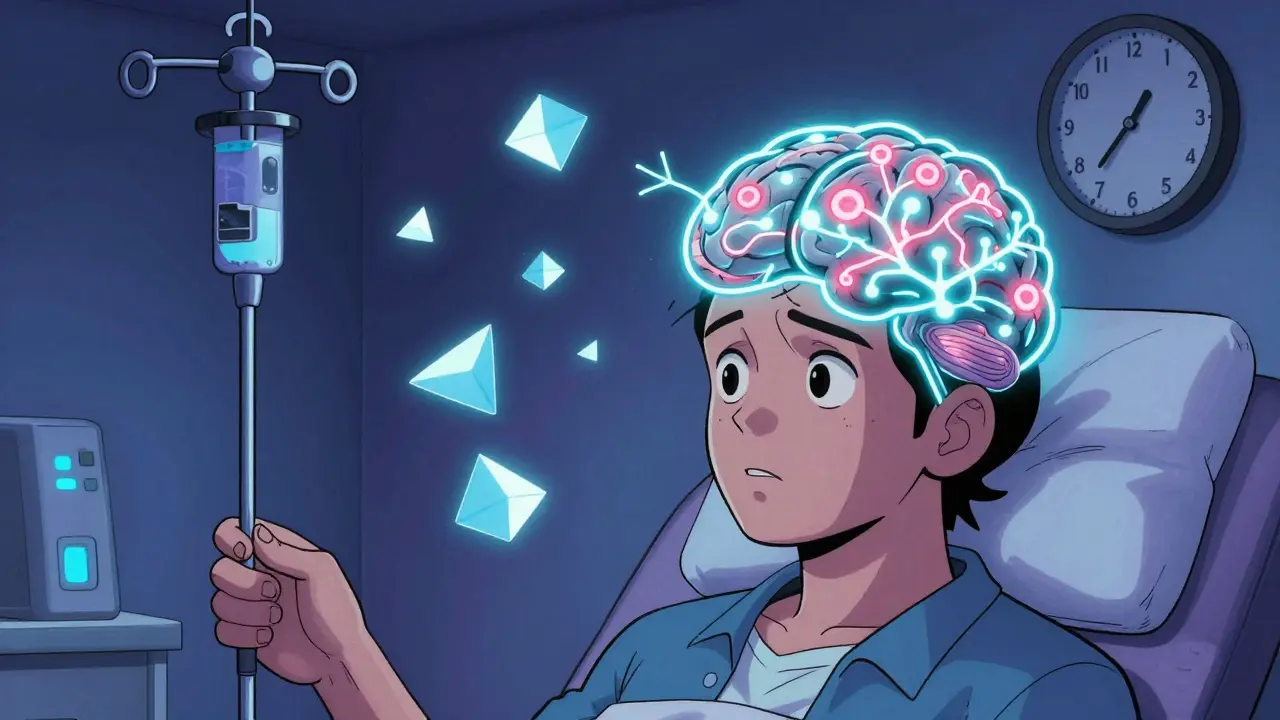
When standard antidepressants fail, people with treatment-resistant depression (TRD) often face months-or years-of debilitating symptoms. For many, hope comes from two powerful but very different tools: ketamine and esketamine. Both work fast, often lifting mood within hours, not weeks. But they’re not the same. One is an old anesthetic used off-label. The other is a branded nasal spray approved by the FDA. Choosing between them isn’t just about effectiveness-it’s about safety, cost, access, and personal tolerance for side effects.
How Ketamine and Esketamine Actually Work
Traditional antidepressants like SSRIs target serotonin, dopamine, or norepinephrine. Ketamine and esketamine work differently. They block NMDA receptors in the brain, which triggers a cascade of changes in neural connections. This isn’t just chemical tweaking-it’s brain remodeling. Within hours, new synapses form, especially in areas linked to mood regulation and stress response. That’s why people feel better so quickly.
Ketamine is a racemic mixture: it contains both (R)- and (S)-enantiomers. Esketamine is just the (S)-enantiomer. That small chemical difference changes everything. The (R)-form seems to play a bigger role in antidepressant effects, while the (S)-form drives dissociation and side effects. That’s why IV ketamine often works better-but also hits harder.
Effectiveness: Which One Works Faster and Better?
A 2025 study from Mass General Brigham followed 153 patients with TRD. 111 got IV ketamine. 42 got intranasal esketamine. The results were clear: ketamine won.
- IV ketamine reduced depression scores by 49.22% after a full course.
- Esketamine dropped scores by 39.55%.
Speed mattered too. With ketamine, patients felt relief after the very first infusion. Esketamine users needed at least two doses before seeing meaningful improvement. This matches earlier meta-analyses showing IV ketamine outperforms nasal esketamine across all time points-from 24 hours to eight weeks.
Real-world data backs this up. On PatientsLikeMe, 63.2% of IV ketamine users reported major relief within 24 hours. For esketamine, it was 51.7%. That gap isn’t small-it’s life-changing for someone in crisis.
Side Effects: Tolerating the Dissociation
Both drugs cause dissociation: feeling detached from your body or surroundings. But the intensity differs.
- 42.3% of IV ketamine users reported dissociation.
- Only 28.7% of esketamine users did.
That’s not just a number. For some, dissociation feels like a dreamy float. For others, it’s terrifying-like being trapped in a nightmare while awake. Hallucinations, dizziness, nausea, and high blood pressure are common with both, but worse with IV ketamine.
That’s why esketamine has an advantage: it’s more predictable. The nasal spray delivers a controlled dose. IV ketamine? It’s a full infusion-sometimes over 40 minutes. Your body absorbs it differently. That’s why dissociation is more common and intense.
Still, 78.4% of esketamine users rated their overall experience as “good” or “excellent.” Only 62.9% of IV ketamine users did. Why? Because the nasal spray is easier. No needles. No IV line. No hospital gown.
Administration: Clinic vs. Office
IV ketamine requires a vein, a monitor, a trained anesthesiologist, and a full clinical setting. The American Society of Anesthesiologists says providers need advanced airway management skills. That means fewer places can offer it.
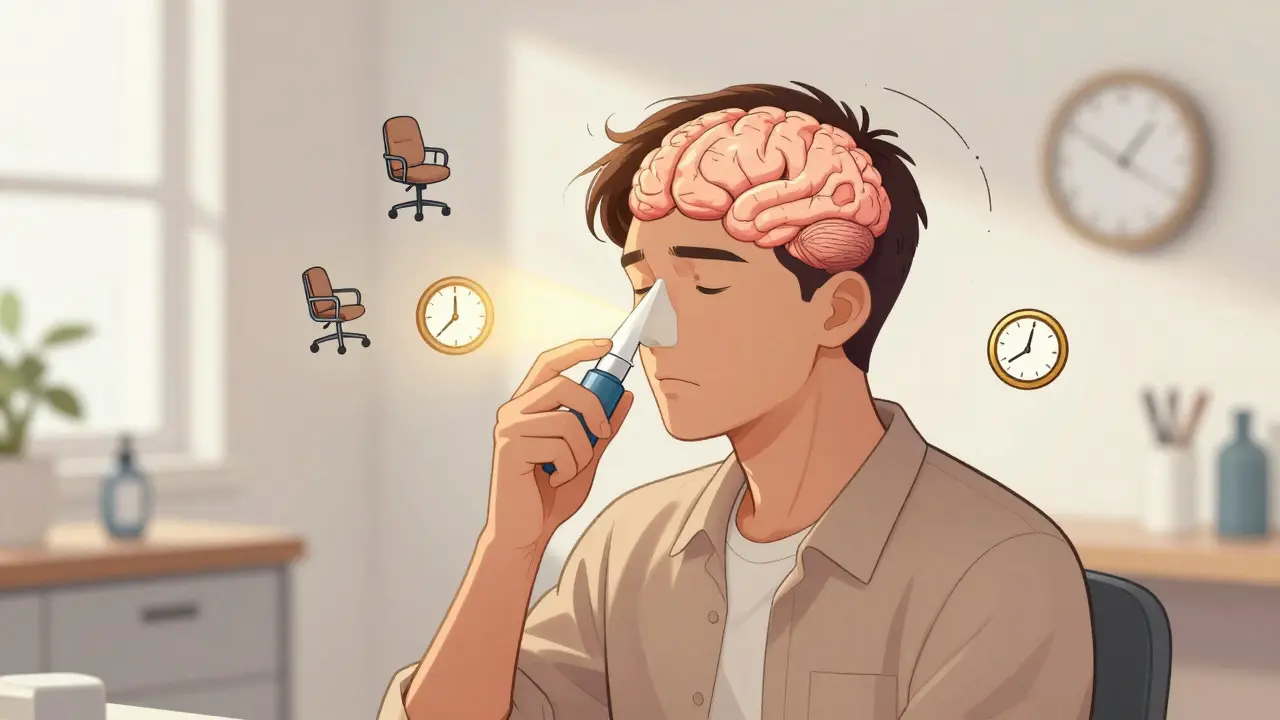
Esketamine (Spravato®) can be given in a psychiatrist’s office. Staff just need basic life support certification. You sit in a chair, spray it up your nose, and wait 2 hours under observation. No IV. No sedation. Just a nasal spray and a chair.
But here’s the catch: both require mandatory 2-hour monitoring after each dose. You can’t drive home. You need someone to pick you up. This makes regular treatment logistically tough.
Cost and Insurance: What You’ll Actually Pay
Cost is a huge barrier. A full course of 8 IV ketamine infusions costs $4,200-$5,600. A comparable esketamine course? $5,800-$6,900.
But insurance? That’s where it gets messy.
- 67.4% of commercial insurers cover Spravato®.
- Only 38.2% cover IV ketamine.
Why? Esketamine is FDA-approved for depression. Ketamine isn’t. Even though it’s been used safely for decades, insurers treat it as “off-label.” That means patients often pay out-of-pocket.
Here’s the twist: IV ketamine is more cost-effective. A 2025 JAMA Psychiatry analysis found it saves $14,327 per quality-adjusted life year (QALY). Esketamine? $18,764. So even though it’s pricier upfront, ketamine gives you more bang for your buck-if you can get it.
Who Gets Which Treatment?
Experts don’t agree on one-size-fits-all. Dr. John Krystal at Yale says IV ketamine is best for life-threatening depression. If someone’s suicidal and needs relief now, ketamine’s speed and power make it the top pick.
Dr. Christine Denny at Columbia argues esketamine is better for maintenance. It’s less intense. Easier to fit into life. Better for long-term use. Especially if you’re already on an oral antidepressant.
For someone with severe anxiety, trauma history, or fear of needles? Esketamine’s nasal route is less triggering. For someone with no history of substance use and urgent need? IV ketamine’s higher efficacy may be worth the risk.
Access: The Hidden Barrier
Only 12.4% of U.S. counties have certified Spravato® centers. Even fewer offer IV ketamine. In rural areas, you might drive 3 hours just for one session. That’s why so many people give up.
Meanwhile, ketamine clinics have exploded-from 142 in 2020 to over 1,000 in 2025. But not all are equal. Some are wellness spas with little medical oversight. Others are fully integrated psychiatric clinics with follow-up care. Choosing the wrong one can be dangerous.
And there’s another problem: insurance doesn’t always cover travel. You’re on your own for gas, time off work, childcare.
Long-Term Use and Future Options
Neither treatment is a cure. Both require maintenance. After the initial 4-6 sessions, most people need booster doses every 1-3 weeks.
At 6 months, 56.3% of IV ketamine responders stayed in remission. For esketamine, it was 48.7%. That gap matters. The more durable the effect, the fewer sessions you need.
New options are coming. In September 2025, the FDA accepted a higher-dose (112 mg) version of Spravato®. And phase 3 trials are testing intramuscular ketamine-a middle ground between IV and nasal. It could be faster than spray, less invasive than IV.
Brain scans are helping too. EEG studies now show that people who respond to ketamine have increased gamma wave activity in frontoparietal brain regions. That might one day let doctors predict who’ll benefit before treatment even starts.
Final Thoughts: It’s Not About One Being Better
Ketamine and esketamine aren’t rivals. They’re tools for different people.
If you need the fastest, strongest relief-and you can access a high-quality clinic-IV ketamine is likely your best shot.
If you’re looking for something easier to stick with, with fewer scary side effects, and your insurance covers it-esketamine makes sense.
Neither works for everyone. Some people don’t respond at all. Others feel better for a few weeks, then plateau. But for those stuck for years with no options? These drugs are changing lives. Not perfectly. Not without risk. But in ways we never thought possible a decade ago.


Megan Nayak on 3 March 2026, AT 21:13 PM
I'm sorry but this whole article feels like a pharmaceutical marketing brochure dressed up as science. Ketamine's been used for decades in ERs and battlefields-why is it suddenly this magical cure? And esketamine? A branded nasal spray that costs more than a used car. Someone's making bank here while people are still waiting for insurance approval. The real story isn't efficacy-it's who gets to profit.