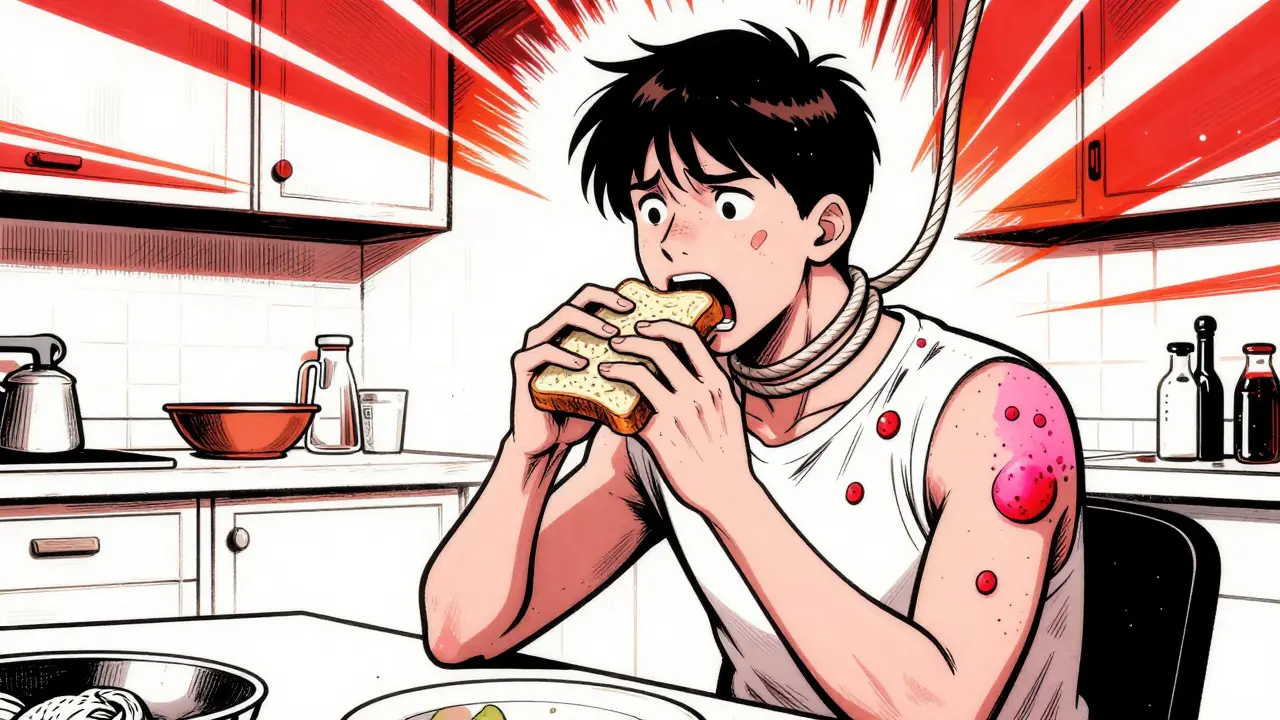
Imagine eating a sandwich and within minutes, your throat tightens, your skin breaks out in hives, and you struggle to breathe. This isn't just an upset stomach; it is a life-threatening immune response known as IgE-mediated food allergy, which triggers rapid inflammatory reactions that can range from mild symptoms to life-threatening anaphylaxis. For millions of people, this scenario is a daily reality. Unlike digestive issues that creep up hours later, IgE reactions strike fast-often within minutes. Understanding how these reactions work and, more importantly, how to prevent them, is the difference between panic and preparedness.
What Is an IgE-Mediated Food Allergy?
To understand prevention, we first need to look at what goes wrong inside the body. In a typical immune system, white blood cells identify harmful invaders like bacteria or viruses. In someone with an IgE allergy, the immune system makes a critical error. It mistakes harmless food proteins-like those in peanuts, milk, or eggs-for dangerous threats.
This process starts when dendritic cells present the food protein to T cells. These T cells then signal B cells to produce specific antibodies called Immunoglobulin E (IgE), which are antibodies that mistakenly identify specific food proteins as harmful. These IgE antibodies attach themselves to mast cells and basophils, essentially priming them like loaded guns waiting for a trigger. The next time you eat that food, the allergen cross-links the IgE molecules on these cells. This causes immediate degranulation-the release of histamine, leukotrienes, and other chemicals into your bloodstream. This chemical flood causes blood vessels to dilate, airways to constrict, and mucus to swell, leading to the classic symptoms of anaphylaxis.
The speed is what makes IgE allergies so dangerous. While non-IgE mediated allergies might cause gastrointestinal distress days later, IgE reactions involve multiple organ systems simultaneously. You might see skin symptoms like hives or swelling (angioedema), respiratory issues like wheezing or stridor, cardiovascular drops in blood pressure, and severe vomiting or diarrhea. Recognizing this rapid onset is crucial because every second counts in treatment.
Who Is at Risk? Common Triggers by Age
Food allergies are not evenly distributed across the population. Current data suggests that about 8% of children and 5% of adults in Western countries live with food allergies. The triggers change significantly as we age. For young children, the "big three" are milk, egg, and peanuts. Milk affects roughly 2.5% of children under three, while egg allergies impact nearly 2%. Peanuts are particularly concerning because they are highly potent; some patients react to trace amounts as small as 1-2 milligrams of peanut protein.
As people move into adulthood, the landscape shifts. Shellfish becomes the most common trigger, affecting nearly 3% of adults, followed by tree nuts at 1.8%. Interestingly, many children outgrow their allergies to milk and egg, with about 80% resolving by age 16. However, nut allergies are much stickier. Only about 20% of children outgrow a peanut allergy, and tree nut allergies resolve in just 10% of cases. This persistence makes long-term management and prevention strategies vital for those allergic to nuts.
| Age Group | Primary Triggers | Prevalence Estimate | Outgrowth Rate |
|---|---|---|---|
| Children (< 3 years) | Milk, Egg, Peanut | ~8% total pediatric prevalence | High for milk/egg (80%) |
| Adults | Shellfish, Tree Nuts, Fish | ~5% total adult prevalence | Low for nuts/shellfish (<20%) |
The Science of Prevention: Early Introduction vs. Avoidance
For decades, doctors advised parents to avoid giving allergenic foods like peanuts to infants until they were older. We now know this advice was backwards. The landmark LEAP (Learning Early About Peanut Allergy) trial published in 2015 changed everything. It showed that high-risk infants (those with severe eczema or egg allergy) who consumed peanut-containing foods regularly between 4 and 11 months of age had an 81% reduction in developing peanut allergy compared to those who avoided peanuts.
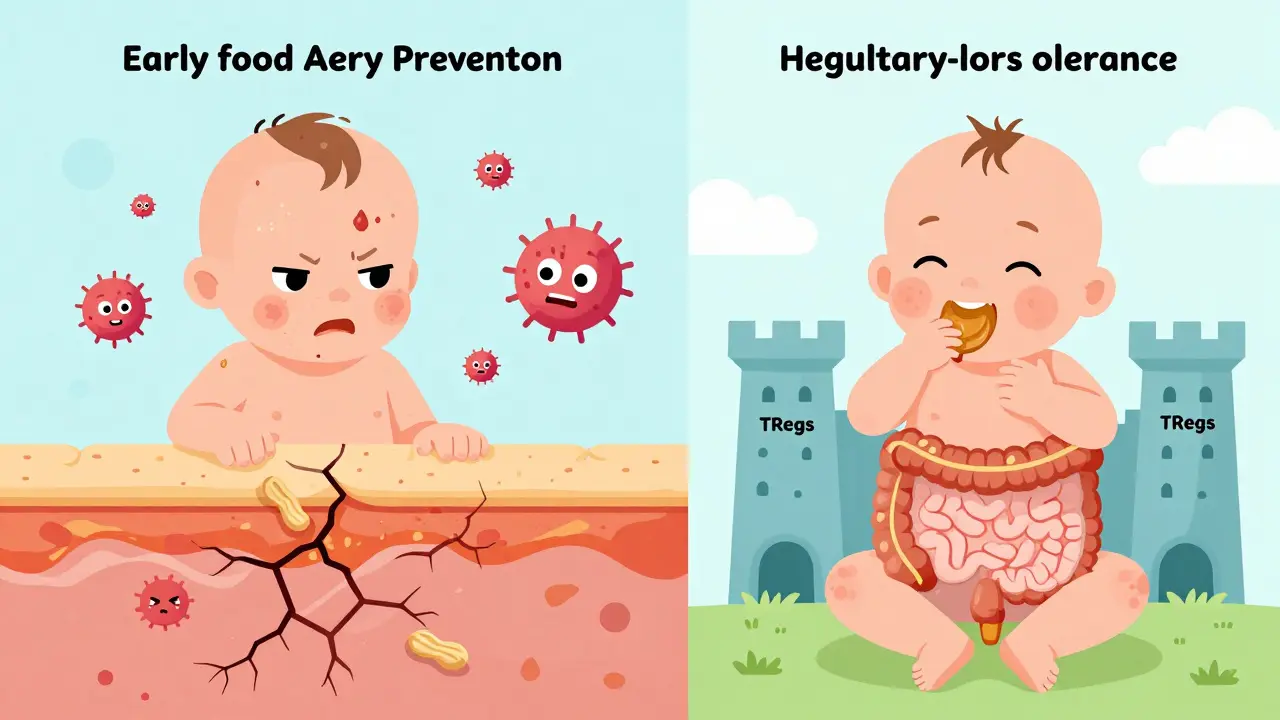
Why does early introduction work? It comes down to the gut versus the skin. The dual-allergen-exposure hypothesis suggests that if allergens enter through damaged skin (like in eczema), the immune system sees them as invaders and creates sensitization. However, if the same allergens are eaten orally, the gut promotes tolerance via regulatory T cells (Tregs). Studies show that infants with adequate vitamin D levels have higher circulating Tregs, suggesting nutrition plays a role in immune modulation. Consequently, current guidelines recommend introducing peanut products to high-risk infants around 4-6 months after evaluation, and to moderate-risk infants around 6 months.
Similar success has been seen with eggs. The EAT study demonstrated a 44% reduction in egg allergy when cooked egg was introduced at 3 months compared to the standard 6 months. Skin barrier integrity also matters. The BEEP trial found that applying petroleum jelly daily from birth reduced food allergy incidence by 50% in high-risk infants. Protecting the skin prevents allergens from entering through cracks and fissures, steering the immune system toward tolerance rather than attack.
Diagnosis: Beyond the Skin Prick Test
If you suspect an IgE allergy, diagnosis requires more than just a guess. A comprehensive approach combines clinical history with objective testing. Skin prick testing involves placing a drop of allergen extract on the skin and pricking it. A wheal (swelling) larger than 3mm compared to the control is considered positive. However, a positive test doesn't always mean you will react clinically. For example, a peanut skin test wheal of 8mm has only a 50% positive predictive value for actual allergy.
Blood tests measure serum-specific IgE levels in kU/L. Diagnostic decision points help interpret these numbers. For instance, a peanut IgE level of 14 kU/L in a child gives a 95% probability of clinical reactivity. Component-resolved diagnostics offer even greater precision. Instead of testing for whole peanut protein, these tests look for specific components like Ara h 2. High levels of Ara h 2 (>0.35 kU/L) strongly indicate a risk of severe reaction, whereas sensitivity to heat-labile proteins might suggest a milder allergy that could be outgrown.
The gold standard remains the double-blind, placebo-controlled food challenge (DBPCFC). This involves giving the patient increasing amounts of the suspected allergen under strict medical supervision. While accurate, it carries risks; studies show a 14-17% chance of requiring epinephrine during the challenge. Therefore, it is reserved for cases where history and testing are inconclusive.
Anaphylaxis Prevention and Emergency Management
Prevention isn't just about avoiding triggers before they become allergies; it's also about preventing severe reactions in those already diagnosed. The cornerstone of emergency care is epinephrine. Auto-injectors like EpiPen and Auvi-Q deliver the first-line treatment for anaphylaxis, requiring administration within 5-15 minutes of symptom onset. Delaying epinephrine by more than 30 minutes increases the risk of biphasic reactions (where symptoms return after initial improvement) by 68% and doubles the likelihood of intensive care admission.
Despite its importance, compliance is low. Research indicates that only 50% of prescribed auto-injectors are carried consistently, and 40% of patients misuse them during emergencies. Training is essential. Newer devices with voice instructions have improved correct administration rates from 60% to 92% in simulations. Everyone in the household, school staff, and close friends should know how to use the device. Anaphylaxis is a medical emergency; antihistamines are too slow and do not treat airway constriction or shock. Epinephrine is the only medication that reverses the physiological cascade of anaphylaxis.

Treatment Options: Immunotherapy and Biologics
For those who cannot avoid accidental exposures, desensitization therapies offer hope. Oral immunotherapy (OIT) involves consuming tiny, increasing amounts of the allergen to raise the reaction threshold. Palforzia, FDA-approved in 2020, allows children aged 4-17 to tolerate roughly two peanuts. Clinical trials showed that 67% of participants tolerated this challenge dose, compared to just 4% in the placebo group. Sublingual immunotherapy (SLIT), where drops are placed under the tongue, shows modest efficacy, helping 50-75% of patients tolerate small amounts of allergen over 12-24 months.
Biologics are another frontier. Omalizumab (Xolair), an anti-IgE antibody, blocks IgE from binding to mast cells. When used alongside OIT, it reduces reaction rates during dose increases by 50%, making the process safer and faster. Emerging therapies include peptide immunotherapy and IL-4Rα inhibitors like dupilumab, which target specific immune pathways. While these treatments don't cure allergies, they provide a safety net against accidental ingestions, which occur in 50-80% of children with peanut allergy over five years.
Living Safely with Food Allergies
Living with an IgE-mediated allergy requires vigilance but not fear. Read labels every time, as formulations change. Communicate clearly with restaurants and schools. Carry your epinephrine auto-injector at all times. Check expiration dates regularly. Join support groups to share tips and stay updated on new research. With proper education, early intervention, and emergency preparedness, individuals with food allergies can lead full, active lives.
How quickly do IgE-mediated food allergy reactions occur?
IgE-mediated reactions typically manifest rapidly, usually within minutes to two hours of ingestion. This speed distinguishes them from non-IgE mediated reactions, which may take hours or days to appear.
Can children outgrow food allergies?
Yes, but it depends on the allergen. Approximately 80% of children outgrow milk and egg allergies by age 16. However, only about 20% outgrow peanut allergies, and tree nut allergies rarely resolve.
Is early introduction of peanuts safe for all babies?
Early introduction is recommended for many, but high-risk infants (severe eczema or egg allergy) should be evaluated by an allergist before starting. Guidelines suggest introducing peanut products between 4-6 months for high-risk infants after assessment.
What is the difference between a skin prick test and a blood test?
Skin prick tests measure immediate local reactions (wheal size) and are quick but can have false positives. Blood tests measure specific IgE levels (kU/L) and provide quantitative data. Both are used together with clinical history for accurate diagnosis.
Why is epinephrine preferred over antihistamines for anaphylaxis?
Epinephrine acts immediately to reverse airway constriction, boost blood pressure, and stop further mediator release. Antihistamines are too slow and do not address the life-threatening cardiovascular and respiratory symptoms of anaphylaxis.
What is Oral Immunotherapy (OIT)?
OIT involves gradually increasing doses of the allergen to desensitize the immune system. It aims to raise the threshold for reaction, providing protection against accidental exposures, though it is not a complete cure.
Does vitamin D play a role in food allergy prevention?
Research suggests a link. Infants with adequate vitamin D levels (≥30 ng/mL) have higher levels of regulatory T cells, which promote immune tolerance. Maternal vitamin D supplementation is also being studied for its preventive effects.
How effective is component-resolved diagnostics?
It offers high specificity. By testing for individual protein components (e.g., Ara h 2 for peanut), doctors can better predict the severity of reactions and the likelihood of outgrowing the allergy compared to whole-food extracts.



Nivetha Narayanan on 27 May 2026, AT 06:35 AM
hey guys! just wanted to say this is such a super helpful post for me and my friends who are always worried about eating out. i love how you explained the science part without being too boring. it really helps to know why our bodies react like that so we can be more prepared instead of just scared all the time. keep up the good work!