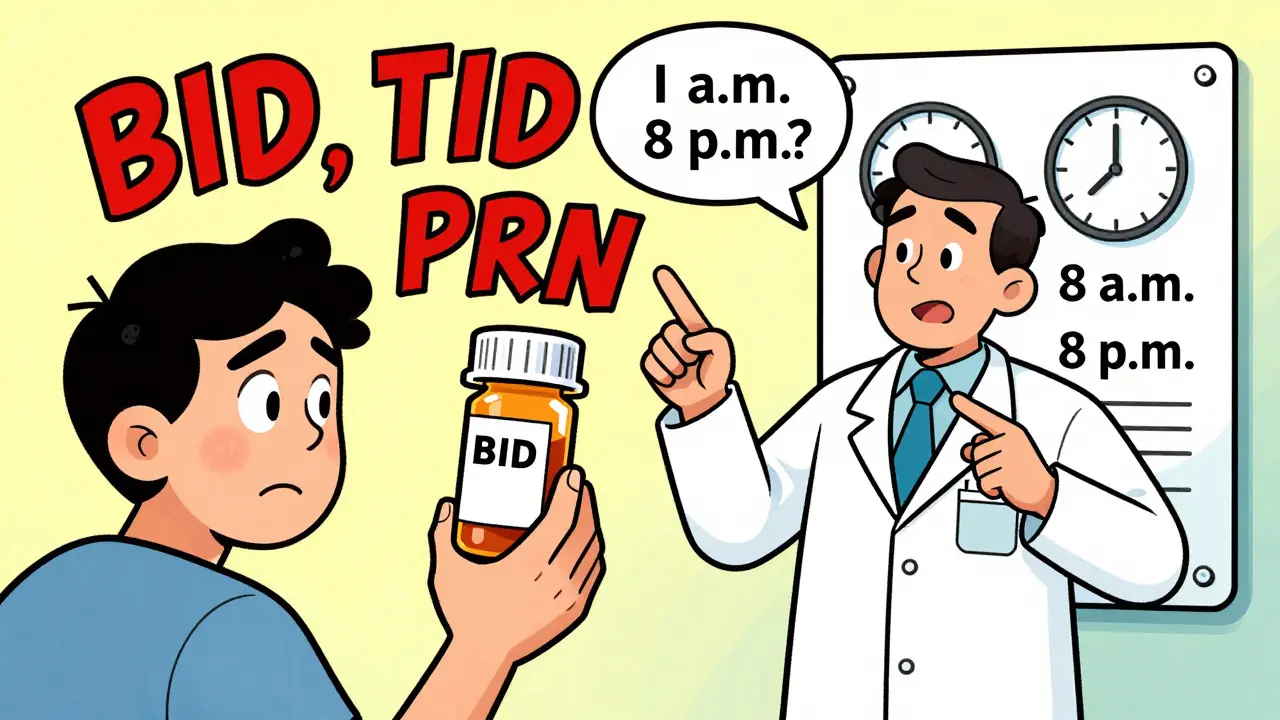
Ever stared at your prescription bottle and wondered what BID, TID, or PRN actually means? You’re not alone. Nearly 7 out of 10 patients in the U.S. admit they don’t fully understand the tiny letters on their pill bottles. These aren’t random codes-they’re Latin abbreviations that have been used for over a century to tell you when and how to take your medicine. But in today’s world, where clarity saves lives, they’re more confusing than helpful.
What BID, TID, and PRN Really Mean
BID stands for bis in die, which is Latin for “twice a day.” That doesn’t mean morning and night-it means roughly every 12 hours. So if your doctor prescribes a medication BID, you should take it around 8 a.m. and 8 p.m., not just with breakfast and dinner. Skipping the second dose because you’re not hungry can drop your drug levels too low, especially with antibiotics or blood pressure meds.
TID means ter in die-three times a day. This isn’t breakfast, lunch, and dinner. It’s every 8 hours. For example: 6 a.m., 2 p.m., and 10 p.m. If you take your TID antibiotic only at breakfast and dinner, you’re leaving a 16-hour gap overnight. That’s enough time for bacteria to bounce back, which is why some infections don’t clear up even when people think they’re taking their meds correctly.
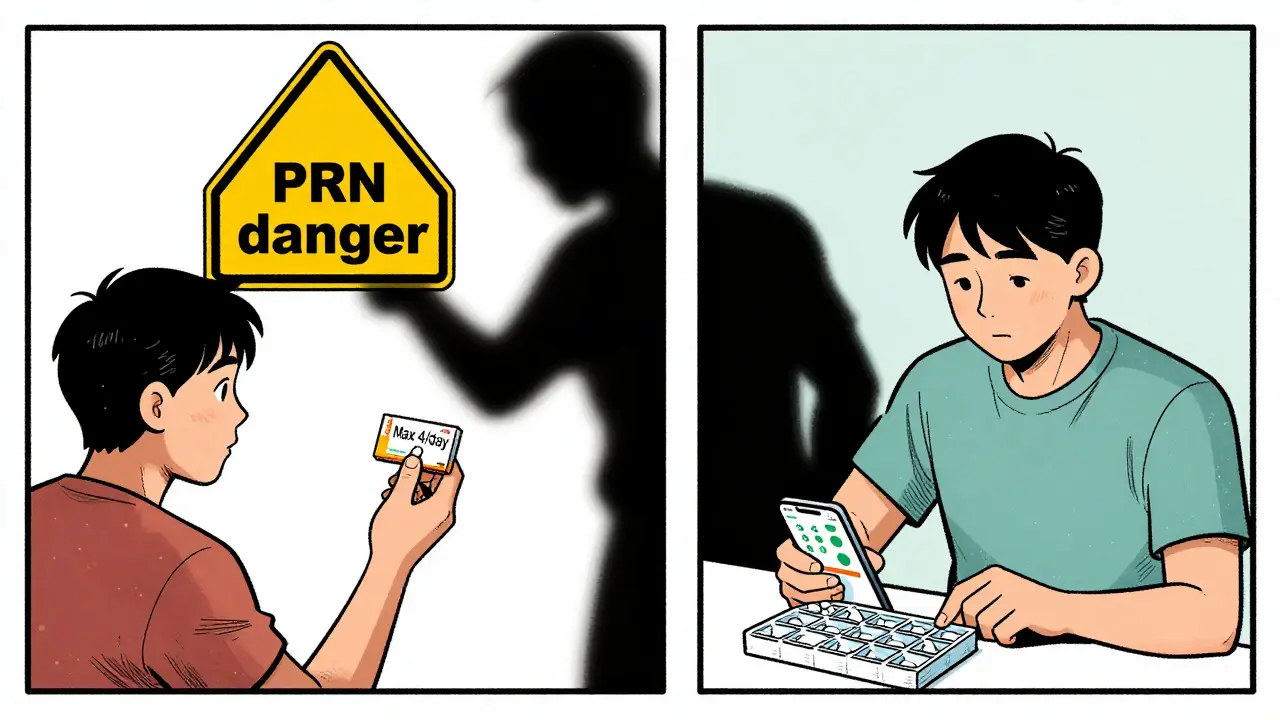
PRN is short for pro re nata, or “as needed.” This one trips up the most people. PRN doesn’t mean “take it whenever you feel like it.” It means take it only when you have the specific symptom listed-like pain, nausea, or trouble sleeping-and only up to the maximum number of doses per day. For example: “Ibuprofen 400mg PRN for pain, max 3 doses in 24 hours.” Taking four pills because you’re still sore? That’s dangerous. Overdosing on painkillers is one of the leading causes of accidental poisoning in older adults.
Other Common Abbreviations You’ll See
Here’s a quick cheat sheet for the rest:
- QD or qd = once daily (take at the same time each day)
- QID = four times daily (every 6 hours)
- Q4H = every 4 hours (this one’s strict-set alarms)
- AC = before meals (take 30-60 minutes before eating)
- PC = after meals (take within 30 minutes after eating)
- HS = at bedtime (right before you go to sleep)
- PO = by mouth (not injection, not crushed, not dissolved)
These aren’t just labels-they’re instructions that affect how well your medicine works. A 2021 Johns Hopkins study found that when people took TID antibiotics with inconsistent timing, treatment success dropped by 27%. That’s not a small difference. It’s the difference between healing and needing a second round of antibiotics.
Why These Abbreviations Still Exist
You’d think by 2025, we’d have ditched Latin terms for plain English. But here’s the truth: many doctors still write prescriptions the same way they were taught in medical school-decades ago. Even though electronic prescribing systems now exist, some physicians still copy-paste old templates. A 2022 FDA report showed that 68% of U.S. prescriptions still use these abbreviations.
Pharmacies are trying to fix it. Major chains like CVS and Walmart now print plain-English translations right on the label: “Take twice daily” instead of “BID.” But smaller, independent pharmacies? Only 41% do it. That means if you pick up a prescription from a local pharmacy, you might still be stuck decoding it yourself.
And it’s not just a U.S. problem. In the UK, doctors stopped using Latin abbreviations back in 2015. They use “twice daily” or “BD” (which stands for bis die in British English). But if you’re a U.S. traveler and your UK doctor writes “BD,” you might think it means “bedtime.” That’s exactly what happened to a patient in a 2022 BMJ case report-she took her blood pressure pill only at night, missing half her doses, and ended up in the hospital.

The Real Danger: Misunderstanding PRN and Timing
PRN is the most dangerous abbreviation because it sounds flexible. But flexibility without boundaries kills. In 2021, the FDA reported that PRN medications were involved in 31% of all dosing errors. People take them too often, too rarely, or at the wrong time.
Take a common example: “Oxycodone 5mg PRN for moderate to severe pain, max 4 doses in 24 hours.” Some patients think, “I had pain yesterday, so I’ll take it today even if I’m fine.” That’s not how it works. PRN means only when you’re in pain-and only up to the max. Taking extra doses can lead to overdose, respiratory depression, or addiction.
And timing matters even more with certain drugs. Blood thinners like warfarin need consistent levels in your bloodstream. If you skip a dose or take it at 10 p.m. one night and 3 a.m. the next, your INR (a blood test that measures clotting) can swing dangerously. That’s why your doctor asks you to check your INR weekly-not because you feel bad, but because the medicine needs steady exposure.
How to Stay Safe: 4 Simple Rules
Here’s what you should do every time you get a new prescription:
- Ask the pharmacist to explain it in plain English. They’re trained to do this. Don’t be shy. A 2022 Pharmacy Times survey found that 89% of patients felt more confident after a pharmacist walked them through their label.
- Use a pill organizer with time labels. Buy one with AM, PM, and “as needed” sections. Studies show this improves adherence by over 50%.
- Download a free app like Medisafe. It converts “TID” into “Take at 6 a.m., 2 p.m., 10 p.m.” and sends you phone alerts. Over 18 million people use it.
- Do a “brown bag review” once a year. Bring all your pills-prescription, OTC, supplements-to your doctor or pharmacist. They’ll spot duplicates, interactions, or outdated instructions.
And if you’re ever unsure? Call the pharmacy. Don’t guess. Don’t assume. Don’t wait until you feel worse. That’s how mistakes happen.
The Future Is Plain English
Good news: the tide is turning. The United States Pharmacopeia (USP) has set a deadline: by December 31, 2025, all U.S. pharmacies must stop using Latin abbreviations on prescription labels. Kaiser Permanente switched to plain English in 2022-and saw a 29% drop in patient calls asking for clarification.
The FDA is also pushing for digital tools that auto-convert “QID” into “Take at 7 a.m., 1 p.m., 7 p.m., and 1 a.m.” based on your daily schedule. That’s coming soon.
But until then? You’re still responsible for understanding your meds. And that’s okay. You don’t need to memorize Latin. You just need to ask.
What to Do If You’re Still Confused
Here’s what to say the next time you’re handed a prescription:
- “Can you write this out in plain English? I want to make sure I’m taking it right.”
- “What time should I take this each day?”
- “Is this medicine safe to take with food?”
- “What happens if I miss a dose?”
- “What symptoms should I watch for?”
These aren’t dumb questions. They’re smart ones. Pharmacists get asked these every day. They expect them. And they’ll thank you for asking.
What does BID mean on a prescription?
BID stands for bis in die, which means twice a day. It doesn’t mean morning and night-it means roughly every 12 hours. For best results, take it at consistent times, like 8 a.m. and 8 p.m., not just with meals.
Is TID the same as three times a day?
Yes, TID means three times a day. But it’s not breakfast, lunch, and dinner. It’s every 8 hours-for example, 6 a.m., 2 p.m., and 10 p.m. Taking it only twice a day leaves gaps that can reduce the medicine’s effectiveness, especially with antibiotics.
Can I take PRN medicine whenever I want?
No. PRN means “as needed,” but only for the specific reason listed on the label. For example, if it says “PRN for pain,” you only take it when you have pain-and only up to the maximum number of doses per day (like 3 or 4). Taking it more often can lead to overdose or side effects.
Why do pharmacies still use Latin abbreviations?
Many doctors still use old templates from medical school, and some electronic systems copy-paste them. Even though electronic prescribing has reduced errors by 44%, 68% of U.S. prescriptions still use Latin abbreviations. New rules require plain English by 2025, but until then, it’s up to you to ask for clarification.
What’s the safest way to remember when to take my pills?
Use a pill organizer labeled with times (AM, PM, PRN) and set phone reminders. Apps like Medisafe automatically convert abbreviations into clear times and send alerts. Studies show this improves adherence by over 50% and reduces missed doses.
What should I do if I accidentally take the wrong dose?
Call your pharmacist immediately. Don’t wait for symptoms. They can tell you if you’re at risk and what to do next. For serious medications like blood thinners or insulin, even small mistakes can be dangerous. It’s always better to check than to assume.


Joe Bartlett on 17 December 2025, AT 10:51 AM
Used to think BID meant morning and night. Turned out I was killing my antibiotics with lazy timing. Now I set alarms. Life’s better.