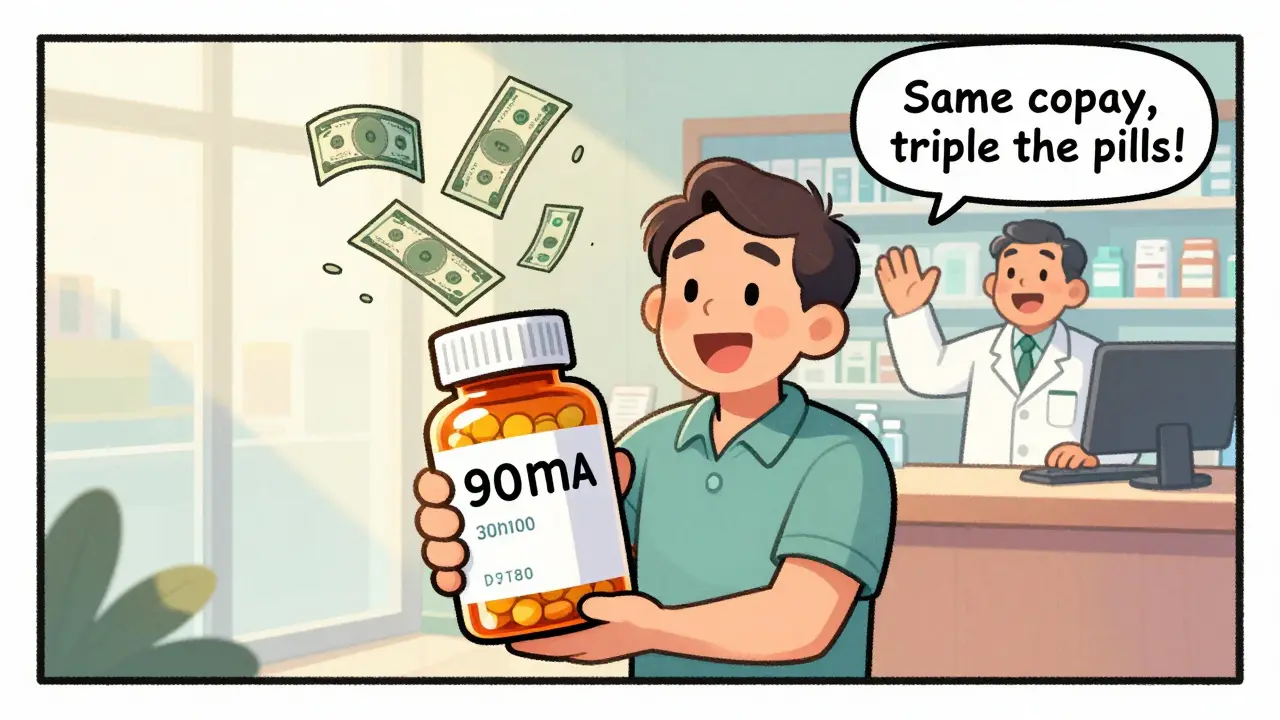
Every time you refill your blood pressure or diabetes medication, you’re paying the same copay-whether you get 30 days or 90 days of pills. That’s not a mistake. It’s a hidden savings opportunity most people never ask for. If you take the same medicine every day for a long-term condition, switching to a 90-day supply could save you up to $40 a year per medication-and cut your pharmacy trips in half. You don’t need a special plan, a doctor’s note, or a fancy app. You just need to ask.
Why 90-Day Fills Save Money
Most insurance plans charge the same copay for a 30-day supply and a 90-day supply. That means if your copay is $4.90, you’re getting three months of medication for the same price as one month. Three times the pills. Same cost. No hidden fees. No surprise charges. For example, if you take a daily pill for high cholesterol and pay $4.90 every 30 days, you’re spending $58.80 a year. Switch to a 90-day fill, and you pay $4.90 just four times a year-totaling $19.60. That’s $39.20 saved annually, just for asking. Multiply that by two or three medications, and you’re talking real money. The math gets even better with mail-order pharmacies. Many plans, like those through CVS Caremark or HPSM’s Postal Prescription Services, offer 90-day fills with free home delivery. You never leave the house. No gas, no parking, no waiting in line. And you still pay the same flat copay.Who Qualifies for a 90-Day Fill
You don’t need to be on Medicare or have a fancy plan. If you’re taking medication for a chronic condition-like high blood pressure, diabetes, asthma, thyroid issues, or depression-you’re likely eligible. Insurance companies don’t require you to prove you’ve been on the drug for a certain time, but they do expect you’ve been taking it consistently. Pharmacies and insurers look for two things:- The medication is for a long-term health issue (not something you take once in a while)
- You’ve filled the prescription at least once before without issues
How to Get a 90-Day Prescription
There are two simple ways to get a 90-day supply. Neither requires paperwork or a special form. Option 1: Ask your pharmacy If your prescription still has refills left, walk into your local pharmacy and say: “Can I get a 90-day supply instead of 30?” Most pharmacists will say yes right away. They can legally dispense a 90-day supply from a 30-day prescription if there are enough refills remaining. No doctor needed. If your prescription doesn’t have enough refills, they’ll call your doctor’s office to request a new 90-day prescription. That’s standard practice now. Most doctors are used to the request. Option 2: Ask your doctor directly During your next appointment, say: “I’d like to switch to a 90-day prescription to save money and cut down on trips to the pharmacy.” Many doctors already do this automatically for chronic conditions. But if they don’t, they’ll write it for you. It takes less than a minute. Don’t assume your doctor won’t agree. Studies show patients who get 90-day fills are more likely to stick with their meds. Doctors want that. They’re not trying to make you come in more often.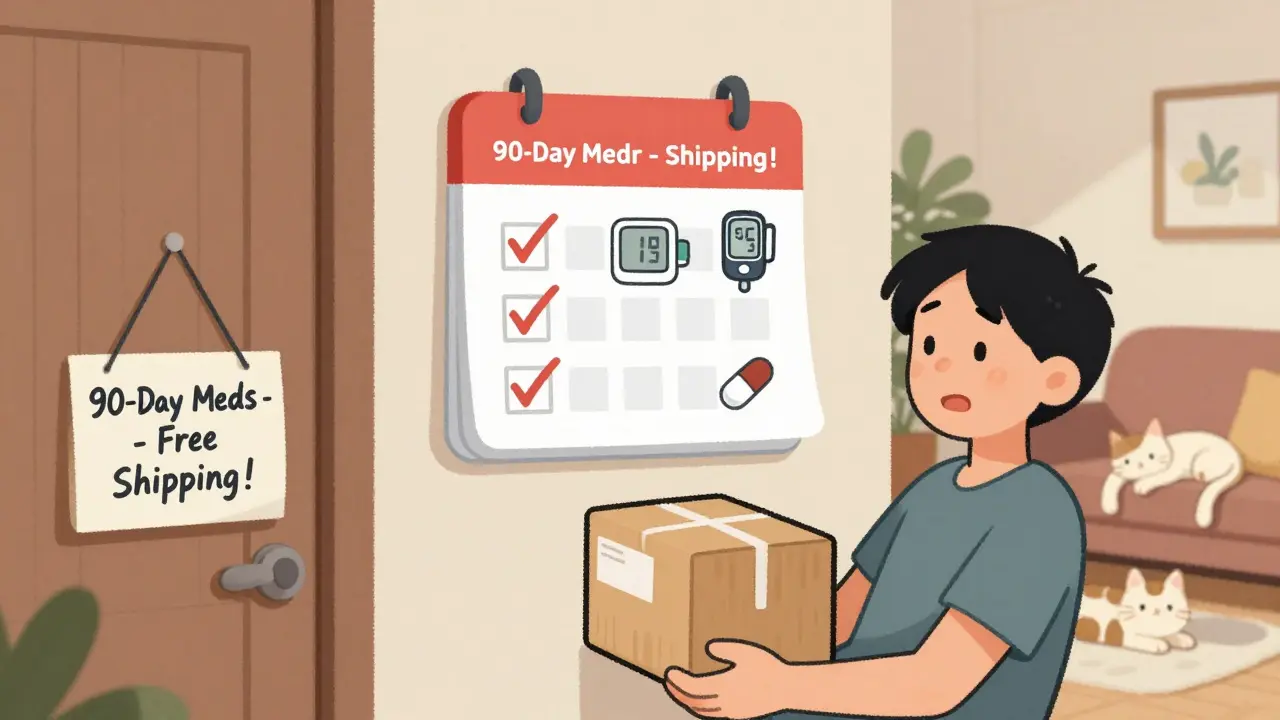
Mail-Order vs. Retail Pharmacy
You can get 90-day fills in two places: your local pharmacy or a mail-order service. Mail-order pharmacies (like CVS Caremark Mail Service, Express Scripts, or HPSM’s PPSRX) specialize in 90-day fills. They ship your meds to your door, often for free. You order online or by phone, and your supply arrives every three months. Many plans offer lower copays through mail-order than retail. Retail pharmacies like CVS, Walgreens, or your local drugstore now offer 90-day fills too. You pick them up the same day. This is great if you want to see your pharmacist in person or need to combine your chronic meds with a short-term prescription (like antibiotics). Here’s the catch: mail-order usually saves more. But retail gives you more control. If you’re unsure, try both. Compare the copay at your local pharmacy to what you’d pay through mail-order. Use GoodRx to check prices. You might be surprised.What to Do If Your Insurance Says No
Sometimes, your plan won’t cover a 90-day fill for a specific drug. That’s rare-but it happens. Common reasons:- The medication is new or has special restrictions
- Your plan requires prior authorization
- You’re on a narrow network with limited options
- Ask the pharmacy to check your plan’s coverage for 90-day fills on that drug
- If they say no, ask them to call your insurer’s pharmacy benefits manager (PBM) to confirm
- Ask your doctor to submit a letter of medical necessity if needed

Real Savings, Real Results
The numbers don’t lie. In 2025, home delivery and retail 90-day fills saved consumers and employers over $600 million. If adoption jumped from 12% to 70%, that number could hit $23 billion over ten years. But beyond the money, there’s a bigger win: better health. People who get 90-day supplies are far less likely to skip doses. One study showed patients on 90-day fills were 25% more likely to stay on track than those getting monthly refills. That means fewer hospital visits, fewer complications, and fewer emergency trips. You’re not just saving cash-you’re protecting your health.Common Myths About 90-Day Fills
Myth: “I’ll run out of pills if I get too much.” You won’t. Your doctor will only write for 90 days if you’ve been stable on the dose. If your dose changes, you’ll get a new prescription. Myth: “My pharmacy won’t give it to me.” They will. Most pharmacies have a 90-day fill option now. If they say no, ask to speak to the manager. It’s not their call-it’s your insurance plan’s. Myth: “I’ll forget to take them.” Actually, the opposite is true. Having all your pills at once makes it easier to stick to a routine. Pill organizers, phone alarms, and weekly routines work better when you’re not scrambling for a refill every month.What to Do Next
Here’s your action plan:- Check your medicine cabinet. Which meds do you take every day for a chronic condition?
- Look at your last three pharmacy receipts. Are you paying the same copay each time?
- Call your pharmacy or log into your insurer’s portal. Ask: “Can I switch my [medication name] to a 90-day supply?”
- If you’re on mail-order, check if your plan offers free shipping for 90-day fills.
- If your doctor hasn’t written a 90-day script yet, ask at your next visit.
Can I get a 90-day fill for any medication?
No-only for medications used to treat chronic conditions like high blood pressure, diabetes, high cholesterol, asthma, thyroid disorders, or depression. You can’t get a 90-day supply for antibiotics, pain relievers, or medications you only take occasionally. Your insurance plan will specify which drugs qualify.
Do I need a new prescription for a 90-day supply?
Not always. If your current prescription has refills left, your pharmacy can dispense a 90-day supply without a new script. If there are no refills left, your pharmacist will contact your doctor to request a new 90-day prescription. Most doctors approve this quickly.
Is mail-order better than retail for 90-day fills?
Mail-order often has lower copays and free shipping, making it the cheapest option. But retail pharmacies now offer 90-day fills too, which is convenient if you need to pick up other meds at the same time. Compare prices using GoodRx or your insurer’s pharmacy tool. Choose the option with the lowest out-of-pocket cost.
Will my insurance cover 90-day fills if I’m on Medicare?
Yes. Most Medicare Part D plans and Medicare Advantage plans include 90-day fill options, especially for maintenance medications. Many dual-eligible special needs plans (D-SNPs) even promote 90-day fills as a standard benefit to improve adherence and reduce costs.
What if my pharmacy refuses to give me a 90-day supply?
Ask to speak to the pharmacist in charge. If they still refuse, call your insurance company’s pharmacy help line. The problem is usually not the pharmacy-it’s a system error or outdated plan info. Your insurer can override the restriction or clarify coverage rules. You have a right to ask.
Can I switch back to 30-day fills later?
Absolutely. If your dose changes, you start a new medication, or you just prefer to refill monthly, you can switch back anytime. There’s no penalty. Your insurance doesn’t lock you in. It’s your choice.
How often do I need to refill if I get a 90-day supply?
Four times a year-every three months. That’s eight fewer trips to the pharmacy than if you got 30-day fills. If you use mail-order, you’ll get your meds delivered automatically. No calls, no lines, no stress.



Trevor Whipple on 13 January 2026, AT 01:48 AM
bro i just switched my metformin to 90-day and saved like $45 this year. i didnt even know u could do this. my pharmacist was like 'oh yeah we do that all the time' like i was the first person to ask. dumb. also i spelled 'refill' wrong in my notes so now i'm mad at myself.