What Is Cardiac Rehabilitation?
Cardiac rehabilitation isn’t just a follow-up appointment-it’s a structured, medically supervised plan designed to help your heart heal after a heart attack, bypass surgery, stent placement, or valve repair. It’s not about resting forever. It’s about moving safely, rebuilding strength, and learning how to live better with a changed heart.
Back in the 1970s, doctors told patients to stay in bed for weeks after a heart event. Now we know that’s the wrong approach. Research shows that getting up, walking, and slowly increasing activity saves lives. The American Heart Association calls cardiac rehab one of the most effective tools in heart care-and yet, most people never even start it.
The Three Phases of Cardiac Rehab
Cardiac rehab happens in three clear stages, each with specific goals and safety rules.
Phase I: Right After the Event (In-Hospital)
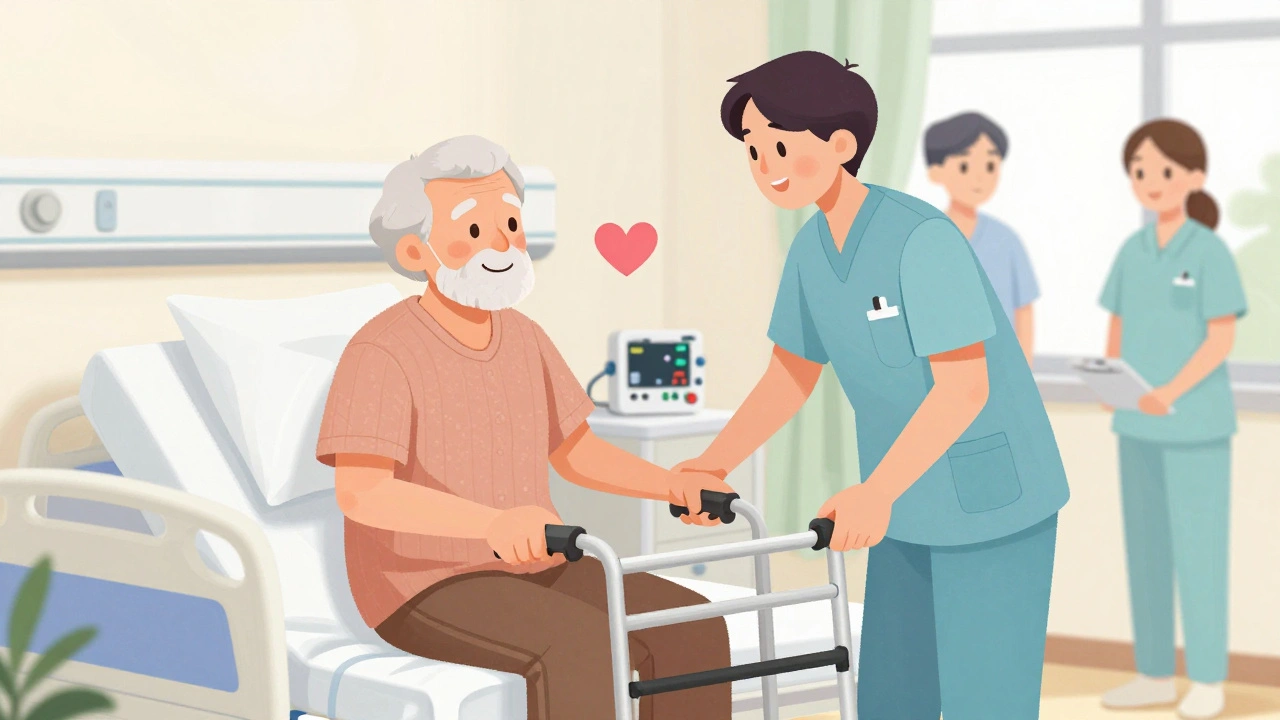
This starts within 24 to 48 hours after your heart attack or surgery. You’re still in the hospital, but you’re not lying still. Nurses and therapists help you sit up, stand, and take a few steps-maybe just to the bathroom or down the hall. Sessions last 3 to 5 minutes at first, with rest in between. You’ll do this 3 or 4 times a day.
Your heart rate is watched closely. It shouldn’t go above 120 bpm, or 20 beats over your resting rate. If you feel dizzy, short of breath, or chest pain, you stop. The goal isn’t to push hard-it’s to prove your heart can handle gentle movement without danger.
Phase II: Outpatient Rehab (1-3 Weeks After Discharge)
This is where real progress happens. Most programs last 12 weeks, with 36 sessions total. You’ll go to a clinic 3 to 5 days a week for an hour each time. Every session includes:
- 5 minutes of warm-up (light walking or stretching)
- 30-40 minutes of supervised exercise
- 5 minutes of cool-down
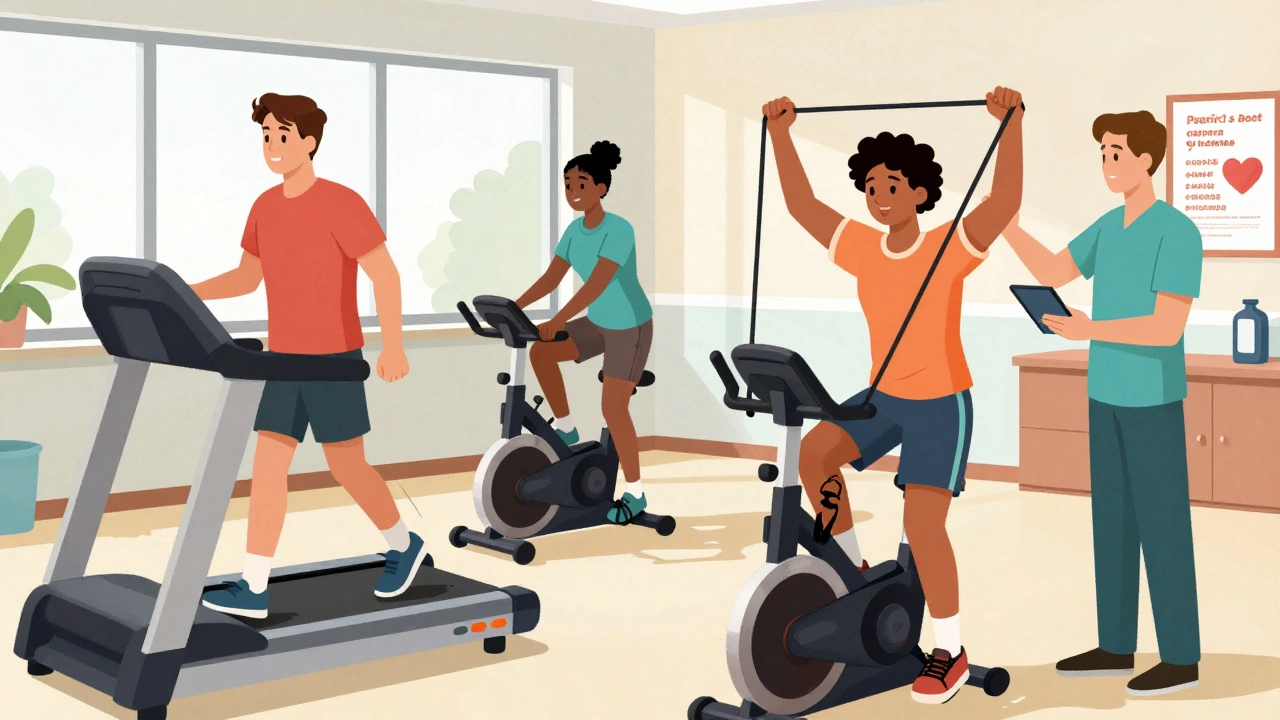
Exercise is moderate. You’re not sprinting. You’re walking on a treadmill, pedaling a stationary bike, or using light resistance bands. Your target heart rate is 40-59% of your heart rate reserve-that’s about 60-75% of your max predicted rate. On the Borg scale (a tool doctors use to measure how hard you feel you’re working), you should be at 11-13. That means you’re breathing harder than normal, but you can still talk in short sentences.
Strength training starts too. You’ll do 8-10 exercises (like seated rows, leg lifts, arm curls) with light weights. Two to three times a week, you’ll do 10-15 reps per set. No holding your breath. No straining. Just slow, controlled movements.
By the end of Phase II, you should see real changes: walking farther without stopping, climbing stairs without gasping, lifting groceries more easily. Your peak oxygen uptake should improve by at least 15%. Your 6-minute walk distance should go up by 10% or more.
Phase III: Long-Term Maintenance
This phase lasts for life. You’re no longer supervised, but you’re still following the plan. The goal: 150 minutes of moderate aerobic activity each week. That’s 30 minutes, 5 days a week. You can break it into 10-minute chunks if needed. Walk, swim, cycle-whatever keeps you moving without pain.
Keep doing strength training twice a week. Keep monitoring your heart rate. Keep tracking your symptoms. And keep showing up for your check-ins with your doctor or rehab team.
Who Should Do Cardiac Rehab?
Cardiac rehab isn’t just for people who’ve had a heart attack. It’s recommended if you’ve had:
- Coronary artery bypass surgery
- Angioplasty or stent placement
- Heart valve repair or replacement
- Heart or lung transplant
- Stable angina (chest pain during activity)
- Chronic heart failure with stable symptoms
Even if you have blockages in your arteries that cause pain when you walk, or if you have a condition like cardiomyopathy, rehab can help. It’s not just for the young or the fit. People in their 70s and 80s benefit just as much.
But it’s not for everyone. You shouldn’t start rehab if you have:
- Unstable angina (chest pain at rest)
- Uncontrolled irregular heartbeat
- Acute heart failure
- Severe aortic stenosis
- Active myocarditis (heart inflammation)
If you’re unsure, ask your cardiologist. Don’t guess. Safety comes first.
Why It Works: The Science Behind the Program
Cardiac rehab isn’t magic. It’s science. A 2022 Cochrane review of over 12,000 patients found that those who completed rehab had a 26% lower risk of dying from heart disease and an 18% lower chance of being readmitted to the hospital. That’s bigger than the benefit from many medications.
Exercise strengthens your heart muscle, improves blood flow, lowers blood pressure, and helps your body use oxygen better. It also reduces inflammation and helps control blood sugar and cholesterol.
But the biggest benefit might be mental. Up to 40% of heart attack survivors develop depression. Rehab teams include counselors who help you cope with fear, anxiety, and the feeling that your body has betrayed you. Talking to others who’ve been through it helps more than you’d think.
And the safety record? Amazing. Only 1 complication happens per 100,000 hours of exercise. That’s safer than driving to the store.
Barriers to Getting Started
Despite the proof, only about 37% of eligible Medicare patients enroll in cardiac rehab. Why?
- No referral: Only 69% of doctors refer their patients. If your doctor doesn’t mention it, ask.
- Transportation: Getting to a clinic is hard if you don’t drive or live far away.
- Time: Juggling work, family, and appointments feels impossible.
- Misconceptions: Some think it’s only for the very sick. Others fear exercise will trigger another heart attack.
The good news? Telehealth rehab is now covered by Medicare. You can do sessions at home with a tablet or phone, monitored remotely. A 2022 study showed home-based rehab improved fitness just as much as in-person programs.
What to Do If You’re Not Referred
If your doctor hasn’t mentioned cardiac rehab, don’t wait. Call your cardiologist’s office. Say: “I had a heart attack/surgery. Am I eligible for cardiac rehab? Can you refer me?”
If they say no, ask why. If they say it’s not covered, check with your insurance. Medicare covers 36 sessions. Most private insurers do too.
And if you can’t get into a formal program right away, start on your own. Walk 10 minutes a day. Gradually add 5 minutes each week. Use a simple pedometer or phone app to track steps. Avoid stairs if you’re breathless. Rest if you feel dizzy. Eat less salt. Sleep well. Take your meds. These aren’t just tips-they’re the foundation of recovery.
Real-Life Tips from People Who’ve Done It
One man in Bristol started rehab after his bypass surgery. He could barely walk to the end of his driveway. Six weeks in, he walked to the local pub with his wife. “I didn’t think I’d ever do that again,” he said.
A woman in her 70s with heart failure joined rehab after her stent. She used to get winded tying her shoes. After 12 weeks, she started gardening again. “I didn’t know I could feel this good,” she told her therapist.
They didn’t have magic. They just showed up. Day after day. Even when it felt hard.

What to Watch For During Exercise
Some discomfort is normal. Chest pain, dizziness, or nausea is not.
Stop and call your rehab team if you feel:
- Chest pressure, tightness, or pain
- Severe shortness of breath (can’t speak at all)
- Dizziness or lightheadedness
- Irregular heartbeat that doesn’t settle
- Unusual fatigue or nausea
Keep a notebook. Write down how you feel after each session. That info helps your team adjust your plan.
What Happens After the Program Ends?
You don’t stop. You just take over. Your rehab team will give you a personalized plan: how often to exercise, what intensity, which activities to avoid. They’ll help you set goals: walk to the park, carry groceries, play with grandchildren.
Keep seeing your doctor every 3-6 months. Get your blood pressure, cholesterol, and weight checked. Stay on your meds. Don’t quit smoking. Limit alcohol. Eat more vegetables, less processed food.
Cardiac rehab doesn’t fix your heart. But it gives you the tools to live with it-stronger, calmer, and more confident than you thought possible.
Final Thought: It’s Not Optional
After a heart attack or surgery, your life changes. Cardiac rehab isn’t a luxury. It’s the most proven way to get back to living-not just surviving.
It’s not about going back to who you were. It’s about becoming someone who knows how to take care of their heart-and isn’t afraid to move forward.



Katie Harrison on 9 December 2025, AT 04:30 AM
I never thought I'd be the type to cry at a rehab session... but when I walked to the mailbox without stopping for the first time, I just lost it. My nurse hugged me. We didn't even talk. Just... stood there. That's when I knew this wasn't just exercise-it was healing.