The American pharmaceutical market relies on a delicate balance between protecting innovation and ensuring affordable access to medicine. For decades, a specific provision known as 180-day exclusivity has been the cornerstone of this balance. It rewards the first company that challenges a brand-name drug patent with a window to sell their version without competition. However, there is a catch. Brand-name companies often launch what are called authorized generics-the same branded product sold under its generic name-right when this protection kicks in. This creates a messy legal battlefield where millions of dollars hang in the balance.
If you are involved in the industry, or simply trying to understand why your prescription prices fluctuate so wildly, you need to know how these two forces collide. The rules aren't just technicalities; they determine which companies get rich, which go bankrupt, and whether patients get cheaper drugs sooner. Since the enactment of the Hatch-Waxman Amendments, the debate over whether authorized generics should be allowed during this exclusivity period has intensified. With new legislative proposals surfacing by 2026, understanding the current legal framework is more critical than ever.
Understanding the 180-Day Exclusivity Window
To grasp the conflict, we have to look at the foundation: the Drug Price Competition and Patent Term Restoration Act of 1984, commonly known as the Hatch-Waxman Act. Congress designed this law to solve a problem. Big Pharma had patents that lasted too long, blocking cheaper alternatives. Meanwhile, small generic companies didn't want to challenge big patents because it cost too much in litigation.
The solution was a trade-off. If a generic manufacturer files an Abbreviated New Drug Application (ANDA) and claims the brand-name patent is invalid-a move called a Paragraph IV certification-they get a reward. If they win that challenge, the Food and Drug Administration (FDA) grants them 180 days of marketing exclusivity. During this time, the FDA cannot approve any other competing generic applications for the same drug. It effectively gives the winner a temporary monopoly.
This exclusivity starts ticking either when the generic product hits the shelves or when a court rules against the brand-name patent, whichever happens first. The goal was clear: incentivize the "bounty hunting" of weak patents. The logic assumes that the first challenger earns this exclusivity solely through the effort of litigating against the patent holder.
What Are Authorized Generics?
While the exclusivity rule sounds protective, the definition of "generic" leaves room for maneuvering. An authorized generic is essentially the brand-name drug sold without the brand label. It contains the exact same ingredients, made in the same facility, under the same manufacturing controls as the name-brand version. Sometimes it's even the exact same bottle, just with a different sticker.
Because it doesn't require a new FDA approval process, launching an authorized generic is fast and cheap for brand-name manufacturers. They don't need to file a full ANDA or prove bioequivalence like standard competitors do. They can introduce this product to the market immediately. The controversy arises when they do exactly that right when the first independent generic wins their 180-day exclusivity clock.
From a regulatory standpoint, the FDA views the authorized generic as distinct from the first generic applicant's product. Therefore, the FDA is still barred from approving *other* independent generics, but the brand-owner can flood the market with their own unbranded version. This undermines the exclusivity prize meant to encourage patent challenges.
The Legal Collision: Exclusivity vs. Strategy
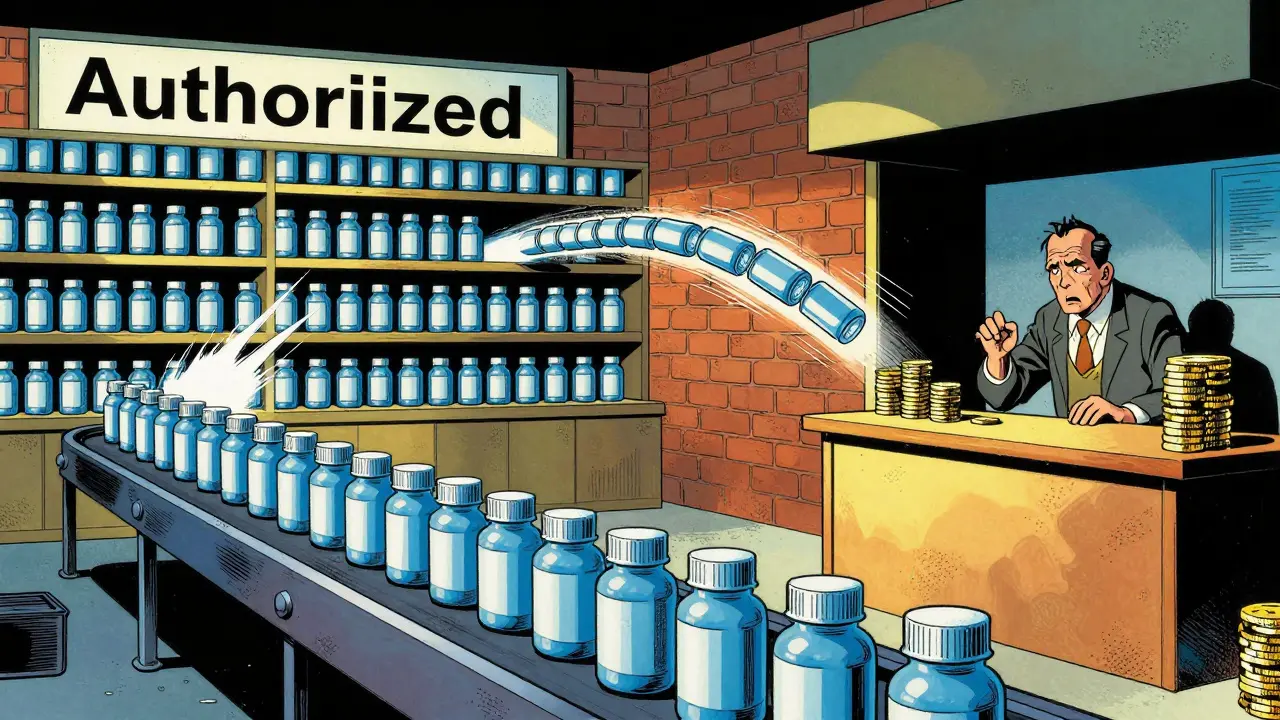
The interaction between these two concepts creates significant friction. When a brand-name company launches an authorized generic during the 180-day period, the independent generic company sees its market share evaporate instantly. Studies show that before an authorized generic enters, the first generic often captures around 80% of the sales volume. Once the authorized version appears, that number often drops to 50% or lower.
Why does this happen? Pharmacists and insurance payers usually prefer the lowest price. If the brand-name company prices their authorized generic aggressively low, it competes directly with the independent generic for reimbursement rates. The independent challenger spent millions on litigation expecting a protected profit stream, only to find they now have to split revenue with the original patent holder who never took the risk of challenging the patent themselves.
Metric
No Authorized Generic
With Authorized Generic
First Generic Market Share
Approximately 80%
Drops to ~50%
Pricing Pressure
Moderate
High
Revenue Potential
$150-$250 million range
Reduced by 30-50%
Patient Cost
Lower
Often Lowest (due to 2-way competition)
This dynamic forces generic companies to negotiate. Many first applicants try to sign contracts with brand manufacturers stipulating that no authorized generic will be launched during the exclusivity window. However, these agreements sometimes run afoul of antitrust laws. The Federal Trade Commission (FTC) has filed multiple lawsuits claiming these deals delay overall competition rather than protect legitimate exclusivity rights.
Financial Risks and Settlement Trends
The financial stakes in this game are massive. Challenging a single drug patent can cost upwards of $3 million in legal fees alone, plus years of regulatory preparation work. Generic companies factor the potential 180-day revenue windfall into their decision to take the risk. When authorized generics enter, that ROI calculation gets complicated.
In high-profile cases, such as the dispute involving Teva Pharmaceuticals and Eli Lilly regarding Humalog, documents revealed estimated losses exceeding hundreds of millions of dollars due to authorized generic entry. These losses aren't theoretical. They change the strategic behavior of the entire industry. Smaller generic firms are increasingly hesitant to file Paragraph IV certifications because the "prize" is no longer guaranteed.
This hesitation impacts patient access. If fewer companies are willing to challenge patents because the financial risk is too high compared to the reward, fewer drugs transition to generic pricing quickly. The intended benefit of the Hatch-Waxman Act accelerates competition, but the unauthorized side effect of brand-name defense mechanisms slows it down.
Regulatory Landscape and Future Legislation
As of 2026, the political pressure to fix this imbalance remains high. Several bills have been reintroduced over the years, including the Preserve Access to Affordable Generics and Biosimilars Act. These proposals aim to explicitly prohibit the launch of authorized generics during the 180-day exclusivity period. The argument is straightforward: if the government awards exclusivity, it shouldn't allow the grantor to undermine the value.
FDA officials have testified before Congress supporting clearer guidelines. Commissioner Robert Califf has noted that the current system creates unintended disincentives for timely generic entry. On the flip side, the pharmaceutical industry group PhRMA argues that authorized generics benefit consumers by introducing price competition faster, even if it hurts the first generic entrant. They cite studies showing lower prices when multiple versions compete immediately.
The tension highlights a fundamental philosophy divide. Is the system about rewarding the person who takes the legal risk (the first generic challenger), or is it about getting the cheapest drug to the patient as fast as possible? Currently, the law favors the latter, but the mechanism used to get there penalizes the former.
Navigating Compliance and Strategy
For companies operating in this space, the path forward requires meticulous planning. You cannot simply wait for FDA approval and assume the clock is safe. There are specific procedural pitfalls that can void your exclusivity entirely, regardless of the brand's actions.
- Timing the Trigger: You must commence commercial marketing correctly. Starting too early can waste days; starting too late misses the start of the window. The FDA defines this as the date of the first shipment to customers.
- Continuous Marketing: You cannot stop selling the product. If the supply chain breaks and the product is unavailable for a continuous period, the exclusivity clock stops or expires.
- Data Integrity: Ensure all notice requirements to the patent holder were met precisely within the 20-day statutory window after filing.
Risk management also involves contract law. Understanding the nuances of settlement agreements is vital. The FTC monitors these closely to prevent collusion. If a settlement looks like a "pay-for-delay" deal where the brand pays the generic to stay out of the market, it violates antitrust principles. Conversely, valid agreements about non-entry of authorized generics can be complex.
Does 180-day exclusivity block all generic competitors?
No. It prevents the FDA from approving subsequent ANDAs for independent generic manufacturers. However, it does not stop the brand-name manufacturer itself from selling an authorized generic version of their own drug.
Can authorized generics be launched before the 180-day period ends?
Yes. Brand-name manufacturers can typically launch authorized generics at any point, even while the first generic company holds their 180-day exclusivity status, unless restricted by a specific contractual agreement.
Who receives the 180-day exclusivity?
It is granted to the "first applicant" who submits a substantially complete ANDA containing a Paragraph IV certification challenging a listed patent and successfully initiates litigation.
How does an authorized generic differ from a regular generic?
An authorized generic is manufactured by the brand-name company (same batch/ingredients) but sold without the brand label. Regular generics are produced by third-party companies and must demonstrate bioequivalence through an application process.
Is there legislation currently preventing authorized generic launches?
As of 2026, proposed bills like the Preserve Access to Affordable Generics Act exist but have not fully become federal law prohibiting the practice universally. State laws vary, but federal regulation allows it.



walker texaxsranger on 28 March 2026, AT 07:49 AM
patent thicket strategies block paragraph IV certification attempts routinely
authorized generic launch timing exploits regulatory loopholes effectively
hatch-waxman exclusivity window gets eroded by branded monopolies
litigation costs outweigh potential roi for smaller generic firms