Up to half of people visiting doctors for head pain receive the wrong diagnosis. It sounds frustrating, doesn't it? You feel terrible, take medication, and it doesn't work because you are treating the wrong problem. Whether it is a tight band around your head or a throbbing drill behind your eye, knowing which category your pain falls into changes everything.
We live in an era where we have better tools to fight pain than ever before, but many of us are stuck guessing. By March 2026, we know that precise identification of whether you have a Tension Headachethe most common primary headache disorder characterized by bilateral pressure, a Migrainea neurological condition involving pulsating pain and often sensory sensitivity, or a Cluster Headachea rare trigeminal autonomic cephalalgia causing excruciating orbital pain determines your path to relief. This isn't just semantics; it is about getting your life back without unnecessary side effects.
Quick Summary / Key Takeaways
- Tension headaches present as a steady squeezing pressure, usually on both sides of the head, and are not aggravated by normal activity.
- Migraines involve pulsating pain, often on one side, accompanied by nausea and sensitivity to light or sound, lasting 4 to 72 hours.
- Cluster headaches cause severe, short bursts of pain around the eye with autonomic symptoms like tearing or a runny nose, occurring in groups or cycles.
- Accurate diagnosis relies on symptom patterns; tracking these details in a Headache Diarya log used to record timing, severity, and triggers of pain episodes is critical for medical evaluation.
- Treatment differs vastly: simple analgesics work for tension, whereas cluster requires oxygen therapy, and migraine requires specific abortive medications like triptans.
The Landscape of Primary Headache Disorders
Before we break down the specifics, it helps to understand what "primary" means in this context. Your brain is complex, and pain signals travel through pathways that are sometimes shared but often distinct. According to the International Classification of Headache Disordersa comprehensive diagnostic system published by the International Headache Society, specifically the third edition (ICHD-3) codified in 2018, there are clear rules for separation. These rules exist to stop the guesswork. Without them, the statistics show a 50% misdiagnosis rate, particularly in emergency settings where speed is prioritized over nuance.
When you experience head pain, your body is signaling an issue. For tension-type headaches, this signal is often muscular or related to stress modulation in the brainstem. For migraines, it involves electrical waves spreading across the cortex and the activation of the trigeminovascular system. Cluster headaches sit in a different camp entirely, rooted in deep brain structures like the hypothalamus. This biological difference is why taking an aspirin might fix a tension headache but feels like throwing water on a fire for a cluster episode.
Tension Headache: The Pressure Band
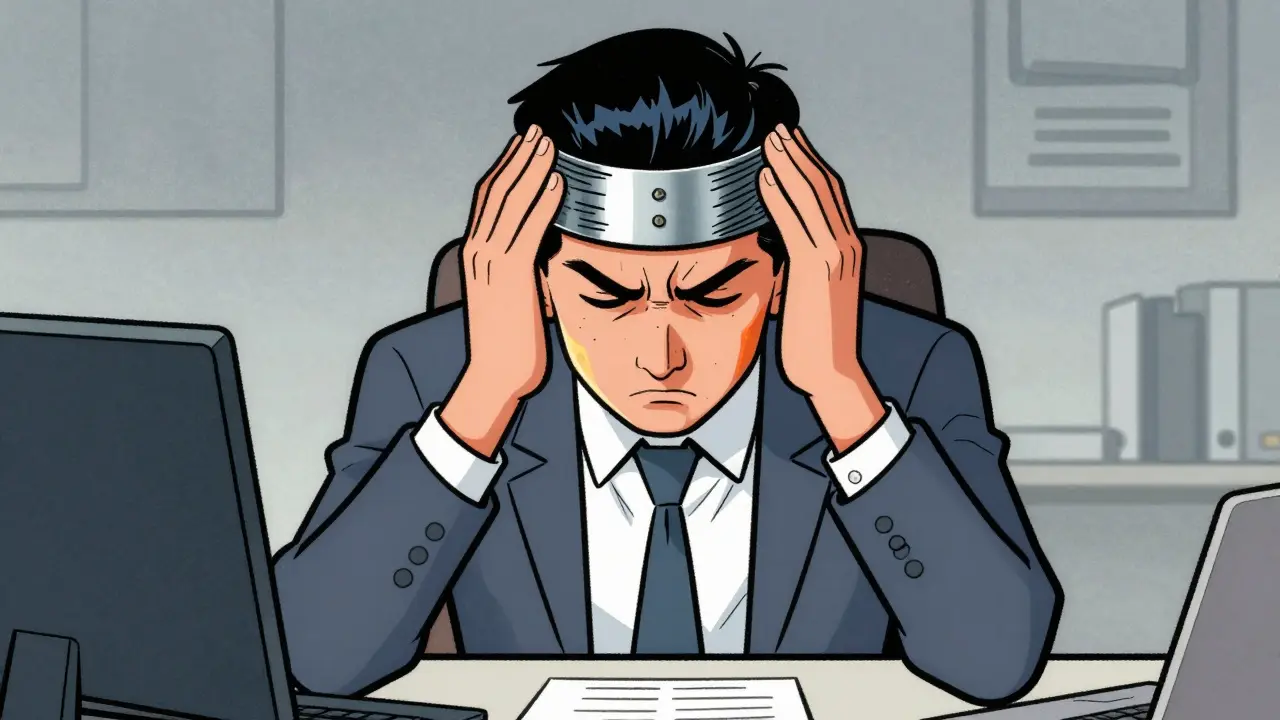
If you describe your pain as a "vice," a "helmet," or simply "pressure," you are likely looking at a tension-type headache. Dr. Harold Wolff first put this into medical literature in 1948, but it remains misunderstood today. Most importantly, the pain sits on both sides of your head-bilateral symmetry. It is not typically one-sided like a migraine.
Here is the reality of the experience: It feels dull and pressing. Imagine wearing a hat that is slightly too small, tightening constantly around your forehead or temples. This sensation does not change much when you move. If you do a step test in the morning, a true tension headache will not get worse with walking or climbing stairs. Routine physical activity is safe. The duration can vary wildly, from thirty minutes to seven days, but unlike other types, you can often function through it, albeit with reduced focus.
- Key Attribute: Mild to moderate intensity.
- Location: Bilateral (both sides).
- Associated Symptoms: None. While some might feel mild light sensitivity, severe nausea or vomiting is rare.
- Frequency: Affects 38.3% of the global population, making it the most prevalent form.
Stress and poor posture are frequent culprits here. Muscle tightness in the neck and shoulders feeds into the head, creating that tightening sensation. It is manageable for most people with Over-the-Counter (OTC) painkillers. Studies indicate about 70% of cases respond well to NSAIDs like ibuprofen.
Migraine: The Neurological Storm
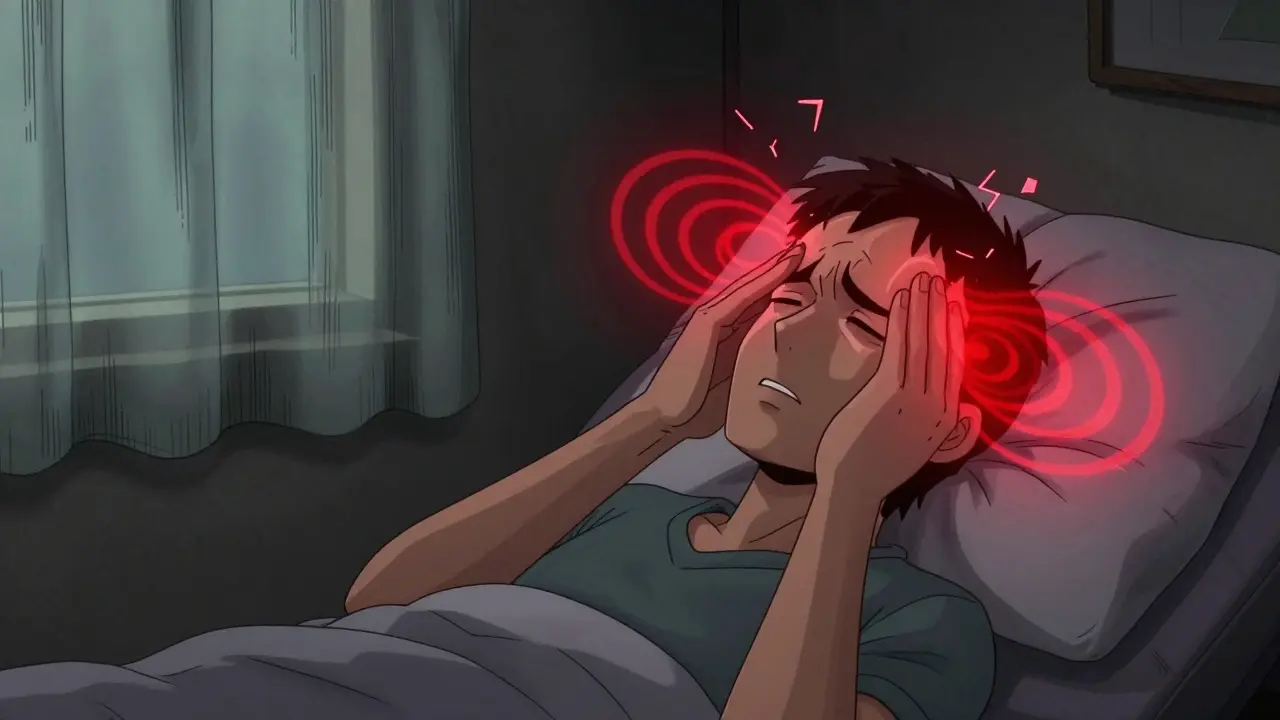
Migraines are not just "bad headaches." They are a complex neurological disorder. Research from the American Migraine Foundation suggests that peak prevalence hits women between ages 35 and 39. Men also suffer, though less frequently. The defining characteristic here is the pulsating quality of the pain. It thumps.
This pain is almost always unilateral (one-sided), though about 40% of patients report it moving to the other side or starting bilaterally. What separates migraine from tension is the associated suffering. Ninety percent of migraineurs experience nausea during an attack. Eighty percent become sensitive to light (photophobia) and sound (phonophobia). Because of this, a migraine patient usually needs a dark, quiet room and total rest. Moving makes it worse. Doing chores is nearly impossible.
One specific feature many know is the Auraa neurological warning sign preceding a headache. About 25 to 30% of sufferers see flashing lights, zigzag lines, or blind spots 5 to 60 minutes before the pain starts. This happens because of cortical spreading depression-a wave of electrical silence moving across the brain surface.
Duration is another major factor. An untreated migraine lasts between 4 and 72 hours. That is a full day to three days of misery. This contrasts sharply with the shorter duration of other types. Furthermore, specific medications like Triptansa class of medications targeting serotonin receptors to reverse migraine mechanisms work specifically for this type, whereas they do nothing for tension headaches.
Cluster Headache: The Alarm Clock Pain
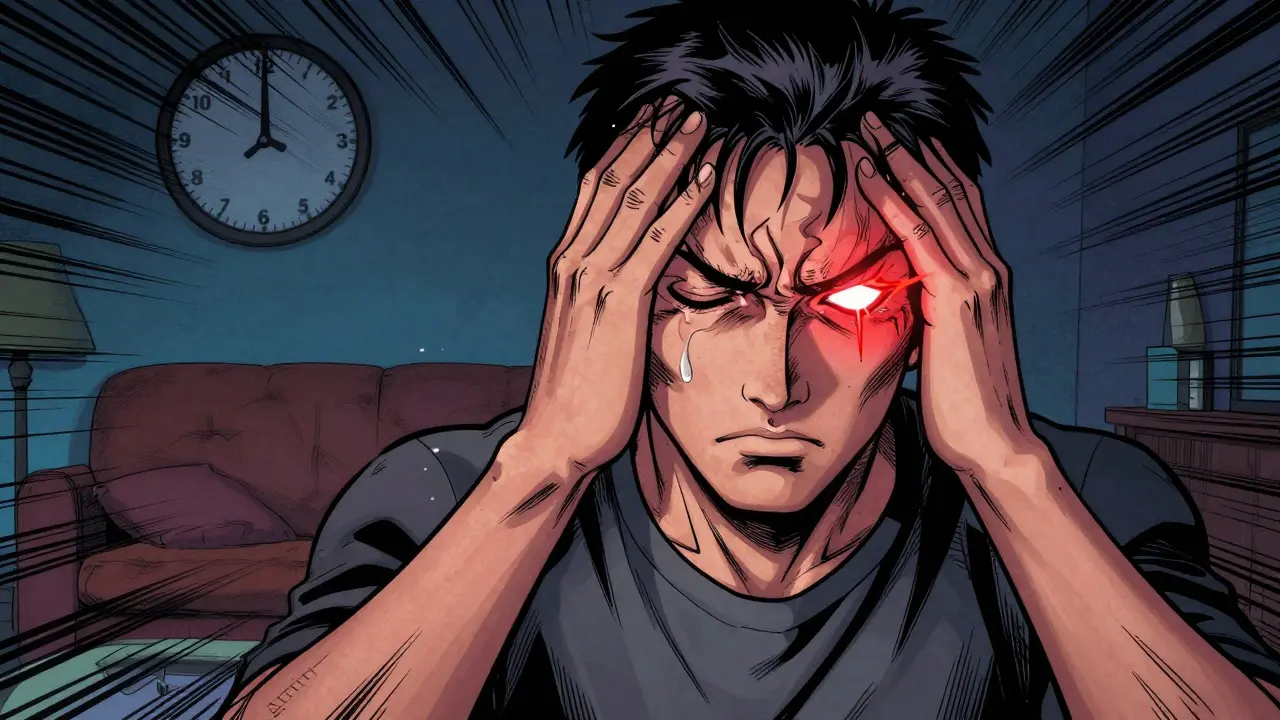
If you have heard the term "suicide headache," it refers to cluster headaches. While that name is dramatic, it speaks to the sheer intensity. We are talking about an 8 to 10 on the pain scale. But it is not just the pain; it is the nature of the attacks. Unlike a migraine where you lie still, cluster headaches make you pace. You cannot sit still. Patients are driven to walk back and forth or rock gently. This agitation is involuntary.
The pain is strictly located on one side, usually focused tightly around one eye or temple. It feels like a hot poker or a drill. Attacks come in clusters-periods of weeks or months where you get hit repeatedly, followed by remission periods where the pain vanishes for years.
What sets this apart biologically is the involvement of the Hypothalamusa region of the brain involved in many functions including sleep regulation and hormone release. During an attack, you see autonomic symptoms on the same side as the pain. One eye tears up profusely. The eyelid might droop (ptosis). The nostril stuffs up. These happen in 80-90% of cases.
Crucially, these attacks are fast. They last 15 to 180 minutes, averaging about 45 to 90 minutes. Then they stop. But during a cluster cycle, you could get anywhere from one to eight of these per day. Often, they strike at the exact same time every day, acting like a broken alarm clock.
Comparing the Three Main Types
Distinguishing between them is vital for choosing the right drug. Taking a triptan for a tension headache won't work, and drinking Tylenol for a cluster headache will leave you in agony while the medicine takes too long to kick in. Look at the breakdown below to spot the differences.
| Feature | Tension Headache | Migraine | Cluster Headache |
|---|---|---|---|
| Pain Quality | Pressing/Tight | Pulsating/Throbbing | Burning/Shooting |
| Location | Bilateral (Both sides) | Unilateral (One side) | Unilateral (Eye/Temple) |
| Duration | 30 mins to 7 days | 4 to 72 hours | 15 to 180 minutes |
| Movement Response | No impact | Worsens with activity | Pacing/Restlessness |
| Autonomic Symptoms | Rare | Photophobia/Phonophobia | Tearing/Nasal Congestion |
Notice the distinction in autonomic symptoms. With a cluster headache, the tear ducts run like a faucet. In a migraine, you don't want to look at light. In tension, you generally just feel uncomfortable pressure. If you confuse the two, you risk being sent home with the wrong pills. Experts from the Mayo Clinic emphasize that distinguishing these symptoms prevents unnecessary scans and treatments.
Tracking Patterns and Seeking Help
Memory is notoriously unreliable when you are in pain. You might think a headache lasts four hours, but it actually lasted four days. Or you might forget you had a drooping eyelid during an attack because you were focusing on the pain. This is why the American Headache Societya non-profit organization dedicated to improving headache care strongly advises keeping a diary. Write down the time, location, intensity (rate it 0-10), and what you ate or did before.
Keep this diary for at least four weeks. When you bring this to your doctor, it acts like a map. It shows the pattern. If your doctor sees a regularity where you wake up at 3 AM with eye pain and tearing, that screams cluster headache. If you see entries noting stress at work followed by a heavy feeling on Sunday evenings, that screams tension.
Current treatments are advancing. In 2023, atogepant was approved for prevention, offering hope for those who haven't responded to older drugs. For migraines, CGRP inhibitors have revolutionized care, allowing many to cut down on acute meds. For cluster headaches, high-flow oxygen delivered via a mask remains the gold standard for immediate relief during an attack, working in roughly 70-80% of cases.
Frequently Asked Questions
Can I have more than one type of headache?
Yes, it is possible. Many people experience tension headaches regularly due to stress but also get occasional migraines triggered by hormonal shifts or weather changes. It is important to track each type separately as the triggers and treatments differ.
What is a cluster period?
A cluster period refers to the timeframe, typically lasting 6 to 12 weeks, during which a person experiences multiple cluster headaches per day. This is followed by a remission period that can last months or years where no attacks occur.
Do cluster headaches feel different from migraines?
Yes, significantly. Migraine pain is usually a pounding throb, whereas cluster pain is sharp and burning. Additionally, cluster headaches cause you to pace and be agitated, while migraines force you to lie still in darkness.
Why do doctors get the diagnosis wrong so often?
Misdiagnosis is common because symptoms can overlap, such as eye redness appearing in both migraines and cluster headaches. Studies suggest up to 50% of initial diagnoses may be inaccurate because detailed history taking is skipped in quick consultations.
Is caffeine good or bad for headaches?
It depends on the type. Caffeine can help boost the effectiveness of painkillers for tension headaches and mild migraines, but relying on caffeine for cluster headaches has little effect. Conversely, caffeine withdrawal itself is a known trigger for tension headaches.


Sophie Hallam on 27 March 2026, AT 02:54 AM
Personal experience confirms the importance of detailed symptom tracking. Stress often plays a huge role in tension headaches. I will keep track of my symptoms better now. The separation between tension and migraine types becomes clear here.