
Night Shift Safety & Alertness Planner
Calculate your sleep window and receive personalized safety recommendations based on medical guidelines.
Based on shift end + commute time until next shift start.
Recommended Protocol
Medication Timing Guide
Imagine it is 3:00 AM. You are halfway through your night shift, eyes burning, brain fog setting in like a thick wall. You reach for that energy drink, or maybe you’re thinking about the pill you took an hour ago to stay awake. Now imagine getting home at 7:00 AM, crashing onto your bed, and taking a sleeping pill because sunlight feels like an enemy. This cycle is not just tiring; it is dangerous. For millions of night-shift workers, sedating medications and wakefulness agents have become essential tools for survival. But are they saving you, or are they quietly increasing your risk of accidents, dependency, and long-term health issues?
Working against your body’s natural clock creates a condition known as Shift Work Disorder (SWD), which is a circadian rhythm sleep-wake disorder resulting from misalignment between internal biological clocks and external environmental changes. According to the American Academy of Sleep Medicine, this isn't just "feeling tired." It is a recognized medical condition affecting up to 10 million Americans. The core problem? Your body wants to sleep when you need to be alert, and it wants to be awake when you need to rest. Medications try to bridge this gap, but they come with strict rules and hidden dangers that many workers ignore.
Understanding the Biological Conflict
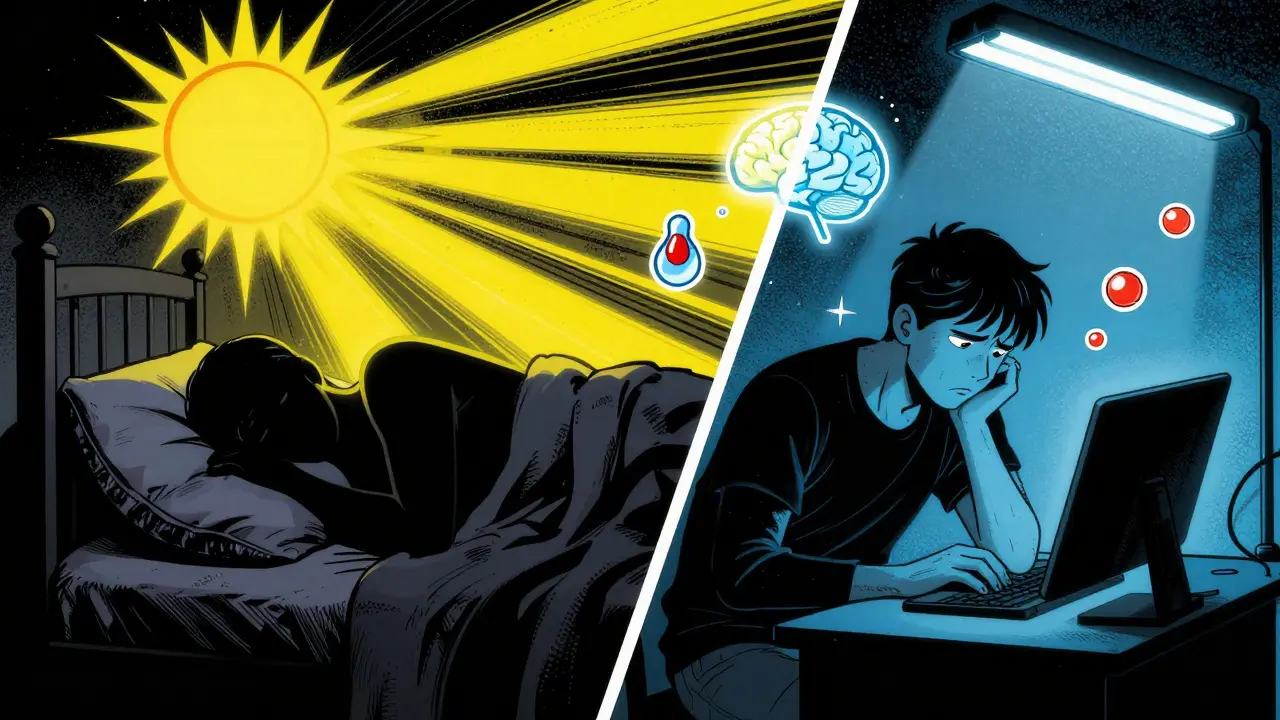
Your body runs on a 24-hour internal timer called the circadian rhythm, which regulates the physical, mental, and behavioral changes that follow a day-night cycle. When you work nights, you fight this rhythm. Light exposure during your shift suppresses melatonin, the hormone that tells your body it’s time to sleep. When you go home, your body temperature is still high, and cortisol levels remain elevated, making deep, restorative sleep nearly impossible without help.
This misalignment leads to severe consequences. The National Safety Council found that fatigued workers are 70% more likely to be involved in workplace accidents than rested counterparts. In healthcare, transportation, and manufacturing, this isn't just a personal health issue-it’s a public safety crisis. Understanding why standard sleep fails is the first step in planning a safe medication strategy.
Sedating Medications: The Double-Edged Sword
Many night-shift workers turn to prescription sleep aids to force their bodies into daytime slumber. Common options include zolpidem (sold as Ambien) and Eszopiclone (Lunesta). These drugs work by enhancing the effect of GABA, a neurotransmitter that calms the brain. However, they require precise timing and carry significant risks.
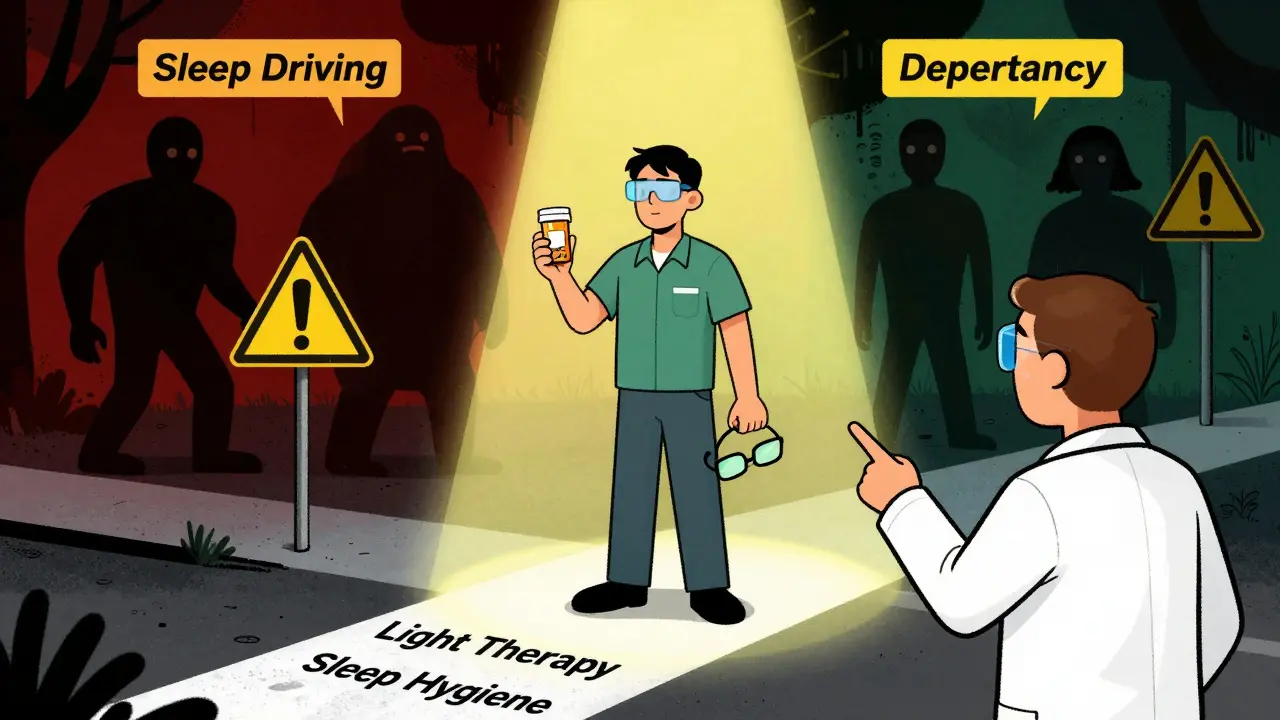
The FDA issued a Boxed Warning in April 2023 for these medications due to reports of serious injuries caused by complex sleep behaviors. This includes sleepwalking, sleep-driving, and sleep-eating. Between 2019 and 2022, there were 66 reported incidents of such behaviors leading to serious injury or death. If you take these pills, you must plan for 7 to 8 hours of uninterrupted sleep immediately after administration. Taking them with only four hours available can leave you with residual drowsiness, impairing your judgment and reaction times for your next shift or commute.
| Medication | Required Sleep Window | Key Risk | Half-Life |
|---|---|---|---|
| Zolpidem (Ambien) | 7-8 hours | Complex sleep behaviors, next-day impairment | 2.5 - 3 hours |
| Eszopiclone (Lunesta) | 7-8 hours | Bitter taste, residual drowsiness | 6 hours |
| Zaleplon (Sonata) | 4+ hours | Short duration, may not sustain sleep | 1 hour |
| Melatonin | Flexible | Low efficacy for full sleep restoration | Variable |
Wake-Promoting Agents: Staying Alert Safely
If sleeping during the day is hard, staying awake at night is equally challenging. Wake-promoting agents like modafinil (Provigil) and armodafinil (Nuvigil) are often prescribed for shift work disorder. Unlike caffeine, which provides a short spike followed by a crash, these medications promote wakefulness by altering neurotransmitters like dopamine and histamine.
Modafinil is considered the first-line pharmacological treatment for SWD. A 2020 meta-analysis showed it improves alertness by 34% on psychomotor vigilance tests compared to placebo. However, it does not fully restore performance to daytime levels. To use it safely, you must take it approximately one hour before your shift begins. Its half-life of 12-15 hours means it stays in your system long enough to keep you awake but also requires careful scheduling to avoid interfering with your daytime sleep later.
Caffeine remains the most popular choice, but its effectiveness diminishes with chronic use. While it blocks adenosine receptors (the chemical that makes you feel tired), it does not eliminate sleep debt. Relying solely on caffeine can lead to anxiety, jitteriness, and disrupted sleep cycles when you finally do lie down.
The Role of Melatonin and Non-Pharmacological Strategies
Melatonin is a hormone naturally produced by the pineal gland that regulates sleep-wake cycles. For night-shift workers, supplemental melatonin can signal to the body that it is time to sleep, even if the sun is shining. Clinical guidelines suggest taking 0.5mg to 5mg three to four hours before desired sleep onset. While it has fewer side effects than prescription sedatives, evidence for its effectiveness in improving daytime sleep quality is mixed. A 2022 Cochrane Review found low-quality evidence for its ability to significantly improve sleep duration after night shifts.
Medication should never be the only tool in your kit. Dr. Charles Czeisler of Harvard Medical School emphasizes that pharmacological interventions alone cannot overcome the fundamental biology of circadian misalignment. Strategic light exposure is crucial. Wearing blue-light-blocking glasses on your commute home helps preserve melatonin production. Conversely, using bright light therapy lamps during the first half of your shift can help reset your internal clock to align better with your work schedule.
Safety Planning and Dependency Risks
The biggest danger for night-shift workers is not just fatigue-it’s dependency. Benzodiazepines and certain Z-drugs (like zolpidem) show habit-forming potential in 25-30% of users after just 4-6 weeks of continuous use. UCLA Health warns that sleeping pills should not be seen as a long-term solution. Tolerance builds quickly, meaning you need higher doses to achieve the same effect, which increases the risk of overdose and severe side effects.
Safety planning involves honest communication with your doctor. Inform them of your exact work schedule. Ask about the half-life of any prescribed medication. If you drive home after your shift, understand the residual effects. The National Highway Traffic Safety Administration found that drivers using prescription sleep medications were 4.5 times more likely to be involved in crashes within two hours of administration. Never mix these medications with alcohol, as the combination can lead to respiratory depression and fatal outcomes.
Creating a Personalized Alertness Protocol
Effective management of shift work disorder requires a multi-layered approach. Start with sleep hygiene: blackout curtains, white noise machines, and a cool room temperature are non-negotiable for daytime sleep. Layer in nutritional strategies: eat lighter meals during the night to avoid digestive discomfort, and stay hydrated without overloading on fluids right before sleep to minimize bathroom trips.
Use medications strategically, not habitually. Reserve strong sedatives for days when sleep is critically needed, rather than every single morning. Rotate between different strategies-light therapy, napping techniques, and mild supplements-to prevent tolerance. Finally, monitor your own metrics. Keep a sleep log to track how different interventions affect your alertness and mood. If you find yourself needing higher doses or experiencing memory lapses, seek professional help immediately.
Can I take melatonin and modafinil together?
Yes, they are often used together but at opposite times. Melatonin is taken before your daytime sleep to help initiate rest, while modafinil is taken one hour before your night shift to promote wakefulness. Always consult your doctor to ensure there are no interactions with other medications you may be taking.
How long should I wait after taking Ambien before driving?
You should not drive until you have had a full 7-8 hours of sleep. Ambien can cause residual drowsiness and impaired coordination for up to 8 hours after ingestion. The FDA warns against operating vehicles or machinery if you have not slept adequately after taking the medication.
Is caffeine safer than prescription wakefulness agents?
Caffeine is generally safer in terms of dependency risk but less effective for severe fatigue. It has a shorter half-life (3-5 hours) and can disrupt sleep if consumed too late in the shift. Prescription agents like modafinil provide more sustained alertness but require a prescription and medical supervision due to potential side effects.
What are the signs of medication dependency for shift workers?
Signs include needing higher doses to achieve the same effect, experiencing withdrawal symptoms (anxiety, insomnia) when missing a dose, and inability to sleep or stay awake without medication. If you notice these patterns, contact your healthcare provider immediately to adjust your treatment plan.
Does light therapy really help with shift work disorder?
Yes, light therapy is a cornerstone of non-pharmacological treatment. Exposure to bright light during the first half of your night shift can help advance your circadian phase, making it easier to stay awake. Wearing blue-light-blocking glasses on the way home helps maintain melatonin levels for better daytime sleep.