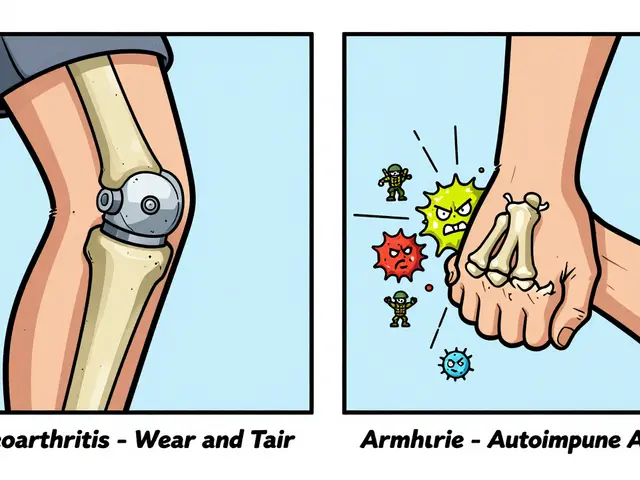
Joint pain is a universal experience. You might have felt it after a long hike, a heavy lifting session, or just waking up on a cold morning. But when that ache settles in and refuses to leave, the label "arthritis" often gets thrown around as a catch-all explanation. The problem? Arthritis isn't one single thing. It’s an umbrella term covering more than 100 distinct conditions.
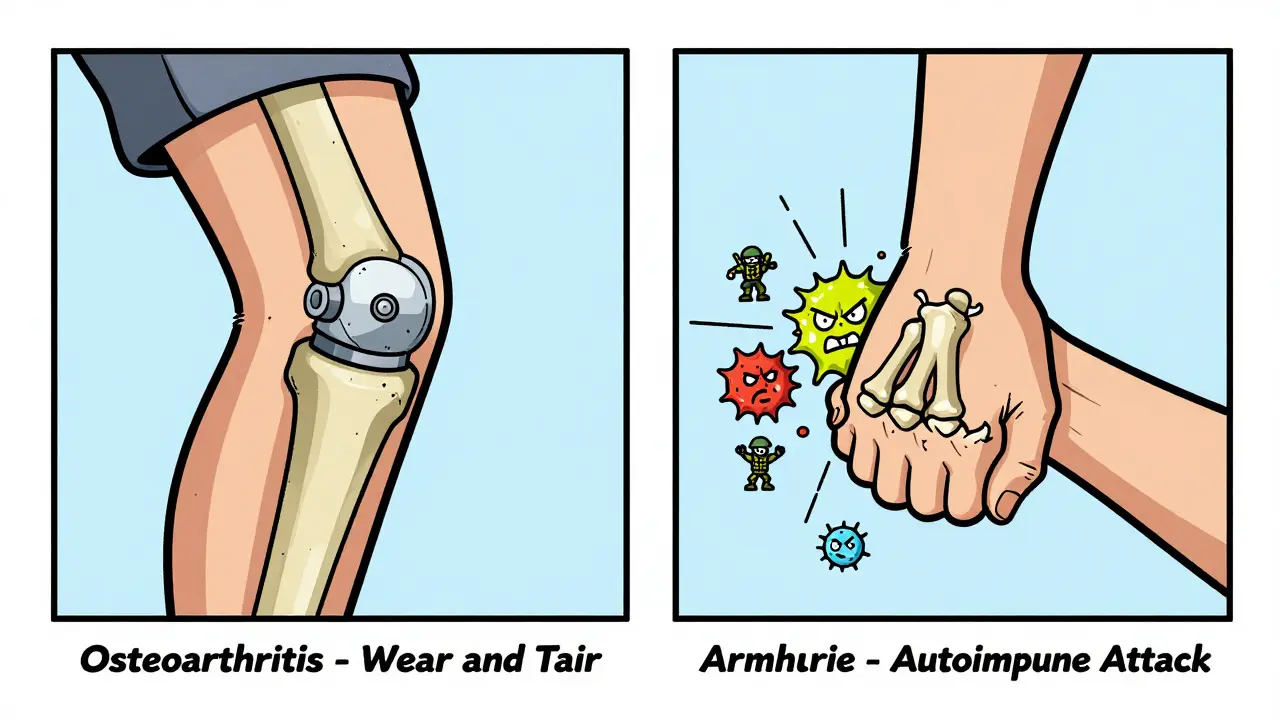
If you are trying to figure out what is happening in your body, knowing the difference between Osteoarthritis is a degenerative joint disease caused by mechanical wear and tear on joints and Rheumatoid Arthritis is an autoimmune disorder where the body's immune system mistakenly attacks healthy joint tissue is not just academic-it changes how you treat yourself. One requires rest and weight management; the other demands aggressive medical intervention to stop your immune system from destroying your joints. Getting this wrong can lead to permanent damage.
The Core Difference: Wear and Tear vs. Autoimmune Attack
To understand these conditions, you have to look at what is actually breaking down inside the joint. Think of your joints like hinges on a door. They have cartilage-the smooth cushioning material-that allows bones to glide past each other without grinding.
In Osteoarthritis (OA), the issue is mechanical. Over time, that cartilage wears away. It’s similar to the tread wearing off a tire. As the cushion disappears, bone starts rubbing against bone. This causes friction, inflammation, and pain. It is a localized problem. If your knee has OA, your lungs and heart are generally fine. The damage stays in the joint.
Rheumatoid Arthritis (RA) works completely differently. Here, the enemy is inside you. Your immune system, which usually fights off viruses and bacteria, gets confused. It decides the lining of your joints (the synovium) is a threat. It launches an attack, causing severe inflammation. This isn’t just about worn-out parts; it’s a systemic firestorm. Because RA is an autoimmune disease, it doesn’t stay confined to your knees. It can affect your eyes, lungs, heart, and skin.
| Feature | Osteoarthritis (OA) | Rheumatoid Arthritis (RA) |
|---|---|---|
| Primary Cause | Mechanical wear and tear | Autoimmune system malfunction |
| Onset Speed | Gradual (years) | Rapid (weeks to months) |
| Morning Stiffness | Less than 30 minutes | Often exceeds 1 hour |
| Joint Symmetry | Often asymmetric (one side) | Symmetrical (both sides) |
| Systemic Symptoms | Rarely affects other organs | Can affect lungs, heart, eyes |
| Typical Age of Onset | Usually over 50 | Any age (peaks 30-60) |
Spotting the Signs: What Does It Feel Like?
You don’t need an X-ray to start noticing patterns in your pain. The way your body feels gives you massive clues about which type of arthritis you might be dealing with.
Pain Timing: With OA, pain usually hurts when you use the joint. Walking up stairs? Knee hurts. Sitting still? It feels better. Rest helps. With RA, the pain is often worse when you are resting. In fact, many people with RA wake up feeling like their joints are locked in concrete. This is called morning stiffness. If your hands feel stiff for more than an hour after getting out of bed, lean toward RA. If the stiffness melts away in 15 minutes, think OA.
Which Joints Are Hit? OA loves weight-bearing joints. Knees, hips, and the spine are prime targets. It also frequently hits the ends of your fingers (the distal interphalangeal joints). RA, however, tends to skip those fingertip joints. Instead, it targets the knuckles (metacarpophalangeal joints), wrists, and ankles. A key tell is symmetry. If your right wrist is swollen, check your left. In RA, they are almost always affected equally. OA might wreck your right knee while leaving the left one perfectly fine.
Body-Wide Effects: Do you feel exhausted all the time? Do you get low-grade fevers or lose weight without trying? These are red flags for RA. Because it is a systemic inflammatory condition, RA makes you feel sick in general. OA patients might be tired because moving hurts, but they rarely experience the deep, bone-weary fatigue associated with autoimmune flares.
Diagnosis: How Doctors Tell Them Apart
When you go to the doctor, they aren’t just guessing. They use specific tools to differentiate between these two very different diseases.
For OA, imaging is king. An X-ray will show the space between your bones narrowing because the cartilage is gone. You might also see bone spurs-those jagged growths that form when bones try to repair themselves under stress. Blood tests for OA are usually normal because there is no systemic inflammation raging through your blood.
For RA, blood work is critical. Doctors look for specific markers:
- Rheumatoid Factor (RF): An antibody found in many RA patients.
- Anti-CCP Antibodies: These are highly specific to RA and can predict a more severe course of the disease.
- Inflammatory Markers: Tests like ESR (erythrocyte sedimentation rate) and CRP (C-reactive protein) will be elevated, showing your body is fighting a widespread battle.
Newer guidelines from the American College of Rheumatology also recommend ultrasound for early detection. Ultrasound can see inflammation in the joint lining before any bone damage appears on an X-ray. This is crucial because early treatment prevents deformity.
Treatment Paths: Why Mixing Them Up Is Dangerous
This is where the stakes get high. Treating RA like OA can result in irreversible joint destruction within months. Conversely, treating OA like RA exposes you to unnecessary immunosuppressants.
Managing Osteoarthritis: The goal here is pain relief and preserving function.
- Weight Management: This is non-negotiable. For every kilogram you lose, you reduce the load on your knees by four kilograms. Losing just 5kg can cut knee pain in half.
- Physical Therapy: Strengthening the muscles around the joint acts as a shock absorber.
- Medication: NSAIDs (like ibuprofen) and acetaminophen help manage pain. Cortisone injections provide temporary relief.
- Surgery: If conservative measures fail, joint replacement is highly effective. OA accounts for 90% of total joint replacements performed annually in the US.
Treating Rheumatoid Arthritis: The goal is remission-stopping the immune attack entirely.
- DMARDs: Disease-Modifying Antirheumatic Drugs like methotrexate are the cornerstone of treatment. They slow down the disease process.
- Biologics: If DMARDs aren’t enough, biologics target specific parts of the immune system. These are powerful but expensive, often costing $20,000 to $50,000 per year.
- Early Intervention: The "window of opportunity" is small. Starting treatment within the first 3-6 months of symptoms significantly improves long-term outcomes and prevents joint deformity.
Beyond the Big Two: Other Forms of Arthritis
While OA and RA dominate the conversation, they aren’t the only players. Knowing about these others can help if your symptoms don’t fit the standard mold.
Gout: This is a metabolic form of arthritis. It happens when uric acid builds up in your blood and forms sharp crystals in your joints. It strikes suddenly, often at night, causing excruciating pain, usually in the big toe. Unlike OA or RA, gout comes in intense flares followed by periods of no pain. Diet plays a huge role here-red meat, shellfish, and alcohol can trigger attacks.
Lupus (SLE): Like RA, lupus is an autoimmune disease. It can cause joint pain and swelling, but it’s famous for its butterfly-shaped rash across the cheeks and nose. Lupus affects multiple systems, including kidneys and skin, making it distinct from the joint-focused nature of OA.
Ankylosing Spondylitis: This primarily affects the spine. It causes inflammation in the spinal joints, leading to severe back pain and stiffness. Over time, it can fuse the vertebrae together. It is strongly linked to a genetic marker called HLA-B27 and often starts in young adulthood.
Psoriatic Arthritis: If you have psoriasis (a skin condition causing scaly patches), you are at risk for this type of arthritis. It can cause swelling in entire fingers or toes (often called "sausage digits") and nail pitting. It shares features with both RA and OA but has its own unique pattern.
Living With Chronic Joint Pain
Regardless of the type, living with arthritis requires a shift in mindset. It’s not just about taking pills; it’s about managing your lifestyle.
Exercise is counterintuitive but essential. For OA, low-impact activities like swimming or cycling keep joints lubricated without pounding them. For RA, gentle movement during flares prevents stiffness, while strength training during remission protects weakened joints. Sedentary behavior worsens both conditions.
Diet also matters. While no diet cures arthritis, anti-inflammatory foods can help. Omega-3 fatty acids (found in fish), turmeric, and leafy greens may reduce inflammation. For gout, avoiding high-purine foods is critical. For OA, maintaining a healthy weight is the most impactful dietary choice you can make.
Mental health is often overlooked. Chronic pain leads to anxiety and depression. Support groups, whether online or in-person, provide validation and practical tips from people who truly understand what you’re going through. You are not alone in this.
Can osteoarthritis turn into rheumatoid arthritis?
No, they are distinct conditions with different causes. However, it is possible to have both simultaneously. Having one does not cause the other, but aging increases the risk for both.
Is rheumatoid arthritis hereditary?
Genetics play a role, particularly the HLA-DRB1 gene, but it is not directly inherited like eye color. You inherit a susceptibility, and environmental triggers like smoking or infections may activate the disease.
What is the best exercise for arthritis?
Low-impact exercises are best. Swimming, water aerobics, cycling, and tai chi are excellent choices. Strength training is also crucial to support joints, but should be done under guidance to avoid injury.
How quickly does rheumatoid arthritis progress?
Without treatment, RA can cause significant joint damage within months. Early diagnosis and aggressive treatment with DMARDs can halt progression and induce remission in many patients.
Does diet affect osteoarthritis?
Yes, primarily through weight management. Excess weight puts immense pressure on weight-bearing joints. Additionally, an anti-inflammatory diet rich in fruits, vegetables, and omega-3s may help reduce pain levels.