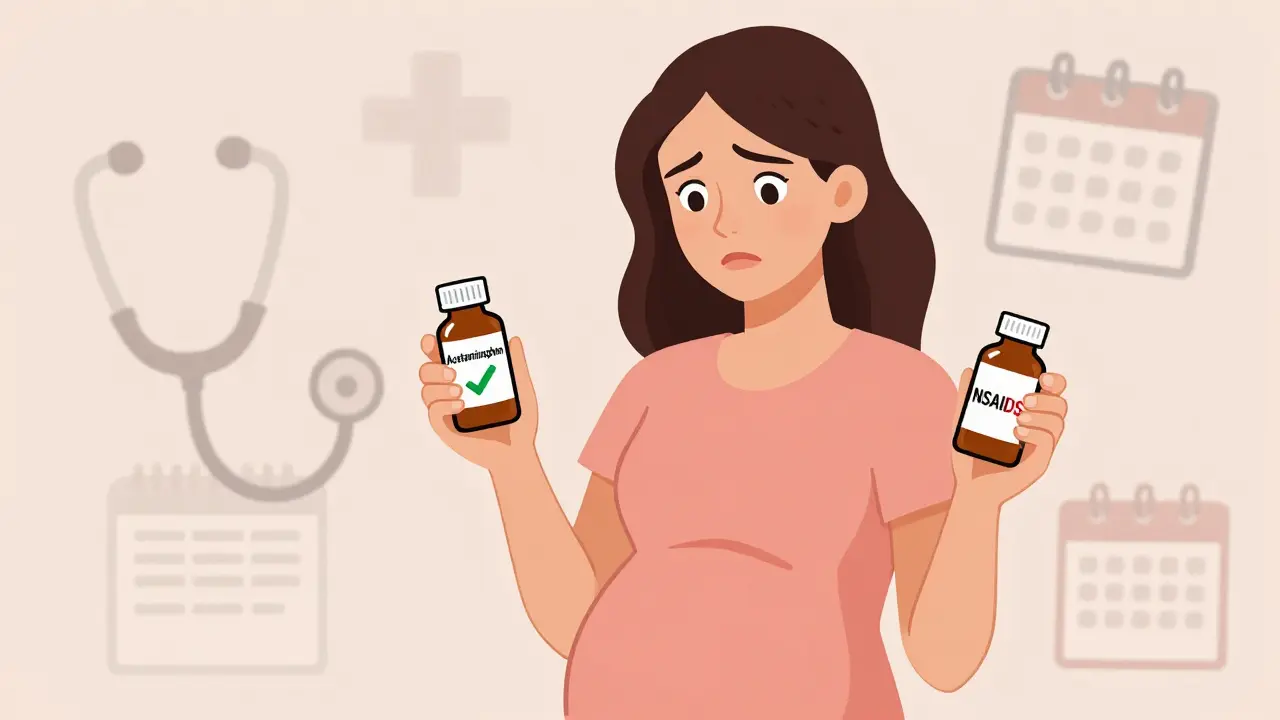
Dealing with a headache or back pain while expecting can feel like walking a tightrope. You want relief, but you are terrified of harming your baby. For years, the advice was simple: take acetaminophen (Tylenol) and avoid ibuprofen (Advil) in the third trimester. But recent updates from major health organizations have made things more complicated. Conflicting headlines about autism risks and new FDA warnings on nonsteroidal anti-inflammatory drugs (NSAIDs) have left many parents-to-be confused.
The reality is that untreated pain and fever carry their own serious risks for both you and your fetus. Understanding exactly which medication is safe at which stage of your pregnancy is crucial. This guide breaks down the current medical consensus on acetaminophen and NSAIDs, separating fact from fear-mongering so you can make informed decisions with your doctor.
Why Medication Choice Matters During Pregnancy
Your body changes dramatically during gestation, affecting how drugs are metabolized and distributed. More importantly, your developing baby relies on specific physiological processes that certain medications can disrupt. The goal isn't necessarily to avoid all medicine; it's to choose the one with the best risk-benefit ratio.
Untreated maternal fever, for instance, is not benign. A study published in Epidemiology in 2019 found that a fever above 100.4°F increases the risk of miscarriage by 1.5 times. In the first trimester, high fevers are linked to neural tube defects. Similarly, chronic severe pain can elevate stress hormones, potentially impacting fetal development. Therefore, having a safe, effective tool to manage these symptoms is medically essential.
Is it safer to suffer through pain than to take medication?
No. Severe pain and high fever pose documented risks to the fetus, including increased chances of miscarriage and developmental issues. Using approved medications at recommended doses is generally safer than leaving these conditions untreated.
Acetaminophen: The Current Gold Standard
Acetaminophen is a widely used analgesic and antipyretic medication considered safe for use throughout all trimesters of pregnancy when taken at standard therapeutic doses. Approved by the FDA in 1955, it has a long history of use. Unlike NSAIDs, it does not inhibit cyclooxygenase enzymes in a way that affects blood clotting or kidney function significantly.
The American College of Obstetricians and Gynecologists (ACOG) maintains that acetaminophen is safe for use in all three trimesters. Their September 2025 FAQ recommends using the lowest effective dose-typically 500 mg-for the shortest duration necessary. They advise against taking it for more than 3-5 consecutive days without consulting your physician.
Recent large-scale studies have helped debunk some of the circulating fears. A 2023 study in JAMA Network Open analyzed nearly 100,000 mother-child pairs and found no significant association between acetaminophen use during pregnancy and children's risk of autism spectrum disorder, ADHD, or intellectual disability. The adjusted odds ratios were close to 1.0, indicating no increased risk.
- Dosage: 325-1,000 mg per dose.
- Maximum Daily Limit: 4,000 mg (though doctors often recommend staying lower).
- Key Benefit: Reduces fever and pain without affecting fetal kidneys or heart structure.
NSAIDs: The Changing Rules
NSAIDs are nonsteroidal anti-inflammatory drugs such as ibuprofen, naproxen, and diclofenac that reduce inflammation, pain, and fever by inhibiting cyclooxygenase enzymes. Common brands include Advil, Motrin, and Aleve. While they are highly effective for inflammation, their safety profile in pregnancy has tightened significantly.
In October 2020, the FDA updated its guidance, mandating that NSAIDs be avoided at 20 weeks or later in pregnancy. This was a shift from previous advice that only cautioned against use after 30 weeks. The reason? Risks to fetal renal function.
Between 20 and 30 weeks, exposure to NSAIDs can lead to fetal renal dysfunction. This can cause oligohydramnios, a condition where there is too little amniotic fluid. An amniotic fluid index below 5 cm is considered low. If this happens, it can affect lung development and limb positioning. The FDA MedWatch data shows renal impairment occurs in 1-2% of fetuses exposed to NSAIDs after 20 weeks.
After 30 weeks, the risks escalate further. NSAIDs can cause premature closure of the fetal ductus arteriosus, a vital blood vessel in the unborn child's heart. This occurs in 0.5-1% of cases. Because of these risks, most obstetricians now advise avoiding NSAIDs entirely during pregnancy unless specifically directed otherwise for very short durations under strict supervision.
| Feature | Acetaminophen (Tylenol) | NSAIDs (Ibuprofen, Naproxen) |
|---|---|---|
| Safety in First Trimester | Generally Safe | Avoid if possible |
| Safety in Second Trimester | Generally Safe | Avoid after 20 weeks (FDA Warning) |
| Safety in Third Trimester | Generally Safe | Contraindicated (Risk of Heart/Kidney Issues) |
| Primary Risk | Theoretical neurodevelopmental concerns (debunked by large studies) | Fetal renal dysfunction, oligohydramnios, premature ductus closure |
| Anti-inflammatory Effect | No | Yes |
Navigating the Autism Concerns
You may have seen headlines linking acetaminophen to autism. These stem from observational studies that suggested a correlation. However, correlation does not equal causation. Many factors contribute to autism risk, and women who take more pain medication might also have underlying inflammatory conditions that are themselves risk factors.
Dr. Steven J. Fleischman, president of ACOG, stated in September 2025 that "not a single reputable study has successfully concluded that the use of acetaminophen in any trimester of pregnancy causes neurodevelopmental disorders in children." The FDA’s September 2025 notice acknowledges ongoing research but emphasizes that acetaminophen remains the safest over-the-counter alternative among all analgesics.
It is important to distinguish between occasional use and chronic, daily use throughout pregnancy. The theoretical risks, if any, appear to be associated with prolonged, high-dose exposure. Occasional use for headaches or fever is considered safe by the vast majority of medical experts, including the Society for Maternal-Fetal Medicine (SMFM) and the American Academy of Pediatrics (AAP).
Practical Tips for Pain Management
Knowing what to take is half the battle. How you take it matters just as much. Here is a practical checklist for managing pain safely:
- Check Combination Drugs: Many cold and flu remedies contain NSAIDs. About 30% of OTC cold medicines include ibuprofen or naproxen. Always read the Drug Facts label. Look for "Active Ingredients" and avoid anything ending in "-profen" or "-xen" after 20 weeks.
- Start Low: Use the lowest dose of acetaminophen that works. Often, 500 mg is sufficient. Do not start with the maximum dose.
- Limit Duration: Try not to take acetaminophen for more than 3-5 days in a row. If you need it longer, call your doctor. Chronic pain needs investigation, not just masking.
- Non-Drug Options: Before reaching for pills, try warm compresses, prenatal massage, gentle stretching, or acupuncture. These can be highly effective for back pain and muscle tension.
- Consult Your Provider: If you have liver disease, talk to your doctor before taking acetaminophen, as it is processed by the liver. If you have kidney issues, avoid NSAIDs regardless of pregnancy status.
What About Aspirin?
Aspirin is technically an NSAID, but it is treated differently. Low-dose aspirin (81 mg) is often prescribed by doctors to prevent preeclampsia in high-risk pregnancies. The FDA’s warning about NSAIDs after 20 weeks specifically excludes low-dose aspirin when prescribed for this purpose. Do not stop taking prescribed low-dose aspirin without talking to your OB-GYN.
When to Call the Doctor
While mild headaches and backaches are common, some symptoms require immediate attention. Contact your healthcare provider if:
- Your headache is sudden and severe (like a "thunderclap").
- You have vision changes along with the headache.
- You experience upper abdominal pain.
- Your fever exceeds 100.4°F and does not come down with acetaminophen.
- You have been taking NSAIDs and notice decreased fetal movement.
Remember, your care team wants you to be comfortable and healthy. Don’t hesitate to ask questions. It is always better to clarify than to guess.
Can I take ibuprofen before I know I'm pregnant?
Accidental use of ibuprofen before knowing you are pregnant is usually not a cause for alarm. However, once you confirm pregnancy, switch to acetaminophen for pain relief. The critical window for NSAID risks starts around 20 weeks, but caution is advised throughout.
Is Tylenol PM safe during pregnancy?
Tylenol PM contains acetaminophen and diphenhydramine (an antihistamine). While acetaminophen is safe, diphenhydramine should be used with caution. Consult your doctor before taking sleep aids, as some ingredients may not be suitable for all stages of pregnancy.
Does the FDA still allow NSAIDs in the first trimester?
The FDA specifically warns against NSAID use at 20 weeks or later. Use in the first trimester is less restricted by federal law but is often discouraged by doctors due to potential early pregnancy risks and the availability of safer alternatives like acetaminophen.
What if acetaminophen doesn't work for my pain?
If acetaminophen is ineffective, do not self-medicate with stronger drugs. Contact your obstetrician. There may be prescription options that are safe for your specific situation, or non-pharmacological treatments like physical therapy that could help.
Are there natural alternatives to painkillers?
Yes. Prenatal yoga, swimming, warm baths (not hot tubs), and heating pads can relieve back and muscle pain. Ginger tea may help with nausea-related discomfort. Always ensure water temperatures are lukewarm to avoid raising your core body temperature.