Many people assume that because generic medications are cheaper than brand-name drugs, they’re automatically affordable. But for millions of Americans, even a $10 copay for a monthly generic prescription adds up fast-especially when you’re taking three, four, or five of them. If you’re struggling to pay for your generics, you’re not alone. In 2023, nearly one in four U.S. adults said they had trouble affording their prescriptions, and generics are often the last line of defense for people who can’t afford expensive brand drugs. The good news? There are real, working ways to cut those costs-even if you don’t qualify for Medicaid or Medicare Extra Help.
Why Generics Still Cost Too Much
Generic drugs are supposed to be 80-85% cheaper than their brand-name equivalents. That’s true on paper. But insurance plans still charge copays, and those add up. For example, if you take levothyroxine, metformin, and lisinopril-all generics-you might pay $16, $10, and $6 per month respectively. That’s $32 a month, or $384 a year. For someone living paycheck to paycheck, that’s not trivial. And if you’re on Medicare, you might be surprised to learn that every dollar you spend on generics still counts toward your $8,300 out-of-pocket cap in 2024 (rising to $2,000 in 2025). That means even if you’re paying $5 per script, you’re still inching closer to hitting your limit.Here’s the catch: while brand-name drug companies often offer copay cards that can reduce your cost to $0 or $5, generic manufacturers rarely do. Why? Thin margins. Generic makers don’t make enough profit to fund assistance programs. So the burden falls on you to find help elsewhere.
Where Real Help Actually Exists
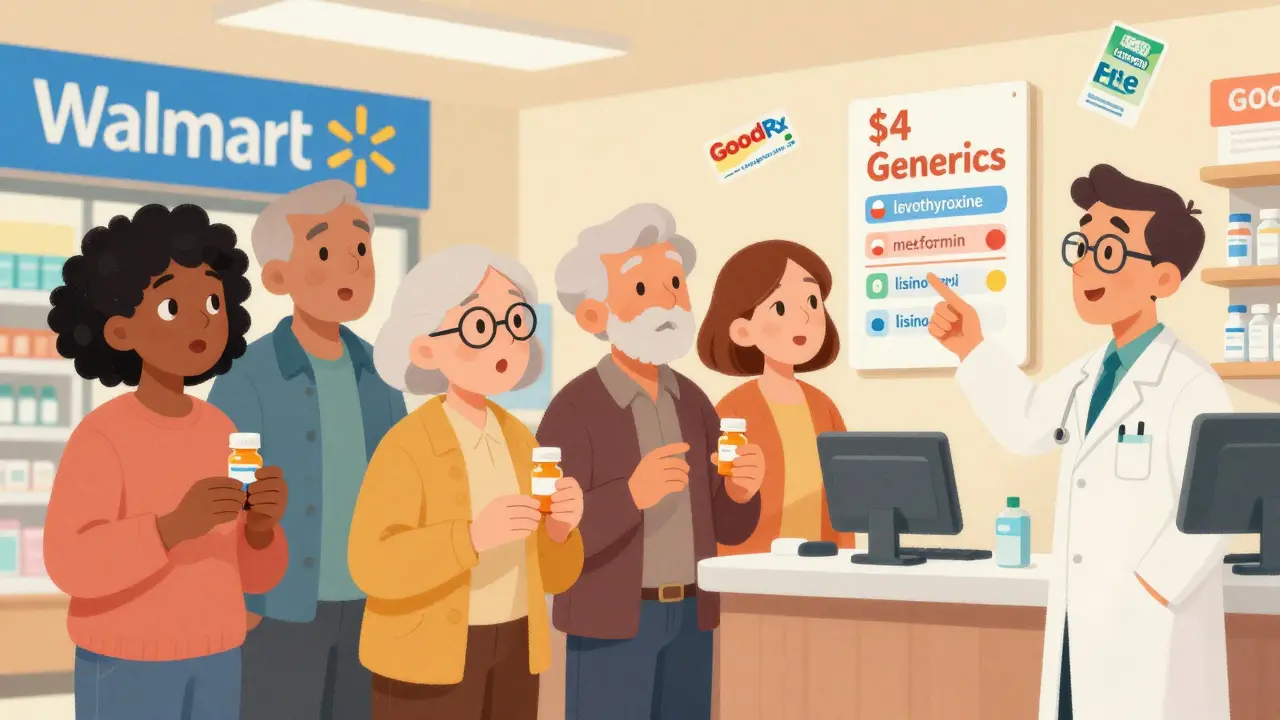
You don’t need a fancy application or a social worker to start saving. Some of the best assistance is right at your local pharmacy.- Walmart’s $4 Generics List: Covers over 150 common generics, including antibiotics, blood pressure meds, and diabetes drugs. No insurance needed. Just ask for the list at the counter.
- Kroger’s $15 Generics Program: Similar to Walmart, but slightly higher price point. Still, it’s cheaper than most insurance copays.
- SingleCare, GoodRx, and RxSaver: These pharmacy discount cards are free to use. You don’t need to sign up, create an account, or provide personal info. Just show the coupon at checkout. In 2023, over 14 million people used SingleCare to save on generics.
These programs work even if you have insurance. Sometimes, the discount is lower than your insurance copay. Always ask: "Is this cheaper than my insurance price?"
Medicare Extra Help: The Hidden Gem
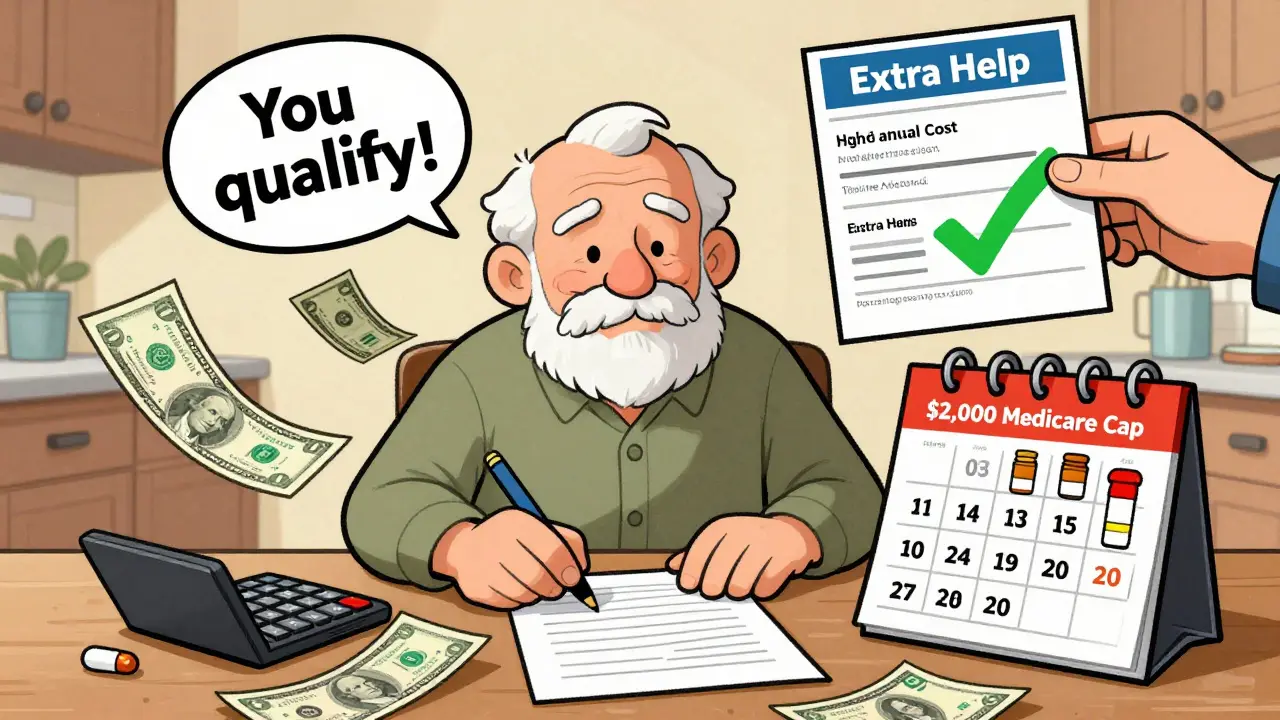
If you’re on Medicare, you might qualify for Extra Help (officially called the Low-Income Subsidy). This isn’t just a discount-it’s full financial protection. In 2025, Extra Help will cap your generic copay at exactly $4.90 per prescription and eliminate your deductible entirely. That’s a huge drop from the $44 average generic copay in 2024.Who qualifies? If your income is below $21,870 for an individual or $29,580 for a couple in 2025, you likely qualify. Even if you don’t think you’re low-income, apply. Many people are approved who didn’t expect it. You can apply through Social Security, your state Medicaid office, or your local State Health Insurance Assistance Program (SHIP). SHIP counselors helped over 1.2 million people with generic cost questions in 2023.
Pro tip: If you get Medicaid, Supplemental Security Income (SSI), or a Medicare Savings Program, you’re automatically enrolled in Extra Help. No application needed.
The Assistance Gap: Who Gets Left Out
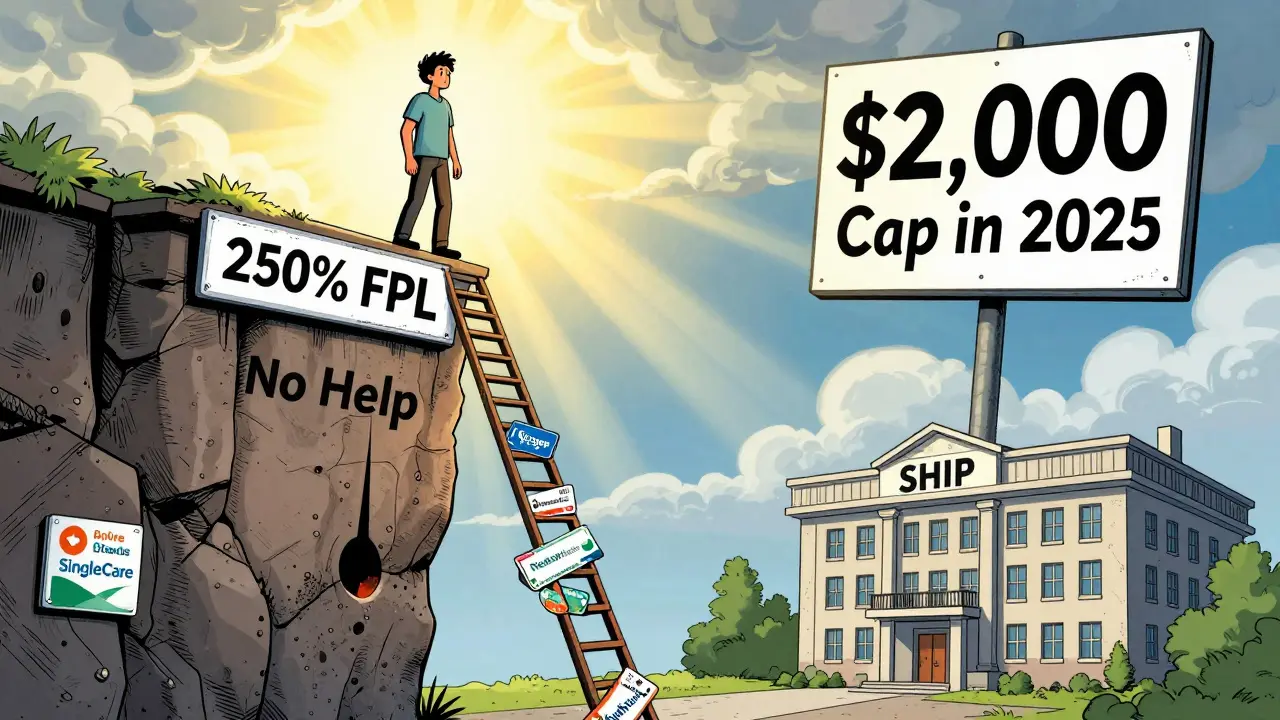
The biggest problem isn’t the poor-it’s the nearly-poor. People who make just above Medicaid limits often fall into what experts call the “assistance cliff.”Take a 65-year-old working part-time who earns $2,100 a month. That’s $25,200 a year. They make $300 too much for Medicaid in most states. They don’t qualify for Extra Help. And because their meds are generics, no manufacturer copay card exists. Their $32 monthly generic bill is a real hardship. In 2023, 78% of applicants to nonprofit programs like the PAN Foundation were approved if they earned under 250% of the federal poverty level ($37,150). But only 12% of those between 250-400% FPL got help. That’s a gap of 66 percentage points.
This is why the Inflation Reduction Act’s $2,000 out-of-pocket cap for Medicare Part D in 2025 is such a game-changer. It doesn’t matter if you’re on a brand or generic drug anymore-you’ll never pay more than $2,000 total in a year. That’s huge. For someone taking five generics, it could cut their annual spending by over 70%.
How to Apply: No Fluff, Just Steps
If you’re serious about lowering your costs, here’s exactly what to do:- Check your pharmacy’s discount list. Ask if they have a $4, $10, or $15 generic program. Use GoodRx or SingleCare to compare prices before you pay.
- Apply for Extra Help. Go to SSA.gov/extra-help or call 1-800-772-1213. You’ll need your income info, bank statements, and tax returns. Don’t wait-processing takes 45-90 days.
- Call your State Health Insurance Assistance Program (SHIP). Find your local SHIP at shiptacenter.org. They’ll walk you through eligibility and help fill out forms. No cost, no obligation.
- Apply to nonprofit programs. Visit NeedyMeds.org or the PAN Foundation website. Look for programs that cover your specific condition. Only 17 of PAN’s 72 programs cover generic-heavy conditions like hypertension or diabetes, so check carefully.
- Apply to multiple programs at once. People who use two or more assistance sources save 40% more on average.
What Doesn’t Work
There are myths out there that can cost you money.- "My insurance covers generics, so I don’t need help." False. Insurance copays vary wildly. You might be paying $15 for a drug that’s $4 at Walmart.
- "I can’t use discount cards with insurance." False. You can choose which to use at checkout. Always compare.
- "I make too much for help." False. Many programs have sliding scales. You won’t know until you apply.
A 2023 study in the Annals of Internal Medicine found that 38% of people skipped their generic meds because they thought they couldn’t afford them. Don’t be one of them.
What’s Changing in 2025
The rules are shifting fast. Starting January 1, 2025:- All Medicare Part D beneficiaries will hit a hard $2,000 out-of-pocket cap-no exceptions.
- Extra Help recipients will pay $0 deductible and $4.90 per generic.
- Insulin (including generic) will cost no more than $2.00 per month.
- Pharmacies must now show you the cash price vs. your insurance price before you pay.
This means the future of generic affordability is brighter than ever-for those who know how to use it. The real challenge now isn’t finding help. It’s knowing where to look.
Can I use GoodRx or SingleCare if I have Medicare?
Yes, but only if you’re not using Extra Help. If you’re enrolled in Medicare Extra Help, you can’t combine it with pharmacy discount cards. However, if you’re on regular Medicare without Extra Help, you can use GoodRx or SingleCare to find lower prices than your plan’s copay. Always compare the cash price with your insurance price at checkout.
Do generic drug manufacturers offer copay cards?
Almost never. Unlike brand-name drug companies, generic manufacturers operate on razor-thin profit margins. They don’t have the resources to offer copay assistance programs. That’s why help comes from pharmacies, nonprofits, and government programs instead.
Why does my generic still count toward my Medicare out-of-pocket limit?
Because Medicare Part D counts every dollar you spend on covered drugs toward your out-of-pocket maximum-whether it’s a $5 generic or a $500 brand drug. This changed in 2025 when the cap dropped from $8,300 to $2,000. Now, even small generic copays add up faster, but you’ll hit the cap sooner, which means less spending overall.
What if I make too much for Extra Help but still can’t afford my meds?
You still have options. Use pharmacy discount programs like Walmart’s $4 list or SingleCare. Apply to nonprofit organizations like NeedyMeds or the PAN Foundation-even if you earn above the typical limit. Some programs have flexibility for hardship cases. Also, talk to your pharmacist: they can sometimes switch you to a cheaper generic version or suggest a therapeutic alternative.
Can I get help for insulin if it’s generic?
Yes-and it’s even better. Starting January 1, 2025, all insulin (brand or generic) will cost no more than $2.00 per month for Medicare Part D beneficiaries. This applies regardless of income. If you’re not on Medicare, check with your pharmacy. Many retailers already offer insulin for $25 or less.


matthew runcie on 21 March 2026, AT 21:19 PM
I’ve been using Walmart’s $4 list for my dad’s meds for years. He’s on four generics and it’s saved him like $600 a year. No fuss, no paperwork. Just walk in and ask. Simple as that.Still blows my mind that people don’t know this exists.